The best flooring for kitchen use in most homes is rigid core waterproof luxury vinyl plank (LVP): it is 100% waterproof, warm underfoot, forgiving, and typically $6 to $11 per square foot installed in Northern Virginia. Porcelain tile is the most durable choice. Waterproof laminate and engineered hardwood work with care. Avoid solid hardwood near the sink.
Choosing the best flooring for kitchen remodels is harder than it looks, because a kitchen floor takes more abuse than any other floor in the house. It gets a dishwasher that will leak one day, a refrigerator that gets rolled out twice a year, cast iron that slips off the stove, and a dog whose water bowl never stays in the bowl. It also has to look right from the family room, because in most Northern Virginia homes built after 1990 the kitchen is open to everything.
I’ve replaced kitchen floors in Fairfax colonials, Arlington condos, Ashburn townhomes, and Alexandria rowhouses, and the failures I pull up tend to be the same few mistakes. This guide ranks the five floors that actually work in a kitchen, explains the installation details that decide whether they last, and gives you realistic 2026 installed prices for Northern Virginia. By the end you’ll know which floor fits your kitchen and exactly what to ask the installer.
In this guide
- What is the best flooring for a kitchen?
- What a kitchen floor has to survive
- Best kitchen flooring compared: cost, durability, and water
- Best flooring for kitchen use: the 5 options that work, ranked
- Best waterproof flooring for kitchen leaks and spills
- Kitchen flooring installation details most guides skip
- Kitchen flooring to avoid
- Kitchen flooring cost in Northern Virginia
- How to choose the right kitchen floor for your home
- Questions to ask a flooring installer before you sign
- Frequently asked questions
- Final Thoughts
What is the best flooring for a kitchen?
Rigid core luxury vinyl plank is the best flooring for a kitchen for most households, and porcelain tile is the best choice when longevity and resale matter more than comfort or cost. Those two cover about nine out of ten kitchens we see. Here’s the short ranking:
- Rigid core LVP (SPC or WPC): best overall. Waterproof, warm, quiet, and priced in the middle.
- Porcelain tile: the most durable kitchen floor. Waterproof and nearly impossible to scratch, but hard and cold.
- Waterproof laminate: the best budget wood look, as long as you understand what its waterproof rating covers.
- Engineered hardwood: real wood that tolerates a kitchen better than solid boards, for owners who wipe up spills.
- Sheet vinyl: the cheapest seam free option for rentals and basement kitchenettes.
The rest of this guide explains why they rank in that order, and when you should break the order.
What a kitchen floor has to survive
The best flooring for kitchen use has to handle four things: water from appliances and the sink, impact from dropped cookware, heavy rolling loads from appliances, and hours of standing. Style matters, but a floor that fails one of these tests will look bad within two years no matter how good it looked on install day.
Waterproof vs. water resistant in a kitchen
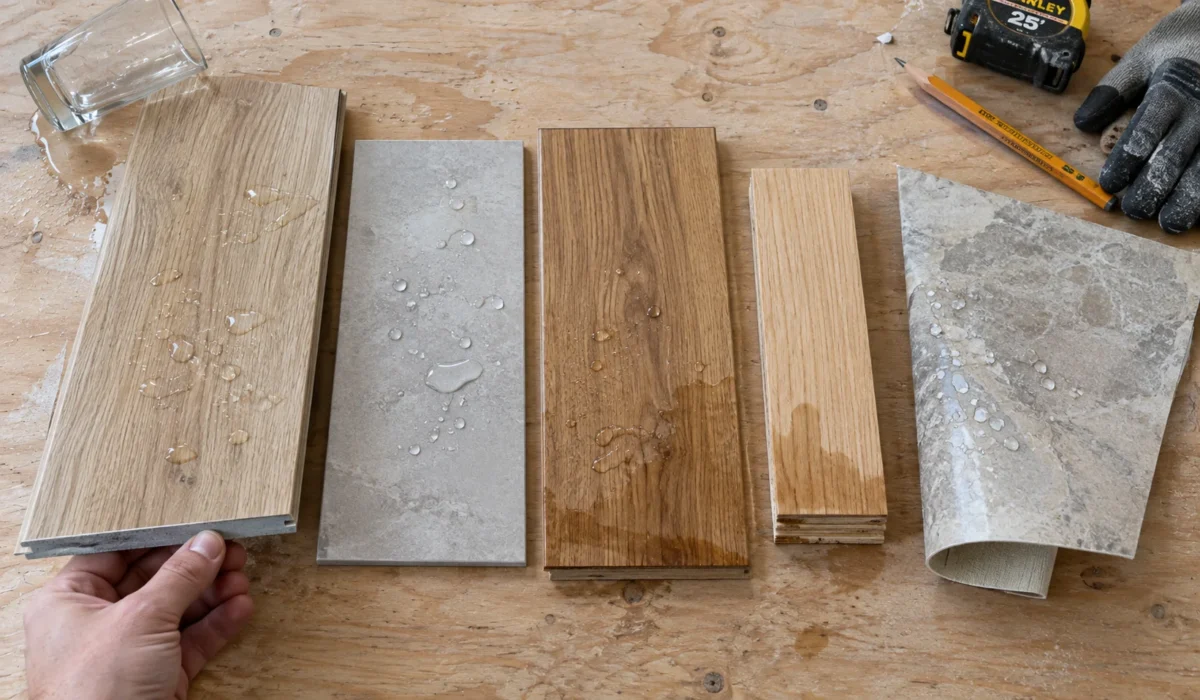
Waterproof means the material cannot absorb water, so a puddle under the dishwasher does no damage to the floor itself. Water resistant means the surface sheds water for a limited time, typically 24 to 72 hours on laminate warranties, before the core or the seams start to take it in. Vinyl and porcelain are waterproof materials. Laminate and wood are water resistant at best.
The distinction matters most in the slow leak you don’t know about. A cracked dishwasher drain hose or a pinhole in the refrigerator’s ice maker line can drip for weeks under a cabinet. On LVP or tile, you clean up and dry the subfloor. On standard laminate or hardwood, you replace the floor.
Dents, scratches, and dropped pans
Kitchens are where the heavy things fall. Porcelain resists scratches better than anything else on this list, but a dropped cast iron skillet can chip a tile, and a glass dropped on tile breaks every time. LVP and sheet vinyl give slightly under impact, so glasses sometimes survive, but vinyl can dent under a sharp point load and scratch when a chair leg drags grit across it.
For wood, hardness is measured on the Janka scale. Red oak rates about 1,290, white oak about 1,360, and hickory about 1,820. Harder species hide dents better, which is why white oak and hickory are the common picks for kitchens with engineered hardwood.
Comfort and slip resistance
If you cook a lot, you stand in the kitchen for hours. Vinyl and cork are the most forgiving underfoot. Tile and stone are the hardest on feet and backs, which is why so many tiled kitchens end up with antifatigue mats in front of the sink.
Slip resistance counts too, because a kitchen floor gets wet and greasy. The national standard for hard surface flooring, ANSI A326.3, sets a minimum wet DCOF (dynamic coefficient of friction) of 0.42 for level interior spaces that are expected to get wet. A kitchen fits that description. Check the spec sheet for any tile or vinyl you’re considering, and avoid polished tile in a busy kitchen.
Best kitchen flooring compared: cost, durability, and water
This table compares the best kitchen flooring options on the things that decide how they perform. Prices are typical installed ranges in Northern Virginia for 2026 and include material, labor, and basic prep, but not removal of an old tile floor or subfloor repair.
| Flooring | Waterproof? | Scratch resistance | Comfort underfoot | Installed cost (NoVA, per sq ft) | Typical lifespan |
|---|---|---|---|---|---|
| Rigid core LVP or LVT | Yes | Good (20 mil wear layer) | Warm, slightly soft | $6 to $11 | 15 to 25 years |
| Porcelain tile | Yes | Excellent | Hard and cold | $12 to $24 | 30+ years |
| Waterproof laminate | Surface only, for a set time | Very good (AC4) | Firm, warm | $5 to $9 | 15 to 20 years |
| Engineered hardwood | No | Fair | Warm | $9 to $16 | 20 to 40 years, can be refinished |
| Sheet vinyl | Yes, seam free in most kitchens | Fair | Soft | $4 to $8 | 10 to 15 years |
Best flooring for kitchen use: the 5 options that work, ranked
Each of these is a legitimate choice for the right kitchen. The order reflects how well each one handles the typical Northern Virginia household, meaning kids, pets, humid summers, and a dishwasher that runs every night.
1. Rigid core luxury vinyl plank: best overall
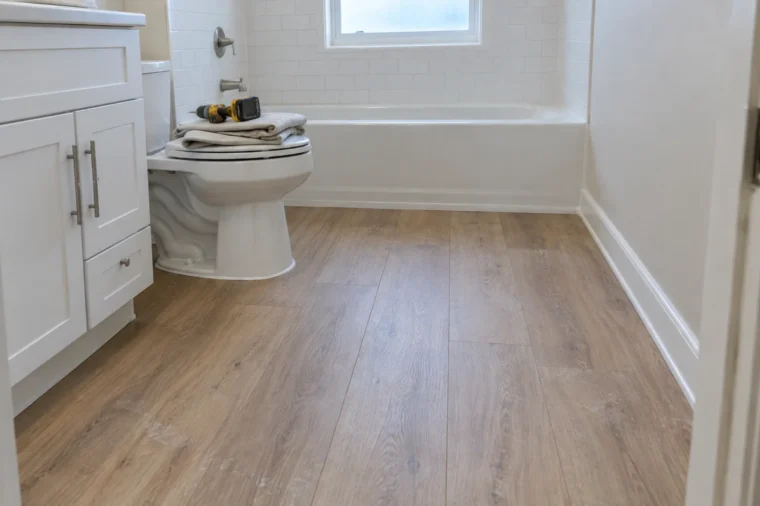
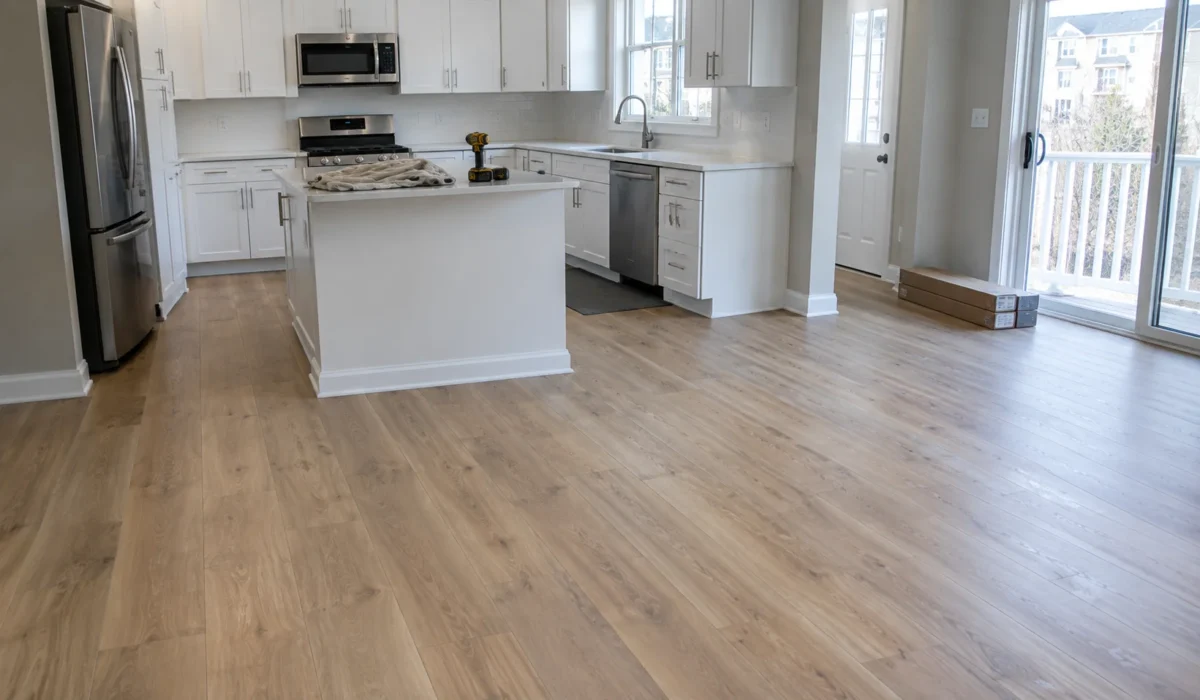
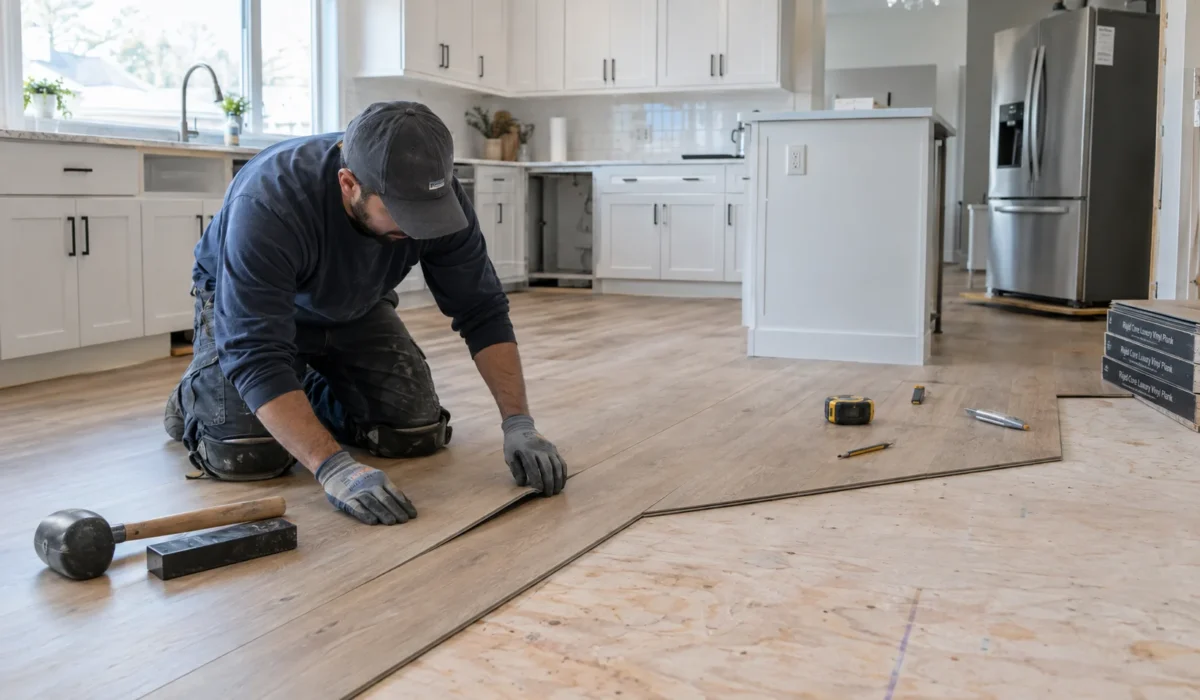
Rigid core LVP is the floor I put in most kitchens now. The plank is 100% waterproof all the way through, so a leak that would ruin laminate or wood is a cleanup job. It’s warmer and quieter than tile, easier on your feet, and the realistic wood looks have gotten good enough that most guests can’t tell from standing height.
What to buy:
- Core: SPC (stone plastic composite) for the best dent resistance, or WPC (wood plastic composite) if you want a slightly softer, quieter floor. Both are waterproof LVP flooring.
- Wear layer: 20 mil for a family kitchen or any house with a dog. The 12 mil products are fine for a condo kitchen with light use. Wear layer thickness matters more than total plank thickness.
- Attached pad: an attached acoustic underlayment helps with sound, which is worth it in a condo where your HOA may have a sound rule.
- Warranty: make sure the residential warranty covers kitchens and names what it excludes.
The tradeoffs are real. Vinyl can dent under a refrigerator dragged without protection, it can fade in a kitchen with a big south facing slider, and it adds less resale value than tile or wood in a higher end home. Rubber backed and latex backed mats can also stain vinyl yellow over time, which is why most vinyl manufacturers tell you to use a vinyl safe mat in front of the sink.
2. Porcelain tile: the most durable kitchen floor
Porcelain tile is the most durable kitchen floor you can buy. It absorbs less than 0.5% water by weight, doesn’t care about heat or grease, and doesn’t scratch under normal use. A porcelain floor installed over a stiff, flat subfloor should outlast the cabinets.
For a residential kitchen, look for a PEI rating of 3 or higher, which covers all residential floors, and a matte or lightly textured finish with a wet DCOF of 0.42 or more. Grout is the weak point in a kitchen, since it absorbs grease and food stains. Cement grout needs sealing every year or two. Epoxy grout costs more up front but doesn’t stain, and in a kitchen I’d pay for it.
The downsides: tile is hard on feet during long cooking sessions, cold in winter unless you add radiant heat, and it breaks anything fragile you drop on it. It also needs a stiff subfloor. Over wood framing, industry guidelines call for deflection no greater than L/360 for ceramic and porcelain, and many older Northern Virginia split levels need added blocking or a thicker underlayment before tile can go down. Our tile flooring installation page covers how we prep for that.
3. Waterproof laminate: the best budget wood look
Laminate gives you a convincing wood look, excellent scratch resistance, and a lower price than LVP. Look for an AC4 wear rating for a kitchen; AC3 is fine for bedrooms but wears faster under kitchen traffic.
The limit is the core. Even laminate sold as waterproof has a compressed wood fiber core. Its warranty typically covers surface water for a set window, often 24 to 72 hours, and does not cover water that gets under the floor from a leaking appliance. I recommend it in kitchens with a dry, attentive household, and I steer people toward LVP if the dishwasher or ice maker is old. Our guide on whether laminate flooring is waterproof walks through the warranty language line by line.
4. Engineered hardwood: real wood for open floor plans
Engineered hardwood has a real wood top layer over a cross laminated plywood core, which makes it far more stable than solid hardwood when Northern Virginia summers push indoor humidity up. If your family room and dining room are already oak, running engineered white oak into the kitchen keeps one continuous floor with no transition strip.
It is not waterproof, and it will dent. It works in a kitchen when you wipe up spills right away, keep a mat at the sink, and don’t mind a lived in patina. A thicker wear layer, typically 2 mm or more, lets you sand and refinish later. Before installation, the NWFA installation guidelines call for checking the moisture of both the wood and the subfloor, a step that gets skipped far too often on kitchen jobs.
5. Sheet vinyl: the cheapest waterproof option
Modern sheet vinyl comes in 12 foot wide rolls, so a galley kitchen or a small L shaped kitchen can be done without a single seam. That makes it one of the most watertight surfaces available and the cheapest to install.
The catch is that it tears and gouges, and you can’t replace one damaged section the way you can pull a single plank. It makes sense in a rental kitchen, a basement kitchenette, or a kitchen you plan to gut in five years.
Best waterproof flooring for kitchen leaks and spills
The best waterproof flooring for kitchen use is rigid core LVP or porcelain tile, because both are fully waterproof materials, not just water resistant surfaces. The next pick is sheet vinyl. Any of the three will survive a dishwasher leak. Laminate and wood will not.
Here’s the part most buyers miss: waterproof flooring protects the floor, not the subfloor. A floating LVP floor has a small gap underneath, so water that reaches the edge at a wall, a cabinet toe kick, or the dishwasher opening can travel under the planks and sit on the plywood. Three habits cut that risk:
- Seal the edges near water. Ask for 100% silicone in the expansion gap along the sink base, the dishwasher opening, and the refrigerator wall before shoe molding goes on.
- Replace old supply lines. Swap rubber dishwasher and ice maker lines for braided stainless when the appliances are pulled for the floor. It’s cheap insurance.
- Add a leak sensor. A small water sensor under the sink and behind the refrigerator tells you about a leak in hours instead of weeks.
Kitchen flooring installation details most guides skip
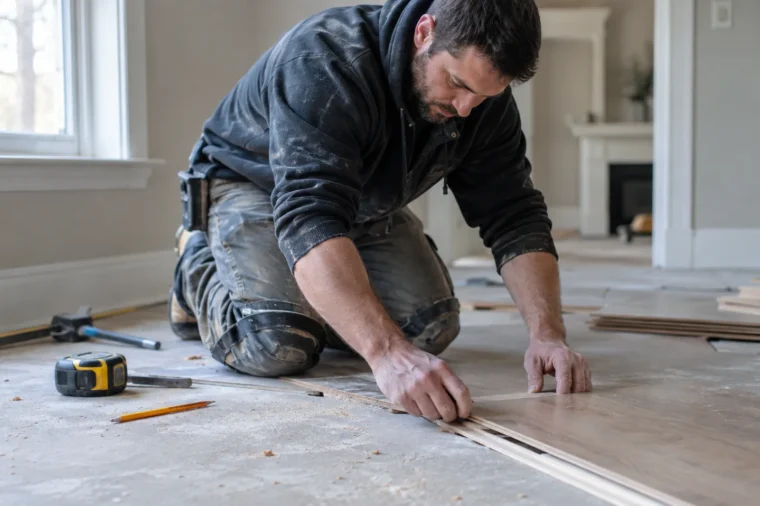
Even the best flooring for kitchen remodels fails when it’s installed carelessly. These are the details that separate a careful installer from a fast one.
Should the floor go under the cabinets?
In a full remodel, the usual approach for tile and glue down floors is to install the floor first and set the cabinets on top. For floating floors, which includes most click lock LVP and laminate, the answer reverses. Most floating floor manufacturers do not allow cabinets or islands to be installed on top of the floor, because the weight pins it and stops it from expanding and contracting. That leads to buckled planks and split joints.
If you’re replacing only the floor and keeping your cabinets, the new floor runs up to the cabinet toe kick with an expansion gap, and new shoe molding or toe kick trim covers the edge.
The dishwasher height trap
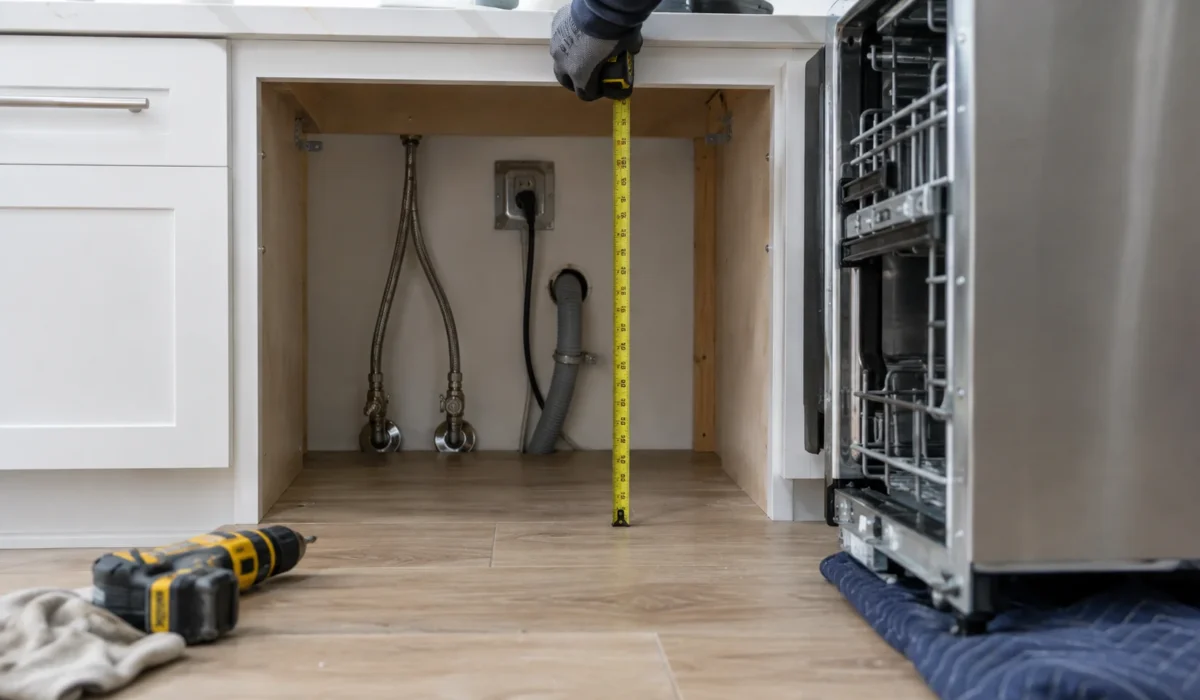
This is the most common kitchen flooring mistake I see. A standard dishwasher needs about 34 inches of height under a 36 inch countertop. If you put new flooring in front of the dishwasher but not under it, the dishwasher is now boxed in by the thickness of the new floor. The day it needs replacing, it won’t come out without cutting the countertop or pulling up the floor.
The fix is simple: run the flooring into the dishwasher opening, or shim the opening to the same height, before the dishwasher goes back in.
Kitchen islands and heavy loads
A permanent island is a cabinet, so the same rule applies. On a floating floor, the flooring should stop at the island base, not run under it. Refrigerators and ranges are fine on a floating floor, but protect the new floor when you move them. Slide appliances on a sheet of hardboard or plywood, never directly across LVP or laminate.
Open floor plans and long runs
Floating floors need room to move. Most manufacturers set a maximum continuous run, often somewhere between 40 and 60 feet depending on the product, before a transition or expansion break is required. In an open kitchen, family room, and dining area, that limit can come up quickly, so plan the transitions at doorways where they look intentional instead of in the middle of the room.
Subfloor flatness
Rigid core LVP and large format tile both show every hump and dip in the subfloor. A common flatness tolerance for rigid core vinyl is 3/16 inch over 10 feet, and for large format tile it’s 1/8 inch over 10 feet. Older kitchens with patched plywood around a former sink location often need leveling compound before anything goes down. Budget for it rather than being surprised.
Kitchen flooring to avoid
Three choices show up in kitchens often and cause problems more often than they should.
Solid hardwood near the sink and dishwasher. Solid wood cups when it gets wet and gaps in dry winters. It can work in a large kitchen with careful owners, but it’s the wrong choice if the house has young kids, dogs, or an older dishwasher. Engineered hardwood or wood look LVP gives the same look with far less risk.
Cheap laminate or thin vinyl. A 6 mil wear layer or an AC2 laminate is built for a bedroom. In a kitchen it wears through in front of the sink and range within a few years.
Carpet. It holds spills and food odor and can’t be cleaned properly. A washable runner over a hard floor gives the comfort without the problem.
Natural stone deserves a caution too. Marble and limestone etch from lemon juice, vinegar, and wine, so they need sealing and careful habits. If you love the look, marble look porcelain gives you most of it with none of the upkeep.
Kitchen flooring cost in Northern Virginia
Here’s what homeowners in Northern Virginia typically pay in 2026 for kitchen floor installation. The best flooring for kitchen budgets is the one you can afford to install properly, including prep.
| Item | Typical Northern Virginia range |
|---|---|
| Rigid core LVP or LVT, installed | $6 to $11 per sq ft |
| Waterproof laminate, installed | $5 to $9 per sq ft |
| Engineered hardwood, installed | $9 to $16 per sq ft |
| Porcelain tile, installed | $12 to $24 per sq ft |
| Sheet vinyl, installed | $4 to $8 per sq ft |
| Remove old vinyl, laminate, or LVP | $1 to $2 per sq ft |
| Remove old tile | $2 to $5 per sq ft |
| Leveling compound for uneven areas | $2 to $5 per sq ft where needed |
| Pull and reset dishwasher and refrigerator | Often $100 to $300 total |
For a typical 150 square foot kitchen in a Fairfax or Reston colonial, that works out to roughly $900 to $1,650 for LVP and $1,800 to $3,600 for porcelain tile, before removal and any subfloor repair. Kitchens that flow into a family room are often priced as one larger area, which lowers the cost per square foot.
Timelines are short for vinyl and longer for tile. An LVP kitchen is usually one day, with appliances back in place that evening. Tile typically takes two to three days, and you won’t want heavy appliances rolled back until the thinset and grout have cured.
If you’d rather have your own number than a range, the FIXO instant quote prices your square footage in about a minute, with removal, baseboards, and delivery included.
How to choose the right kitchen floor for your home
The best flooring for a kitchen depends on who uses it and how long you’ll stay. Match your situation to the closest line below.
- Young kids or dogs: rigid core LVP with a 20 mil wear layer. Waterproof, quiet, and tough on claws and spills.
- Serious home cooks: LVP for comfort during long sessions, or porcelain with an antifatigue mat if you want the durability.
- Selling in the next few years: porcelain tile or engineered hardwood usually read as higher end to buyers in McLean, Vienna, and Great Falls. In a starter townhome in Manassas or Woodbridge, quality LVP competes well.
- Open floor plan with existing hardwood: engineered hardwood matched to your existing floors, or a wood look LVP carried through the whole main level.
- Condo: LVP with an attached acoustic pad, after checking your HOA’s flooring and sound rules.
- Rental or basement kitchenette: sheet vinyl or entry level LVP.
Want to see how the kitchen fits with the rest of the house? Our room by room guide to the best flooring for a house covers living areas, bedrooms, basements, and stairs.
Questions to ask a flooring installer before you sign
A good installer can answer each of these without hesitating:
- Will the floor run under the dishwasher, or will you shim the opening to match?
- For a floating floor, where will you stop at the cabinets and island, and how will you trim the edge?
- Where are the transitions going in an open floor plan, and why there?
- How will you check subfloor flatness, and what does leveling cost if it’s needed?
- Is pulling and resetting the appliances included, and will you replace old supply lines?
- Is the price fixed before the job starts?
Fixo DMV installs kitchen floors across Northern Virginia, Maryland, and DC with a fixed price agreed up front. Our LVP flooring installation page shows exactly what’s included for the floor most kitchens end up with.
Frequently asked questions
What is the best flooring for a kitchen with dogs?
Rigid core LVP with a 20 mil wear layer is the best flooring for a kitchen with dogs. It’s waterproof, so water bowl spills and accidents can’t soak in, and it’s quieter under claws than tile. Choose a textured, matte finish in a midtone color, which hides scratches and paw prints better than a very dark or glossy plank.
Is LVP or tile better for a kitchen?
LVP is better for comfort, warmth, cost, and speed of installation. Tile is better for scratch resistance, longevity, and resale in higher end homes. In Northern Virginia, LVP typically costs about half as much installed and goes down in a day. Pick tile if you plan to stay 15 years or more; pick LVP if the kitchen gets hard daily use from kids and pets.
Is laminate flooring good for a kitchen?
Laminate can work in a kitchen if you choose an AC4 rated waterproof product and wipe up spills promptly. It resists scratches better than most vinyl. Its weakness is the wood fiber core, which can swell if water from a leaking dishwasher or refrigerator line gets under the floor. If your appliances are older, LVP is the safer choice.
Should kitchen flooring go under the cabinets?
Tile and glue down floors usually go in first, with cabinets set on top. Floating floors, including most click lock LVP and laminate, should not have cabinets or islands installed on top of them, because the weight stops the floor from moving and can cause buckling. Check your product’s installation instructions before the cabinets go in.
What is the most durable flooring for a kitchen?
Porcelain tile is the most durable kitchen flooring. It is fully waterproof, very hard to scratch, unaffected by heat and grease, and often lasts 30 years or more. Choose a PEI 3 or higher rating, a wet DCOF of 0.42 or more for slip resistance, and epoxy grout so grease and food don’t stain the joints.
Can you put LVP over existing kitchen tile?
Often, yes. Rigid core LVP can go over sound, flat, well bonded tile if deep grout lines are skim coated first. The catch is height: the new floor raises the surface, which can trap the dishwasher and create a lip at doorways. Removing the old tile usually costs $2 to $5 per square foot and avoids both problems.
How long does it take to install a new kitchen floor?
Most LVP and laminate kitchen floors are installed in one day, and you can use the kitchen that evening. Tile usually takes two to three days because the thinset and grout need time to cure. Add a day if the old floor is tile or the subfloor needs leveling.
Final Thoughts
The best flooring for kitchen remodels in most Northern Virginia homes is rigid core waterproof LVP, with porcelain tile as the choice for maximum durability and resale. Waterproof laminate and engineered hardwood work in kitchens with careful owners and newer appliances. Whichever you pick, the installation details, especially the dishwasher opening, the cabinet edges, and the subfloor, decide how long it lasts.
If you’re in Northern Virginia, Maryland, or DC and want a fixed price for your kitchen, Fixo DMV will price it online in about a minute, bring samples to your door, and have most kitchen floors down in a day. Get your instant quote or call (757) 589 6859, any day from 8am to 8pm.
 4.9 on Google14 reviews
 Licensed & InsuredVirginia · Maryland · Washington, D.C.
 Workmanship GuaranteedInstallation backed in writing
 Locally OwnedServing NoVA, MD & D.C.