Tile flooring installation costs in 2026 run $12 to $25 per square foot installed for ceramic or porcelain in the DMV, and $18 to $35 or more for natural stone. A typical bathroom runs $900 to $1,800; a 200-square-foot kitchen runs $2,800 to $5,500. Most rooms take two to four days, plus 24 to 72 hours before normal use.
Tile flooring installation cost is the number homeowners most often get wrong, and usually in the same direction. They price the tile, add a little for labor, and then the quote comes in at double what they expected. The gap isn’t the tile. It’s the mortar, the backer board, the old floor coming out, the toilet, and the three days a skilled setter spends on their knees making the surface flat.
I’ve priced and scheduled tile floors across Northern Virginia, Maryland, and Washington, DC for years, and this guide lays out what you’ll actually pay in 2026, what’s inside a fair quote, and how many days the room will be out of service. You’ll also get the questions that separate a solid installer from one who’ll surprise you after demo day.
What does tile flooring installation cost in 2026?
Tile flooring installation costs $12 to $25 per square foot installed for ceramic and porcelain in most US markets, with labor making up roughly half of that. Angi’s 2026 tile installation cost data puts the national average project around $2,000, with most homeowners landing between a few hundred dollars and about $4,500 depending on room size and tile choice.
That range is wide because the word tile covers a $2 ceramic square and a $30 slab of marble, and because labor swings with the room. A square kitchen with a flat subfloor and 12×24 porcelain in a straight lay is the cheapest tile job there is. A 1950s bathroom with a sagging subfloor, a toilet, a tub apron, and herringbone marble is the most expensive.
Tile floor installation cost per square foot by material
| Tile type | Material only (per sq ft) | Installed (per sq ft) | Where it makes sense |
|---|---|---|---|
| Ceramic | $2 to $8 | $12 to $20 | Bathrooms, laundry rooms, budget kitchens |
| Porcelain | $3 to $12 | $14 to $25 | Kitchens, entryways, mudrooms, high traffic |
| Wood-look porcelain plank | $4 to $10 | $15 to $26 | Open main levels, matching hardwood |
| Large format porcelain (24×24 and up) | $5 to $15 | $18 to $30 | Modern kitchens and primary baths |
| Natural stone (slate, travertine, marble) | $8 to $30 or more | $18 to $35 or more | Primary baths, formal entryways |
| Mosaic sheets | $8 to $25 | $20 to $40 | Shower floors, accents, small baths |
Two things to remember when you read that table. The installed price includes setting materials, and those add $2 to $4 per square foot on their own: thinset mortar, backer board or membrane, grout, and sealer. And every job needs overage. Order 10 percent extra tile for a straight lay and 15 percent for diagonal or herringbone, because the cuts at every wall and doorway eat tile fast.
What tile installers charge for labor
Tile installation labor costs $5 to $15 per square foot in 2026 for floor work, with the DMV sitting toward the upper half of that range. Straight lay ceramic in an open room lands near $5 to $7. Large format porcelain, patterns, or stone push labor to $10 to $15 because each tile takes longer to set flat and more of them need cutting.
Most installers price floors per square foot and price odd work (showers, niches, curved walls) by the hour, typically $60 to $100 an hour for a lead setter. Some quote a flat day rate. Any of those is fine as long as the total is fixed before demo starts and the quote says what happens if the subfloor is worse than expected.
Tile flooring installation cost in Northern Virginia, Maryland, and DC
Tile flooring installation in the DMV typically costs 10 to 20 percent more than the national average because labor rates in Fairfax, Montgomery County, and the District are higher than most of the country. Here’s what homeowners here typically pay in 2026, installed, with setting materials included.
| Item | Typical DMV range |
|---|---|
| Ceramic or porcelain floor tile, installed | $12 to $25 per sq ft |
| Natural stone floor tile, installed | $18 to $35 or more per sq ft |
| Remove old ceramic tile floor | $2 to $5 per sq ft |
| Remove vinyl, laminate, or carpet | $1 to $2 per sq ft |
| Pull and reset toilet (new wax ring) | $150 to $300 |
| Subfloor patch or repair | $150 to $400 for a typical spot |
| Self-leveling compound for a wavy floor | $2 to $5 per sq ft where needed |
| Electric radiant heat mat under tile | $10 to $20 per sq ft, plus thermostat |
| Small room minimum charge | $600 to $900 |
Three real-world examples show how those add up:
- A 5×8 hall bath (40 sq ft), midrange porcelain: Tile and labor around $700, toilet pull $200, old vinyl removal $60. Total typically $900 to $1,300, driven more by the minimum charge than by square footage. This is where bathroom floor tile installation quotes surprise people: the per square foot number looks high because the room is small and the toilet is in the way.
- A 12×14 kitchen (168 sq ft), 12×24 porcelain: Tile and labor $2,500 to $3,800, old floor removal $300, a bit of leveling near the sink wall $200. Total typically $3,000 to $4,300.
- A 300 sq ft open kitchen and breakfast area in a McLean or Bethesda colonial, large-format porcelain. Tile and labor $5,400 to $8,000, removal $600, leveling $500. Total typically $6,500 to $9,000.
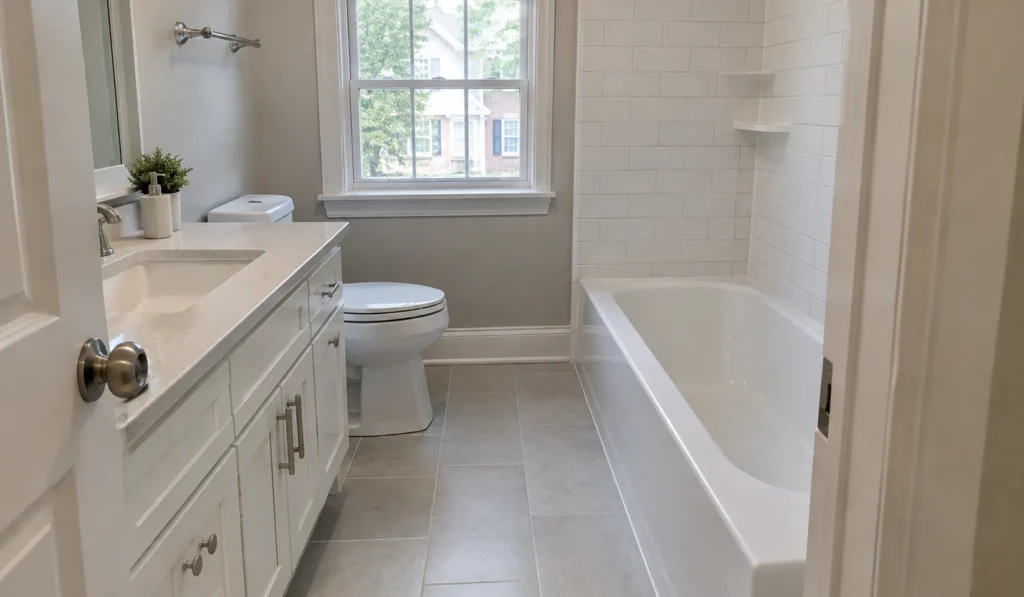
Prices are similar across the region. A tile installation in Maryland, say a Gaithersburg or Silver Spring bathroom, is priced within a few percent of the same job in Arlington. Washington DC tile flooring jobs in row houses often carry a small premium for parking, stairs, and carrying tile up to a second-floor bath.
What’s in a tile installation quote
A complete tile installation quote lists the tile, setting materials, labor, removal, prep, and any fixture work as separate lines, so you can see exactly what you’re paying for. Most of the difference in tile flooring installation cost between two quotes comes from what each one includes, so if a quote is one number in a text message, ask for the breakdown before you compare it with anyone else’s.
A fair quote for a floor usually contains:
- Tile, with the overage included (10 to 15 percent).
- Setting materials: thinset mortar (a polymer modified mortar meeting ANSI A118.15 for large format tile, one of the ANSI tile installation standards published by the Tile Council of North America), backer board or an uncoupling membrane, grout, caulk, and sealer.
- Labor for layout, cutting, setting, grouting, and cleanup.
- Removal and haul away of the existing floor.
- Subfloor prep: screwing down loose plywood, patching, leveling.
- Fixture work: pulling and resetting the toilet, cutting around a vanity, shimming a dishwasher opening.
- Transitions and trim: thresholds at doorways, shoe molding or baseboards reset after the floor goes in.
- Disposal fee if the installer hauls the debris.
What’s rarely included and worth asking about: moving furniture and appliances, new baseboards (as opposed to resetting the old ones), plumbing beyond the toilet, and a flange extender if the new floor sits higher than the old one.
Add-ons that move the price the most
| Add on | Why it costs what it does | Typical effect |
|---|---|---|
| Removing old tile | Demo hammer, dust control, heavy debris, and the old thinset has to be ground off | Adds $2 to $5 per sq ft, half a day to a day |
| Leveling a wavy subfloor | Tile needs 1/4 inch flatness over 10 feet; leveler is priced by the bag and takes a day to cure | Adds $200 to $800 in most rooms |
| Large format tile | Needs a flatter floor, back buttering, and leveling clips; more breakage on cuts | Adds $3 to $6 per sq ft in labor |
| Herringbone or diagonal | Twice the cuts and more waste | Adds 20 to 40 percent to labor and 5 percent to tile |
| Natural stone | Softer, needs sealing before and after grouting, stricter deflection limits | Adds $5 to $10 per sq ft |
| Radiant heat mat | Extra layer, extra cure, and an electrician for the thermostat | Adds $10 to $20 per sq ft plus $300 to $600 electrical |
| Epoxy grout | Harder to work, must be cleaned fast | Adds $1 to $3 per sq ft |
What makes tile flooring installation cost more or less
Nine factors decide where your project lands inside the ranges above.
- Room shape. Rectangles are cheap. L-shaped kitchens, angled walls, and rooms full of doorways mean more cuts and more time.
- Tile size. Small mosaics and very large slabs both cost more to set than 12×12 or 12×24; the sweet spot for labor is the middle.
- Subfloor condition. A flat, stiff subfloor is free. A 1970s plywood floor with a sag near the tub is not.
- What’s coming out. Vinyl peels; old ceramic fights you. Removing tile can cost as much as installing the new floor in a small bath.
- Fixtures. Every toilet, vanity, or appliance is time and risk.
- Pattern. Straight lay is the baseline; everything else adds cuts.
- Material grade. Rectified porcelain with tight edges sets faster and flatter than cheap ceramic with size variation, which can offset part of its higher price.
- Access. A basement or a fourth-floor walk-up adds carrying time for tile, mortar, and debris.
- Scope bundling. Tiling a kitchen and both baths in one visit lowers the per square foot rate because setup, cleanup, and travel are shared.
If you’re comparing tile with other floors for the same room, our guides to the best flooring for kitchen remodels and the best flooring for bathroom projects show where porcelain beats rigid core vinyl and where it doesn’t.
How long does tile floor installation take?
Tile floor installation takes two to four days for most single rooms, then 24 to 72 hours before normal use, because mortar and grout each need a cure window before they can carry traffic. A bathroom is typically three days from demo to toilet reset; a 200 square foot kitchen is typically three to four days; a whole main level can run one to two weeks.
| Project | Working days on site | Days before normal use |
|---|---|---|
| Powder room or hall bath (30 to 50 sq ft) | 2 to 3 | 1 to 3 after grout |
| Kitchen (150 to 250 sq ft) | 3 to 4 | 1 to 3 after grout |
| Primary bath with tub and shower | 4 to 6 | 3 for the floor, longer for the shower |
| Open main level (500 sq ft or more) | 6 to 10 | 1 to 3 after final grout |
| Large format or stone, any room | Add 1 to 2 days | Add 1 day |
The reason tile takes longer than a floating floor isn’t the setting. A good crew sets 150 to 250 square feet a day. It’s the waiting: the leveler has to cure before the backer board, backer board mortar has to cure before tile, tile mortar has to cure before grout, and grout has to cure before you live on it.
Day by day tile installation timeline
Here’s how a typical 12×14 kitchen runs when the subfloor is in decent shape:
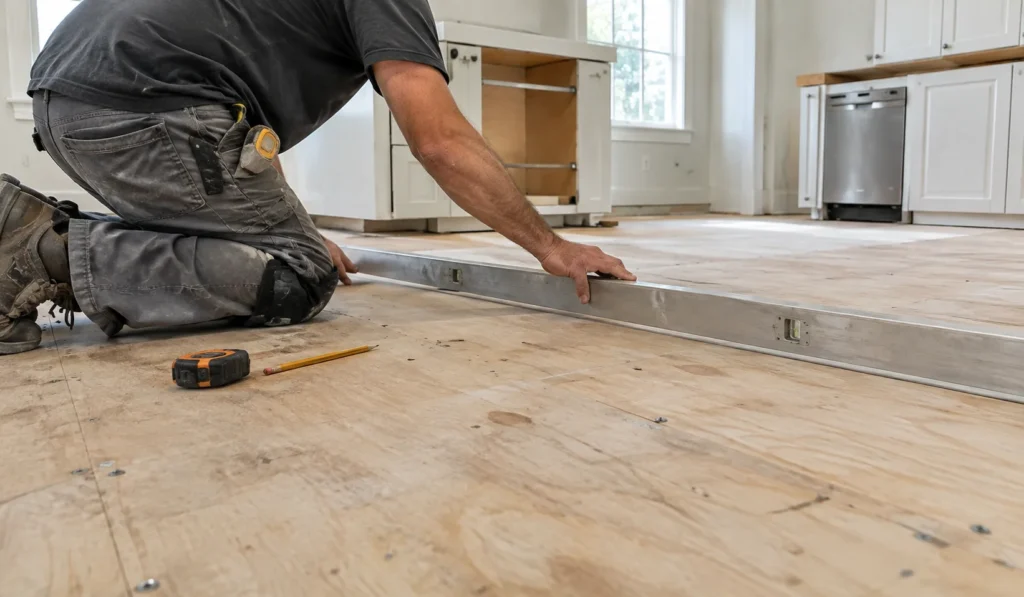
- Day 1, demo and prep: Appliances and furniture out, old floor removed, subfloor checked for flatness with a 10 foot straightedge and for movement by walking it. Loose sheathing gets screwed down. If leveler is needed, it goes down now and cures overnight.
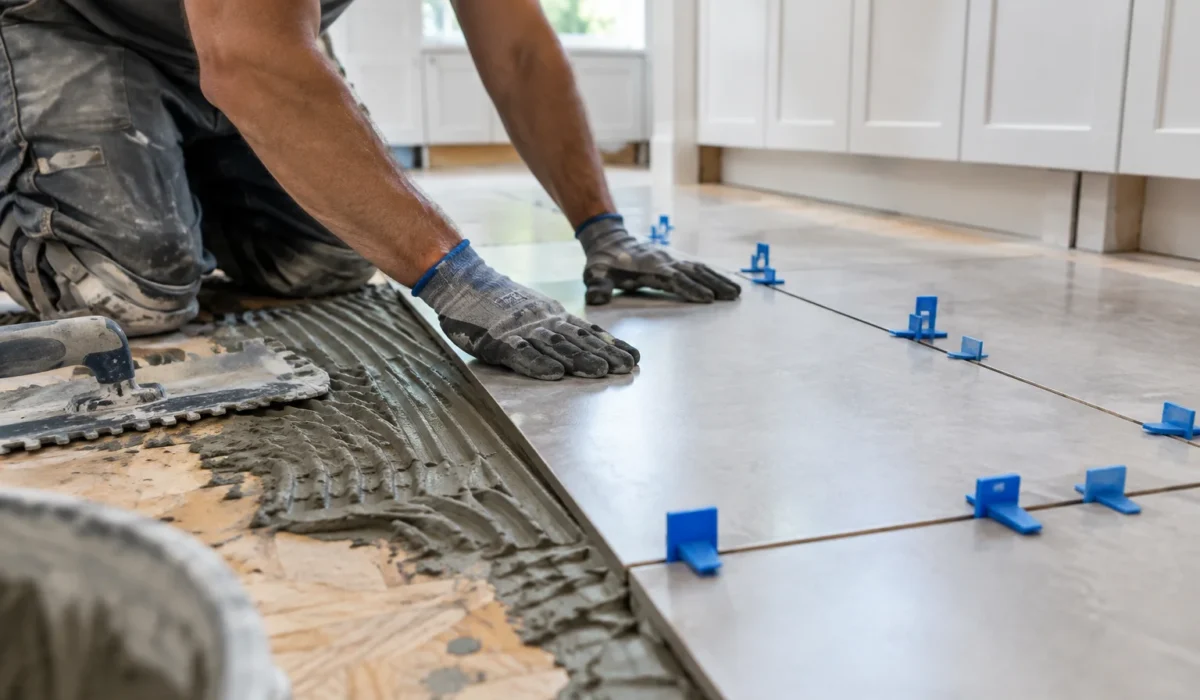
- Day 2, substrate and layout: Backer board set in thinset and screwed down, or an uncoupling membrane bonded to the subfloor. Chalk lines snapped from the room’s center so the cut tiles land evenly at the walls, not as a sliver on one side. Some crews start setting the same afternoon.
- Day 3, setting: Thinset combed on with the notch size the tile calls for, tiles pressed and checked for mortar coverage (80 percent for dry areas, 95 percent in wet rooms), leveling clips on large format, cuts at the perimeter with a wet saw. Nobody walks on it overnight.
- Day 4, grout and finish: Grout packed, hazed off, and tooled. Silicone at the perimeter and at any change of plane. Transitions set at the doorways. Baseboards or shoe molding reset once the grout has firmed up, usually the next morning.
A bathroom follows the same order compressed into three days, with the toilet going back on the final morning after the grout has cured enough to hold it. For a primary bath with a tiled shower, the pan and walls add two to three days on their own.
When you can walk on new tile, move furniture back, and get it wet
With standard cement grout, you can walk on new tile in socks or soft shoes after 24 hours, put furniture and appliances back after 48 to 72 hours, and expose the floor to standing water after 72 hours. Cement grout keeps hardening for weeks, so slide nothing heavy across it in the first few days.
Epoxy grout shortens that: light traffic in 12 to 24 hours and water within 24. Rapid-set grouts and mortars can allow walking within a few hours, which is how a one-bathroom household gets its toilet back the same evening, but they cost more, and the crew has to move fast. Whatever product is used, the manufacturer’s data sheet sets the cure times, and warranties depend on following them.
Sealing comes last. Cement grout should cure 48 to 72 hours before sealer goes on, and many installers come back a week later to seal so the grout has fully dried. Porcelain doesn’t need sealing; natural stone does, usually before grouting and again after.
What makes a tile job run over schedule
Most delays come from three things: wood that’s soft or sagging under the old floor, leveling that takes a second coat, and tile that arrives short or damaged. The first two are why the price should be fixed, but the schedule should have a day of slack.
Weather matters more than people expect in the DMV. Humid July days slow grout cure and cold January basements slow mortar, so a crew that asks for an extra day in those months isn’t padding the job. And in a home with one bathroom, the timeline is the whole project: ask the installer how they’ll sequence the toilet, and plan a place to shower for two nights.
Ceramic vs. porcelain vs. stone: cost, time, and where each belongs
Porcelain is the best value for most DMV homes: it costs a few dollars more per square foot than ceramic, sets about the same, and lasts decades in kitchens and entryways. Ceramic wins on price in bathrooms and laundry rooms. Stone is a look-first choice that costs more to buy, install, and maintain.
| Feature | Ceramic | Porcelain | Natural stone |
|---|---|---|---|
| Installed cost (DMV) | $12 to $20 per sq ft | $14 to $28 per sq ft | $18 to $35 or more per sq ft |
| Install time | Baseline | Same, plus a day for large format | Add 1 to 2 days for sealing |
| Water absorption | Higher; fine for floors, seal the grout | Under 0.5 percent; best for wet rooms | Varies; needs sealing |
| Hardness and chip resistance | Good; glaze shows chips | Excellent; color runs through | Softer; marble scratches, slate flakes |
| Subfloor requirement | L/360 deflection | L/360 deflection | L/720 deflection, stiffer floor |
| Slip resistance | Choose DCOF 0.42 or higher for wet rooms | Same; many matte porcelains qualify | Honed finishes are safer than polished |
The slip resistance row matters most in kitchens and baths. The 0.42 wet DCOF benchmark comes from ANSI A326.3, the TCNA slip resistance standard, and most manufacturers now print the rating on the box or spec sheet.
The deflection line is the other one to ask about. Stone needs a floor twice as stiff as ceramic or porcelain, and a lot of floors with joists 16 inches on center in older Fairfax and Montgomery County houses don’t meet it without an extra layer of plywood. That’s a cost your installer should find on the site visit, not after the tile is bought.
DIY tile flooring installation or hire a pro?
A straight lay ceramic floor in a square powder room with a flat subfloor and no toilet complications is a reasonable weekend project for a patient DIYer who owns or rents a wet saw. Anything with a large format tile, a wavy floor, a toilet flange, stone, or a pattern is where a professional earns the labor line.
Labor is the biggest share of tile flooring installation cost, so it’s the part DIY saves. The honest math: on a 40 square foot bath you’d save $300 to $500 and spend a full weekend plus $150 in tool rental. On a 200 square foot kitchen you’d save $1,200 to $2,000 and spend a week, and one mistake in flatness shows as lippage you’ll feel underfoot for twenty years. The nine ways tile jobs go wrong are covered in our post on tile flooring installation mistakes that crack tile, and nearly all of them happen below the tile where you can’t see them.
If you do it yourself, buy rectified tile, use a leveling clip system, check flatness before you open a single box, and let every layer cure before the next one goes on.
Want to know what happens on each day of the job? Our tile floor installation process guide walks through it step by step.
Questions to ask a tile installer before you sign
A good tile installer can answer each of these without pausing:
- Is the price fixed, and what exactly happens if the subfloor is soft or out of flat when you open it up?
- Backer board or uncoupling membrane, and why that choice for my floor?
- What mortar are you using, and is it rated for my tile size?
- Will you pull and reset the toilet, and is a new wax ring or a flange extender included?
- How will you check flatness, and what does leveling cost per bag if it’s needed?
- What grout, and when can I walk on it, put furniture back, and get it wet?
- Are removal, disposal, transitions, and resetting baseboards in the price?
- Are you licensed and insured in Virginia, Maryland, or DC, and can you show it?
If the answer to the first question is vague, keep looking.
Commercial tile installation: how the numbers change
Commercial tile installation prices by the same per square foot logic but with different inputs: harder porcelain or quarry tile, epoxy grout as standard, movement joints every 20 to 25 feet in the field, and work scheduled around business hours. Expect $15 to $30 per square foot installed for a retail or restaurant floor and a schedule set by cure times rather than crew speed, because a floor that opens to the public a day early costs more to fix than the day it saved.
Offices usually pair tile in restrooms and lobbies with carpet where people sit. For carpet tile and broadloom pricing, codes and scheduling, see our guide to commercial carpet installation.
Tile flooring installation with Fixo DMV
Fixo DMV installs tile floors across Northern Virginia, Maryland, and Washington, DC with one rule that fixes most of what goes wrong in this trade: the price is agreed before anyone picks up a hammer. We check flatness and deflection at the measurement visit, write removal, prep, and fixture work into the quote as their own lines, and tell you which day the toilet goes back before demo starts. That keeps your tile flooring installation cost the same on the last day as it was on the first.
If you’d like a fixed number for your kitchen, bath, or entryway, our tile flooring installation service page shows what’s included, and you can start your free quote online or call (757) 589- 6859 any day from 8 am to 8 pm.
Frequently asked questions
How much does it cost to tile a 200 square foot floor?
Tiling a 200 square foot floor typically costs $2,800 to $5,500 installed for ceramic or porcelain in the DMV, and $4,000 to $7,500 for natural stone. That includes tile with overage, mortar, backer board, grout, and labor. Add $400 to $1,000 if an old tile floor has to come out, and $200 to $800 if the subfloor needs leveling.
Is porcelain more expensive to install than ceramic?
Porcelain costs slightly more to install than ceramic, usually $2 to $5 more per square foot, because the tile itself costs more and it’s harder to cut. Labor is close to identical for standard sizes. The gap widens with large format porcelain, which needs a flatter floor, leveling clips, and back buttering that add $3 to $6 per square foot in labor.
How long after tile is installed can you walk on it?
You can walk on newly installed tile 24 hours after grouting with standard cement grout, in socks or soft soled shoes. Wait 48 to 72 hours before moving furniture or appliances back and before exposing the floor to water. Epoxy grout allows light traffic in 12 to 24 hours; rapid set products can allow walking within a few hours.
How much do tile installers charge per square foot for labor?
Tile installers charge $5 to $15 per square foot for floor labor in 2026, with the DMV in the upper half of that range. Straight lay ceramic or 12×24 porcelain in an open room sits near $6 to $9 here. Patterns, large format tile, stone, and small rooms with fixtures push labor toward $12 to $15 per square foot.
Does removing old tile cost extra?
Yes. Removing an old ceramic or porcelain floor typically costs $2 to $5 per square foot in the DMV, and it’s usually a separate line on the quote. Old thinset has to be ground off the subfloor so the new floor sits flat, which is why tile removal costs more than pulling vinyl, laminate, or carpet at $1 to $2 per square foot.
Is tile cheaper than LVP to install?
No. Tile flooring installation cost is roughly twice that of rigid core luxury vinyl plank: $12 to $25 per square foot installed for porcelain versus $6 to $12 for LVP in the DMV, and tile takes three days where LVP takes one. Tile wins on lifespan and resale in primary baths and kitchens; LVP wins on budget, warmth underfoot, and speed.
Final Thought
Tile flooring installation cost in 2026 comes down to three numbers: $12 to $25 per square foot installed for ceramic and porcelain in the DMV, $18 to $35 or more for stone, and the add ons for removal, leveling, and fixtures that can add 15 to 30 percent to a small room. Plan on two to four working days for one room and another one to three days before you live on the floor.
The installer you want is the one who checks the subfloor before quoting, fixes the price before demo, and tells you the cure schedule without being asked. Get that, and a tile floor set this fall will still look right when the house sells.
 4.9 on Google14 reviews
 Licensed & InsuredVirginia · Maryland · Washington, D.C.
 Workmanship GuaranteedInstallation backed in writing
 Locally OwnedServing NoVA, MD & D.C.