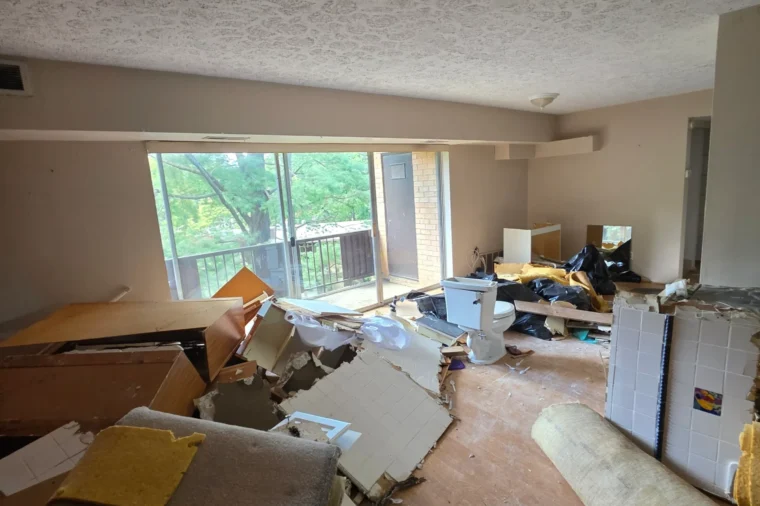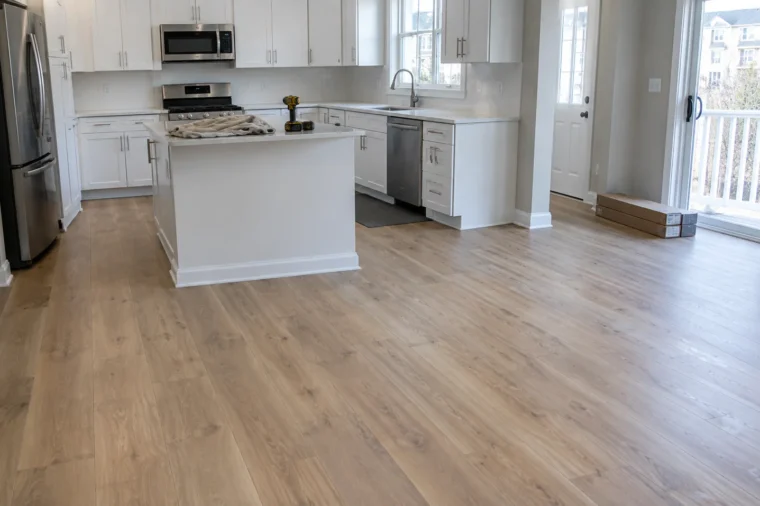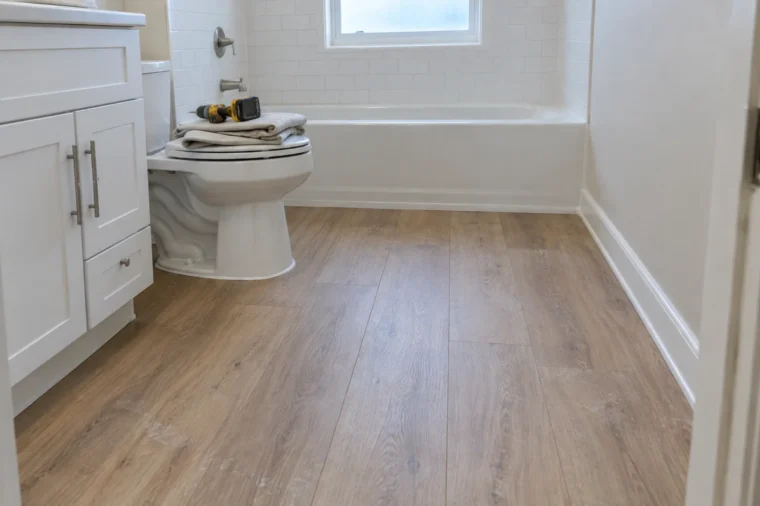
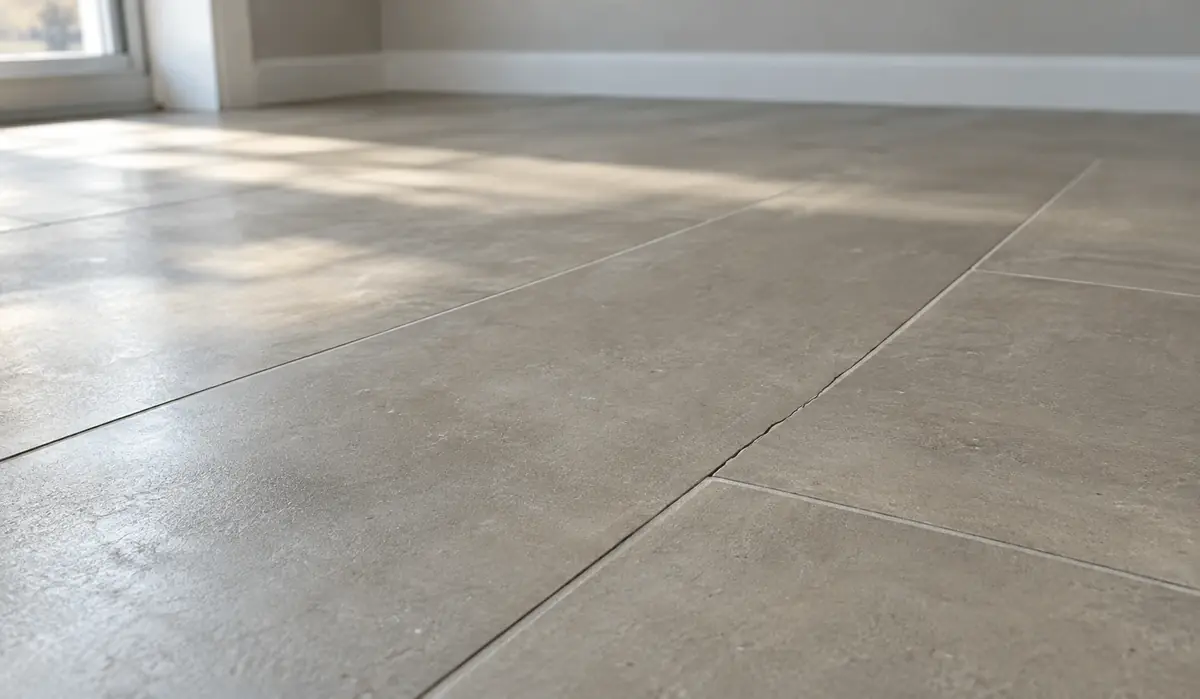
A cracked tile almost never starts at the tile. It starts an inch or two below it, in a subfloor that flexed, a mortar bed that never made full contact, or a floor that had nowhere to move. That is the maddening part of tile flooring installation: the mistakes are invisible on day one and unmistakable on month nine, when a hairline crack runs across four tiles in one straight line.
Porcelain is harder than the concrete it sits on, so if your floor is cracking the tile is not the weak link. The assembly under it is the problem. Below are the nine failures behind most of the repair calls we take across Northern Virginia, Maryland and DC, what each one looks like after the fact, and how to check for it before anyone mixes mortar.
Why tile cracks in the first place
Tile flooring installation fails from the substrate up, not the tile down. Nine mistakes cause most cracked floors: an out-of-tolerance subfloor, a bouncy floor structure, no crack isolation over a slab, thin mortar coverage, the wrong trowel or mortar, missing movement joints, early foot traffic, an unsuitable underlayment, and a tile rated for the wrong use.
Tile cracks when the surface beneath it moves and the tile is held rigid against that movement. Joists, subfloor, mortar, tile and grout all expand, contract and deflect at different rates, and tile is the least forgiving of them. Tile almost never fails because it moved. It fails because something under it moved and the tile had no way to move with it.
That is why the crack pattern tells you so much. A thin crack running in a straight line through several tiles and continuing through the grout is a substrate problem: something below shifted. A single tile with a spidered or starred crack, with sound tiles all around it, is usually a void under that one tile or a dropped object.
Read the pattern before you price the repair. Replacing tiles above a moving substrate just buys you another year. Almost every tile flooring installation that fails early fails for one of the nine reasons below.
The nine tile flooring installation mistakes that crack tile
1. Nobody checked whether the subfloor was flat
Flatness is a measured tolerance, not a judgment call. ANSI A108.02 allows a maximum variation of 1/4 inch in 10 feet for tile with all edges shorter than 15 inches. For tile with any edge 15 inches or longer, which covers any 12×24, 24×24 or plank tile, that tightens to 1/8 inch in 10 feet, and 1/16 inch in 2 feet.
Most homes fail that second number badly. A dip or a hump means part of the tile is bridging air, and a tile bridging air along a traffic path is a tile waiting to snap. The same flatness also governs lippage: with grout joints under 1/4 inch, allowable lippage is about 1/32 inch, roughly the thickness of a credit card.
Check it with a 10-foot straightedge laid in several directions, marking high and low spots with a pencil. Low areas get patched or floated with self-leveling underlayment; high spots get ground down. Do it before the tile arrives, not on the morning it is being set.
2. Nobody checked the floor for bounce
Flat and stiff are two different problems. Industry guidance puts the minimum floor rigidity for ceramic and porcelain at L/360, measured before the tile underlayment goes down. Natural stone needs the structure to be roughly twice as stiff, L/720, because stone has almost no tensile give.
The low-tech test: set a glass of water on the bare subfloor and walk the room hard while someone kneels across from you. If it ripples, you have deflection. Older rowhouses and 1950s ramblers around DC and inner Maryland often carry 2×8 joists at 16 inches on center spanning further than anyone would frame today.
The fix is structural: sistering joists, adding blocking, or adding a stiffening layer of plywood, and it belongs in the scope before tile flooring installation starts. An uncoupling membrane will not make a bouncy floor stiff. It is built for a different problem entirely.
3. Tile went straight over a cracked slab
Existing cracks in a concrete slab telegraph up through tile, usually along the same line and usually within the first two heating seasons. Slabs shrink as they cure and keep moving with temperature.
An uncoupling or crack isolation membrane, the category covered by ANSI A118.12, lets the tile layer move independently of the slab. Schluter DITRA is the best known product in that category and there are several comparable systems.
One honest limit: these membranes handle shrinkage and minor lateral movement. They do not bridge an active structural crack, a settling foundation, or a slab sitting at two different heights. That needs a structural repair first, and any tile set over it is temporary.
4. The mortar never made full contact
This is the most common defect we find, and the easiest to prevent. ANSI requires 80% mortar coverage on the back of the tile in dry interior areas and 95% in wet areas and exteriors, with full support at the corners and edges.
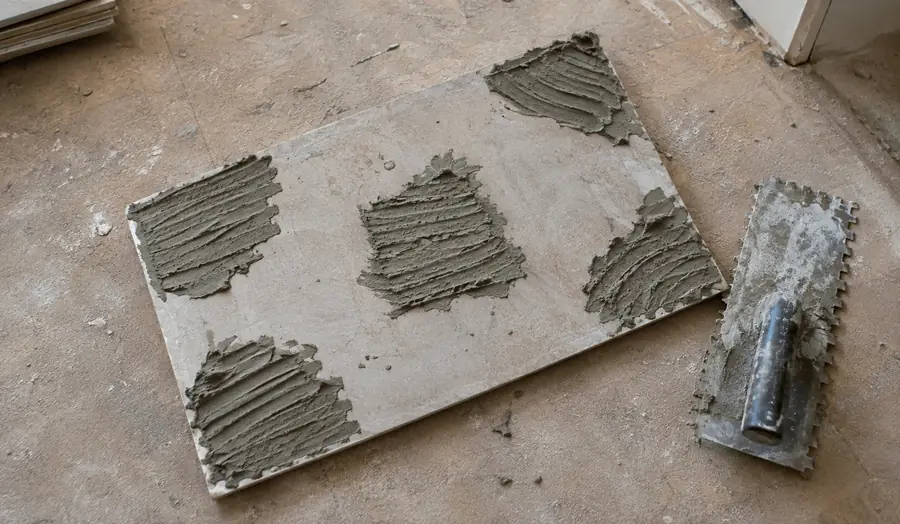
The failure mode even has a nickname: spot bonding, or the five dab method: a scoop of mortar at each corner and one in the middle. It sets fast and feels solid. It also leaves the middle of every tile hollow, and hollow tiles crack under a table leg or a dropped pan.
Ask your installer to pull one tile mid-job and show you the back. It takes two minutes, the tile goes right back down, and it tells you more about the quality of the tile flooring installation than any photo gallery will.
5. Wrong trowel, wrong mortar for the tile size
Trowel size scales with tile size. A 1/4 x 1/4 inch square notch that works fine for 6-inch tile leaves nowhere near enough mortar under a 12×24. Large-format tile typically calls for a 1/2 inch square notch or a euro-notch, plus back-buttering.
Mortar matters just as much. Standard thin-set shrinks as it cures and cannot hold a large tile at the right height. Large-and-heavy-tile mortar, still called medium-bed by a lot of crews, is formulated to resist that sag.
One more detail most homeowners never see: ridges should be troweled in straight parallel lines, all in one direction, then flattened as each tile is set and moved perpendicular to those ridges. Swirled, circular ridges trap air pockets that never fill.
6. No movement joints anywhere in the floor
Tile needs somewhere to go. The TCNA Handbook detail EJ171 sets the spacing: interior floors generally get a movement joint every 20 to 25 feet in each direction, dropping to 12 feet where the floor is exposed to direct sunlight or moisture or sits on an above-ground slab, and to 8 to 12 feet outdoors.
Just as important, and far more often skipped in homes: a soft joint wherever tile meets a restraining surface: perimeter walls, columns, thresholds, tub aprons, pipe penetrations. That perimeter gap is filled with sealant, not grout, and it disappears under the baseboard and shoe molding.
And if the slab has a control joint, it has to carry up through the tile. Grouting over a control joint guarantees a crack directly above it.
7. Grouted too soon, walked on too soon
Mortar cure times are longer than most weekend schedules allow. In most cases you want a full 24 hours before grouting, and longer in cold or humid conditions, over a membrane, or under large non-porous tile, which traps moisture and slows the cure underneath.
After grouting, light foot traffic is typically fine at 24 hours, but heavy loads such as appliances, a vanity or furniture on casters should wait around 72 hours. Rolling a refrigerator across a floor grouted the night before is a reliable way to crack the tile it passes over.
If a contractor promises tile down and fully in service the same day, ask what product they are using and why. Rapid-set mortars exist and are legitimate, but they should be a deliberate choice rather than an afterthought.
8. The wrong underlayment under the tile
Tile does not belong directly over particleboard, luan, hardboard or cushioned sheet vinyl. Those surfaces move with humidity, crush under load, or offer no reliable bond.
A wood-framed floor typically wants at least 1-1/8 inches of total subfloor thickness, usually a 5/8 or 3/4 inch structural subfloor plus 1/2 inch cement backer board or an approved membrane, following the manufacturer’s own instructions.
A misconception worth clearing up: cement backer board does not add stiffness and is not waterproof. It gives mortar a stable, dimensionally consistent surface to bond to. That is all. If the floor bounces, backer board will not save it, and if the room is wet you still need a waterproofing membrane over it.
9. The wrong tile specified for the room
Wall tile is thinner and softer than floor tile, and it cracks when used underfoot. Floor tile should carry a wear rating suited to the traffic, and for level interior areas likely to get wet, ANSI A137.1 sets a wet dynamic coefficient of friction of at least 0.42, the slip resistance number worth asking about for a bathroom or an entry.
Layout matters too. Large-format tile is manufactured with a slight crown along its length, so a running bond offset by a full 50% pushes the high center of one tile against the low end of the next and creates lippage. Industry guidance now caps the offset at roughly 33% for tile with any edge over 15 inches unless the manufacturer says otherwise. Plenty of otherwise sound installations are spoiled by a brick pattern that looked right on paper.
Repair or replace? What cracked tile usually costs
Cost depends entirely on whether the cause sits at the surface or below it, and a tile flooring installation quote that leaves out the prep is the usual reason two bids differ so much. Nationally, installing tile flooring averages around $1,900, with most projects landing between $800 and $3,000, according to Angi’s 2026 cost data.
| Situation | What it usually involves | Typical cost |
|---|---|---|
| One or two cracked tiles, sound floor around them | Cut out, re-set, color-match grout | Usually a minimum service call plus materials |
| Hollow or drummy tiles in one area | Remove the section, re-set with full coverage | Labor typically $3 to $15 per sq ft |
| Cracks tracking a slab crack | Tear-out, crack isolation membrane, reinstall | Add removal at roughly $5 per sq ft |
| Uneven or dipped subfloor | Floor leveling before any tile goes down | Typically $2 to $30 per sq ft |
| Failed or rotted subfloor | Structural repair or replacement | Typically $40 to $65 per sq ft |
Two things worth being honest about. Color-matching a discontinued tile is often impossible, which is why a box of attic stock is the cheapest insurance in the house. And if the cause is structural, a spot repair is a temporary patch, and you are paying twice.
When DIY tile flooring installation makes sense
Small, square, small-format, on a concrete slab and not a wet area, such as a powder room, a laundry or a mudroom, is a fair DIY project for a patient person with a wet saw and a weekend.
Hire out anything with these conditions:
- Large-format or natural stone tile, where flatness tolerance and mortar coverage get unforgiving
- A wood-framed second floor, or any floor that moves when you walk it
- A shower or bathroom floor that needs waterproofing tied into the drain
- Radiant heat under the tile
- A floor that has already cracked once
Run the numbers before you commit. A wet saw rental, a 10-foot straightedge, self-leveler, membrane and the right mortar add up quickly on a 40 square foot room, sometimes to more than the labor you were trying to save.
What to ask before you hire
The answers to these separate a real tile contractor from a general handyman, and they are worth asking whether you found the company through a referral or a floor installation near me search:
- What flatness tolerance will you hold, and how will you correct the subfloor to get there?
- Which membrane are you using, and is it included in the quoted price?
- Where will the movement joints and perimeter soft joints go?
- What mortar and trowel size are you using for this tile size?
- Will you pull a tile mid-job so I can see the mortar coverage?
- What is the warranty, in writing, if the floor cracks in eighteen months?
- Are you licensed and insured in my state?
That last one matters more than people expect. Virginia, Maryland and DC each license separately, and plenty of floor repair contractors near me searches surface crews licensed in only one of the three.
Commercial tile installation follows different rules
Commercial tile installation is a different specification, not just a bigger version of a residential job. Traffic loads, cleaning chemicals, thermal shock and health code all change what the assembly has to do.
Commercial quarry tile installation in a restaurant kitchen is the clearest example. It is typically set in a thick-bed mortar over a sloped, waterproofed deck, with a coved base at the walls and epoxy grout rather than cement grout. Cement grout breaks down under grease, boiling water and daily sanitizer. The failure shows up first as grout washout around the fryer and the drains, then as loose tile.
Commercial flooring restoration is worth pricing before demolition. If the tile is sound and the substrate is stable, deep cleaning, grout removal and replacement, and resealing can recover a floor for a fraction of a tear-out, and without closing the space for a week.
Where FIXO fits
Local building stock shapes the risk. DC and Alexandria rowhouses often carry three or four layers of old flooring over undersized joists. Bethesda and Silver Spring basements sit below grade, where slab moisture drives efflorescence and bond failure if the slab is not tested first. And the region’s swing from humid summers to dry winter heating puts real movement through every floor, which is exactly why perimeter joints matter here.
At FIXO DMV we install tile across Northern Virginia, Maryland and DC, and the subfloor assessment happens before the price is fixed, not as a change order halfway through. Washington DC tile flooring jobs and bathroom tile installation in Gaithersburg MD get the same four checks: flatness, deflection, moisture, and a plan for where the floor is allowed to move.
If you are comparing quotes from a bathroom floor tile installation near me search, ask each company how they handle those four things. The answers will sort the list quickly.
Ready to price a floor? Our tile flooring installation service covers porcelain, ceramic and stone across the DMV, and the estimator gives you a fixed installed price in about a minute with removal included. Not sure whether yours is a repair or a replacement? Send us a photo. That one is usually answerable without a visit. If you want the process first, how it works walks through measurement, materials and install day.
Related reading: floor repair or replace if the damage is already done, and flooring installation in Washington DC if you are in the District.
Tile flooring installation questions, answered
Why did my tile crack in a straight line across the floor?
A straight crack that runs through several tiles and continues through the grout points to substrate movement: a crack in the slab below, a control joint that was grouted over, or a deflecting wood floor. The tile is following something underneath it. Replacing the tiles without addressing the cause will produce the same crack again, usually within a year or two.
Can you replace one cracked tile without redoing the whole floor?
Yes, if the surrounding tile is well bonded and the cause was impact rather than movement. The tile is scored, broken out, the mortar bed is cleaned back to the substrate, and a matching tile is set and grouted. The two catches are color-matching a tile that may be discontinued, and grout that has aged differently from the new joint.
How long after tile flooring installation can you walk on the floor?
In most cases, wait 24 hours after grouting for light foot traffic and about 72 hours before moving appliances or heavy furniture across it. The mortar under the tile usually needs a full 24 hours before grouting, and longer in cold or humid conditions or under large non-porous tile that slows the cure.
Do I need an uncoupling membrane over a concrete slab?
It is strongly recommended on any slab with existing cracks, on above-grade concrete, and under large-format or natural stone tile. The membrane lets the tile move independently of the slab so shrinkage cracks do not telegraph up. It will not fix an active structural crack or a settling foundation, which need repair before tile goes down.
Does cement backer board stop tile from cracking?
No. Backer board gives mortar a stable, dimensionally consistent surface to bond to, but it adds essentially no stiffness and it is not waterproof. A floor that deflects will still crack tile with backer board over it. Structural rigidity comes from the joists and subfloor; waterproofing comes from a separate membrane.
How much does it cost to fix cracked floor tile?
A few isolated tiles usually fall under a contractor’s minimum service call plus materials. Larger repairs are priced by area: tile labor typically runs $3 to $15 per square foot, with old tile removal adding around $5 per square foot and floor leveling from $2 to $30 per square foot, depending on how far out of tolerance the subfloor is.
Is 12×24 tile more likely to crack than smaller tile?
It is less forgiving, not inherently weaker. Large-format tile demands a flatter substrate at 1/8 inch in 10 feet, more mortar coverage, back-buttering, and an offset of about 33% rather than a 50% brick pattern. Meet those conditions and it performs well. Skip them and the tile spans voids and cracks. Installation standards from the Tile Council of North America and the flatness guidance published by the Ceramic Tile Education Foundation are the primary sources worth reading before you sign anything.
 4.9 on Google14 reviews
 Licensed & InsuredVirginia · Maryland · Washington, D.C.
 Workmanship GuaranteedInstallation backed in writing
 Locally OwnedServing NoVA, MD & D.C.