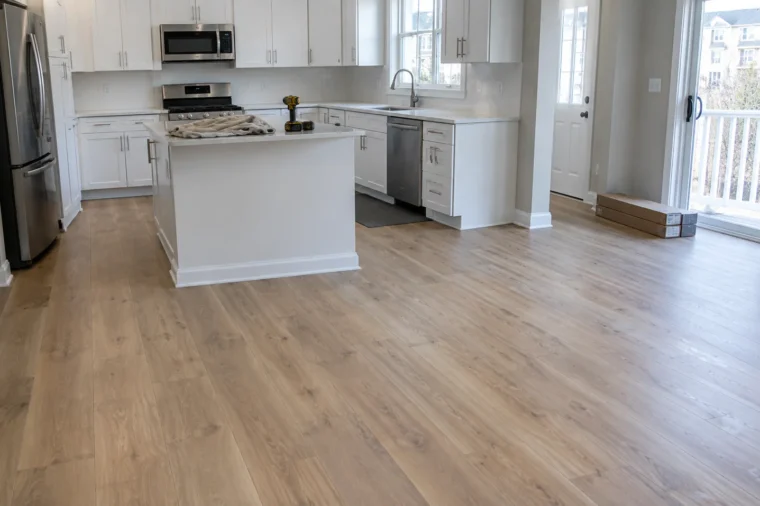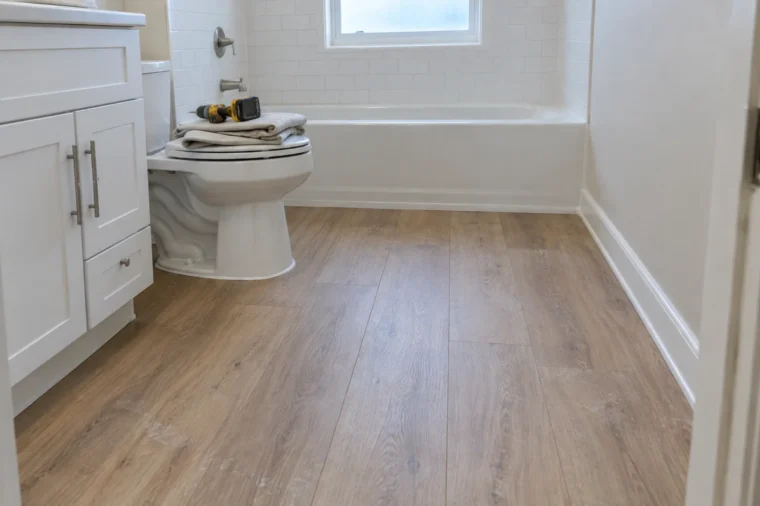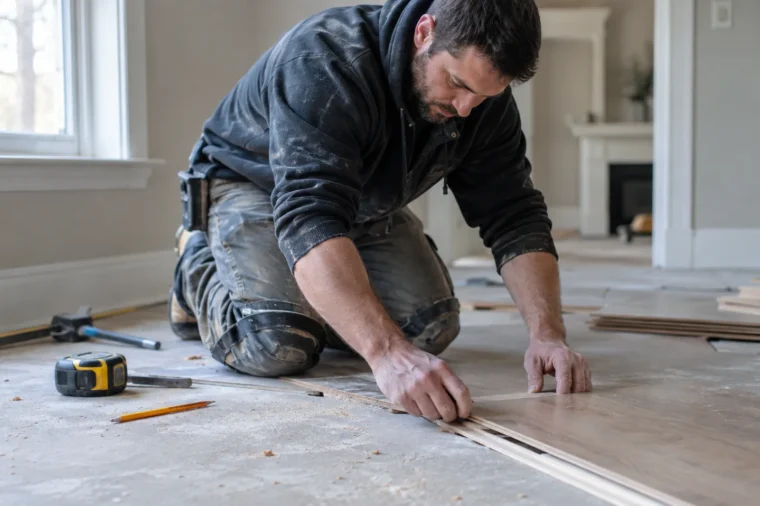
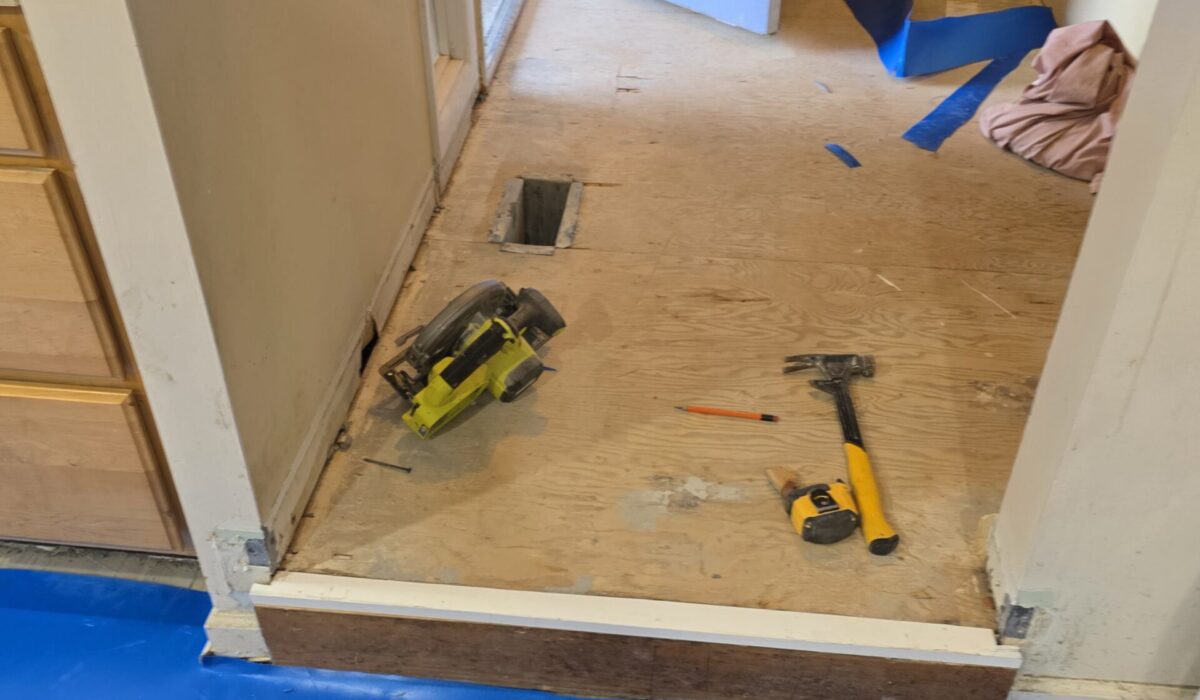
No. Almost no laminate flooring is waterproof, and the ones marketed that way are making a much narrower promise than the word suggests. This matters in the DMV, where half the housing stock has a below-grade level and summer humidity sits in the seventies for months. Here is what the labels actually mean, what happens to a laminate floor when water gets in, and where laminate is the right call anyway.
Is laminate flooring waterproof, or only water-resistant?
Asking is laminate flooring waterproof gets a straight answer: no, not in the way the word is normally understood. Almost every product sold as waterproof laminate is waterproof at the surface and along a sealed edge for a stated number of hours, typically 24 to 72. The core underneath is high-density fibreboard, and fibreboard swells irreversibly once water reaches it. So the honest answer to is laminate flooring waterproof depends on where the water comes from: a wiped-up spill is a non-event, while a dishwasher leak overnight or vapour rising through a basement slab will destroy the floor from underneath regardless of the surface claim.
Is laminate flooring waterproof, or water-resistant?
Laminate is a sandwich: a printed decorative layer under a clear melamine wear layer, bonded to a core of high-density fibreboard — compressed wood fibre and resin. That core is the whole story. Wood fibre swells when it absorbs water, and unlike solid wood it does not shrink back when it dries. The swelling is permanent.
| Label | What it usually means | What it does not mean |
|---|---|---|
| Water-resistant | Surface spills can sit for a stated window — often 24 to 72 hours — before damage, if wiped up | That the plank can be wet on the underside, or that the seams are sealed |
| Waterproof laminate | A treated or wax-sealed core plus tighter joints, warranted against topical water for a stated period | Immersion, standing water, or water arriving from below through a slab |
| Waterproof (LVP / SPC) | The core is plastic or stone composite and does not absorb water at all | That the room is protected — the subfloor beneath can still hold moisture |
Read any laminate warranty closely and you will usually find the same three exclusions: standing water, moisture from the subfloor, and damage from appliance or plumbing failure. Those three are precisely the events people mean when they ask whether a floor is waterproof.
What failure actually looks like
Water almost never enters through the face of a laminate plank. It goes down the seam, reaches the exposed fibreboard edge, and wicks along it. What you see next, in order:
- Edge swelling within hours. The plank edge lifts a fraction of a millimetre, and the joint stops being flush. You feel it barefoot before you see it.
- Peaking within days. The swollen edges push against each other and the row lifts.
- Delamination. The decorative layer separates from the core and the printed surface chips at the seam.
None of it reverses. There is no sanding, drying or refinishing a laminate plank — the repair is replacement, and because click-lock rows interlock, replacing a plank in the middle of a room means unclicking back to it or cutting it out and gluing the replacement in. If you are weighing a patch against pulling the whole floor, our guide on how to tell whether a floor needs repair or replacing walks through the checks we make.
The 30-minute rule
If you have laminate and something spills, the useful mental model is not “how long can this sit?” but “get it up now”. A wiped spill is a non-event. The same spill left under a dog bowl or a plant pot for a week is a replaced plank.
The DMV problem: basements and slabs
Northern Virginia, Montgomery County and DC row houses share a specific condition: a concrete slab that is in contact with soil, and soil that holds water. Concrete is not a moisture barrier. It moves vapour upward continuously, and the drier the air above it, the harder it pushes.
That vapour reaches the underside of a floating floor, where there is no wear layer, no melamine and no seal — just exposed fibreboard. A laminate floor in a basement can fail without a single spill ever landing on it. This is why any laminate or LVP over concrete needs a moisture test first and a 6 mil vapour retarder second, and why we generally steer people away from laminate below grade entirely. There is more on what does work down there in waterproof basement flooring.
Humidity, not just water
Laminate expands and contracts with the seasons like any wood-based product. A DMV summer at 70% indoor relative humidity followed by a January at 25% with the heat running is a big swing. Two consequences worth knowing:
- The expansion gap is structural. A floating floor needs roughly 1/4 in to 3/8 in of clearance at every wall, pipe and door frame. If it is filled with trim nailed through the plank, or with grout, or with a bead of construction adhesive, the floor has nowhere to go and it will peak in August.
- Acclimation is real. Cartons need 48 hours in the room they will live in, at normal living temperature, before installation. Flooring delivered from a cold truck and laid the same morning will move afterwards.
Where laminate is genuinely the right choice
All of the above is a description of one weakness, not a verdict. Laminate is a strong material in the right room:
- Bedrooms, living rooms, hallways, stairs, offices — above grade, no plumbing, no exterior door.
- Households with dogs. An AC4 or AC5 laminate wear layer resists scratching better than most luxury vinyl and better than any site-finished hardwood.
- Realistic wood look on a budget. Modern embossed-in-register laminate reads as wood at a price LVP does not match.
- Underfoot feel. A 12 mm laminate over a good pad sounds and feels more solid than a 5 mm vinyl plank.
Where to choose something else
| Room | Laminate? | Better option |
|---|---|---|
| Finished basement | No | Rigid core LVP over a vapour barrier, or tile |
| Full bathroom | No | Porcelain tile |
| Powder room | Only with a waterproof-core product | LVP or tile |
| Kitchen | Yes, with an AC4+ water-resistant core | LVP if you have had a leak before |
| Laundry / mud room | No | LVP or tile |
| Above-grade bedrooms and living areas | Yes | — |
Making a laminate floor last
- Damp-mop, never wet-mop. No steam mops — heat plus water at a seam is the worst possible combination.
- Seal the perimeter in wet-adjacent rooms with a flexible silicone bead behind the baseboard, which still allows movement.
- Put a tray under plant pots and a mat under the dog bowl. Both are slow leaks by another name.
- Fix an appliance drip the week you notice it, not the month.
- Keep indoor humidity between roughly 35% and 55% year round — good for the floor, good for the doors, good for you.
Is laminate flooring waterproof enough for your room?
If water is the reason you are hesitating, the honest answer is usually rigid core luxury vinyl rather than a laminate with a waterproof sticker. We put the three materials side by side in LVP vs laminate vs engineered hardwood, and you can see specifications and pricing for what we install on the laminate and LVP pages. For a fixed installed price on your own rooms, the estimator takes about a minute.
Is laminate flooring waterproof? Common questions
Is waterproof laminate a marketing term?
Largely. It describes surface and edge performance for a stated exposure window, not the fibreboard core, which is why the rating is quoted in hours.
Can laminate go in a bathroom?
A powder room with no shower is defensible. A full bathroom is not, because standing water reaches the core through expansion gaps at the perimeter.
What happens when the core gets wet?
The board swells at the joints and peaks, and it does not recover on drying. Industry test methods used by NALFA measure swelling and surface wear separately, which is exactly why the two claims differ. Where the moisture rises from a slab, the US EPA moisture guidance applies before any floor goes down.
 4.9 on Google14 reviews
 Licensed & InsuredVirginia · Maryland · Washington, D.C.
 Workmanship GuaranteedInstallation backed in writing
 Locally OwnedServing NoVA, MD & D.C.