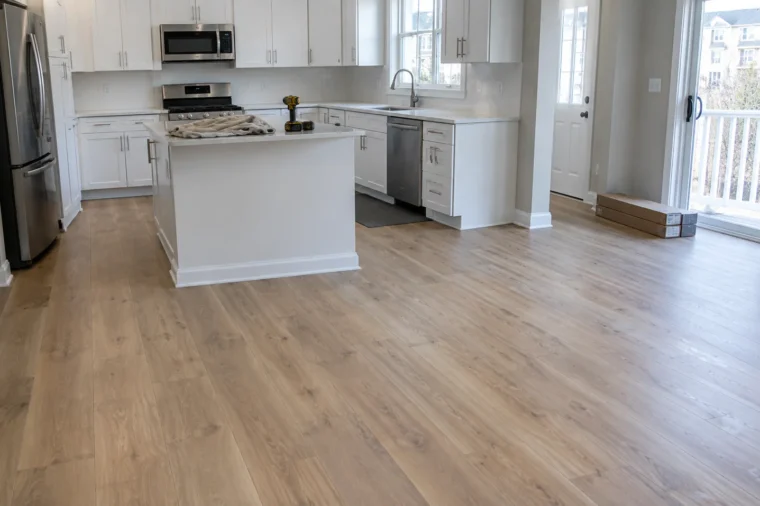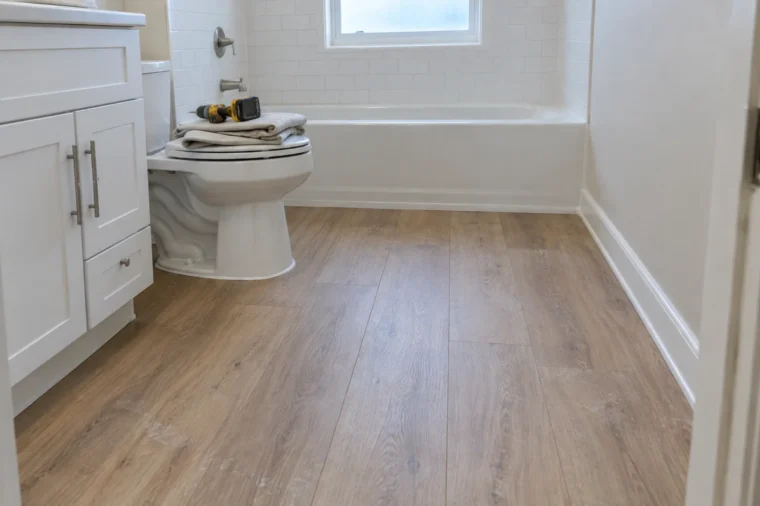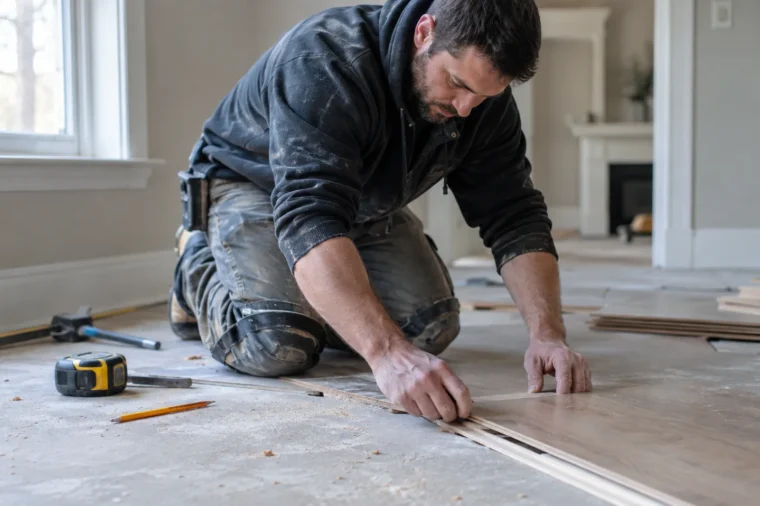
Three materials, three completely different products, and showroom samples that all look like oak. The choice is easier than it seems once you stop comparing looks and start comparing what each one is made of — because that is what decides where it can go, how long it lasts and what happens when something spills.
LVP vs laminate: which should you actually choose?
The LVP vs laminate decision comes down to what the core is made of. LVP has a plastic core that does not swell when water reaches it, so it survives basements, bathrooms and laundry rooms. Laminate has a fibreboard core that swells permanently once water gets past the seal, but it is harder underfoot and usually renders wood grain more convincingly. In practice the LVP vs laminate choice is settled by the room rather than by preference: below grade or anywhere with a plumbing fixture, choose LVP; on dry main levels and bedrooms where realism and scratch resistance matter more than water, laminate is the better floor for the money.
LVP vs laminate: what they actually are
| Luxury vinyl plank | Laminate | Engineered hardwood | |
|---|---|---|---|
| Surface | Printed film + clear urethane wear layer | Printed paper + melamine wear layer | Real wood veneer, 0.6–6 mm |
| Core | Plastic (WPC) or stone composite (SPC) | High-density fibreboard | Plywood or HDF |
| Water | Core is unaffected | Core swells permanently | Tolerates humidity, not standing water |
| Refinish? | No | No | Once or twice, if the veneer is thick |
| Typical life | 15–25 years | 15–25 years | 30–60 years |
| Typical installed | $4–$9 /sq ft | $4–$8 /sq ft | $9–$16 /sq ft |
| Resale effect | Neutral to positive | Neutral | Positive |
Ranges are typical Washington DC metro market ranges, not FIXO quotes.
The one number that matters in each
Every category has a single specification that predicts how the floor will look in five years. Salespeople rarely lead with it.
- LVP: wear layer in mils. 6–8 mil is rental grade. 12 mil is a quiet household. 20 mil is the number to want in a family home with a dog and a hallway. The photograph underneath costs nothing to change; the wear layer is what you are actually buying.
- Laminate: AC rating. An abrasion class from AC1 to AC5. AC3 is the residential minimum, AC4 is right for a main level, AC5 for heavy traffic. Millimetre thickness buys underfoot feel and sound, not durability — a thick AC3 will wear out before a thin AC5.
- Engineered hardwood: veneer thickness. Under 2 mm cannot be sanded, and is a wood-look floor with a wood price. 3 mm or more can be refinished at least once, which is the whole argument for the category.
LVP vs laminate, room by room
| Room | First choice | Why |
|---|---|---|
| Finished basement | Rigid core LVP | Slab vapour rules out anything wood-based |
| Kitchen | LVP | Appliance leaks are a question of when |
| Main-level living and dining | Engineered hardwood | Where the resale and the feel are worth paying for |
| Bedrooms and upstairs hall | Laminate | Dry, above grade — the best value in the house |
| Stairs | Engineered hardwood or laminate | Matched treads and nosings, hard-wearing |
| Full bathroom / laundry | Tile | The only genuinely wet-rated option |
| Rental turnover | Mid-grade LVP | Replaceable plank by plank between tenants |
Choose by household
Dogs. A laminate AC5 wear layer resists claw scratching better than most LVP, and both beat site-finished hardwood by a distance. But dogs also bring water — bowls, wet paws, accidents — which pushes the answer back toward LVP in any room where that happens. Pick per room, not per house.
Small children. LVP and laminate both handle spills; LVP handles them for longer before anyone notices. LVP is also softer and quieter underfoot than laminate over the same pad.
Selling in two or three years. Engineered hardwood on the main level still moves buyers in Arlington, McLean and Bethesda in a way vinyl does not. Elsewhere in the house, a good LVP is unremarkable in the right way.
Staying twenty years. Engineered hardwood is the only one of the three you can sand and start over. Amortised across that time it is often the cheaper floor, not the dearer one.
Sound-sensitive condo. Buildings in DC, Arlington and Bethesda often mandate a minimum IIC rating. Check the building rules before you fall in love with a product — the underlayment specification is usually not negotiable.
The mistake worth avoiding
Choosing one material for the whole house because it is simpler. A main level in engineered hardwood, a basement in rigid core LVP and bedrooms in laminate is a common, sensible specification — each room gets what suits it, and the transitions are three strips of trim.
What none of them fix
All three are floating or glued over whatever is already there, and none of them corrects a subfloor. Flatness within roughly 3/16 in over 10 ft, no deflection underfoot, and a tested slab below grade — those conditions decide whether any of these floors lasts. A premium plank on a bad subfloor will fail before a budget plank on a good one. If the floor you have now is failing, start by deciding between a repair and a replacement.
LVP vs laminate: straight recommendations
- One material, whole house, best value: 20 mil rigid core LVP.
- Best floor per dollar in dry rooms: 12 mm AC4 laminate.
- Best long-term asset: engineered hardwood with a 3 mm+ veneer, main level only.
- Below grade: rigid core LVP or tile. Nothing else.
- Wet rooms: porcelain tile.
See the numbers for your rooms
Full specifications for what we install are on the LVP, laminate, engineered hardwood and tile pages. For a fixed installed price on LVP or laminate, the estimator takes about a minute — hardwood and tile are quoted at the measurement, because the subfloor work varies too much to promise a number before we have seen it.
Related reading: what LVP installation costs, is laminate waterproof?, and basement flooring that lasts.
LVP vs laminate questions
Is LVP or laminate better for a basement?
LVP, without qualification. Its core is plastic, so standing water does not cause irreversible swelling the way it does in laminate fibreboard.
Which feels better underfoot?
Laminate is harder and quieter with good underlayment, while LVP is softer and warmer. Thicker LVP with an attached pad narrows the gap noticeably.
Does either compare to engineered hardwood?
Neither refinishes. Engineered hardwood can be sanded once or twice depending on wear layer thickness, which is why the National Wood Flooring Association treats wear layer as the specification that determines a wood floor lifespan.
 4.9 on Google14 reviews
 Licensed & InsuredVirginia · Maryland · Washington, D.C.
 Workmanship GuaranteedInstallation backed in writing
 Locally OwnedServing NoVA, MD & D.C.