Somewhere between one scratched plank and a floor that squeaks in four rooms, repairing stops being the sensible option. Most people ask the question too late, after paying for two patch jobs that a replacement would have made unnecessary. Here is how to tell which side of the line you are on, room by room and material by material.
Do you need a floor repair or a replacement?
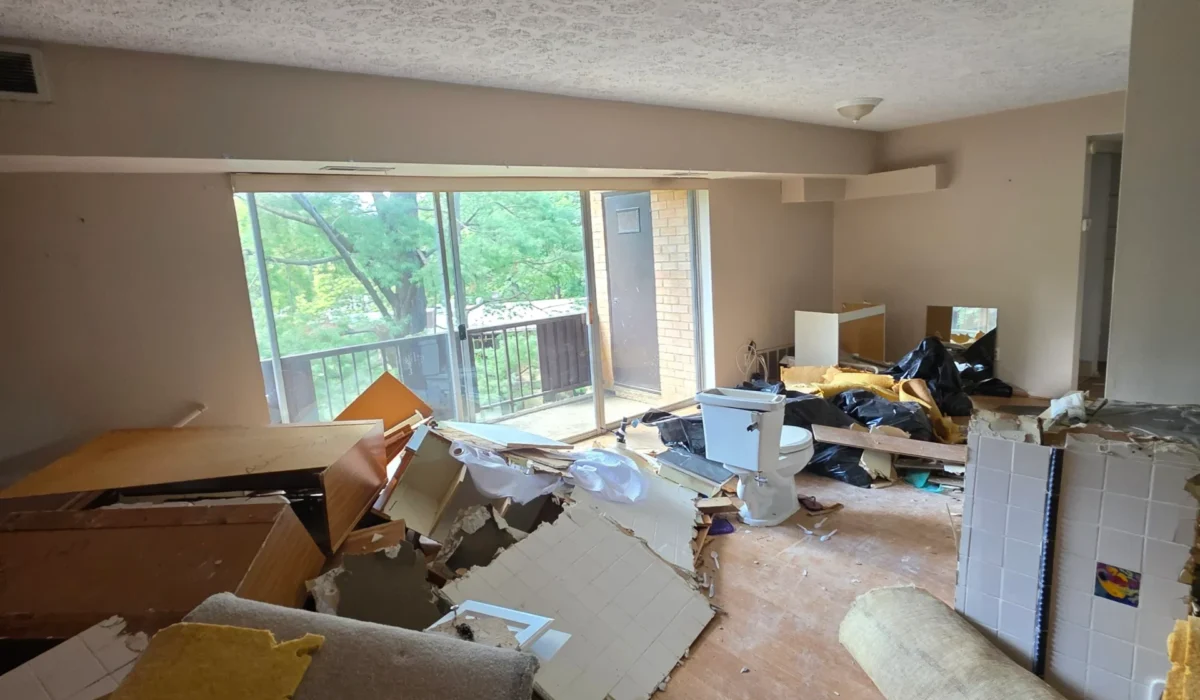
A floor repair is the right call when four things are true at once: the damage sits in one area rather than scattered across the room, the cause has stopped, matching material is still available, and the subfloor underneath is sound. Replace instead when the subfloor itself has failed, when damage covers more than roughly 25% of the room, when the material is discontinued, or when a hardwood floor has already been sanded close to its fasteners. The useful rule of thumb: a floor repair costing more than about 40% of a full replacement is rarely the better spend, because you pay for the same disruption twice and finish with an older floor.
The quick test
Repair is usually right when all four of these are true:
- The damage is in one place, not scattered across the floor.
- The cause has stopped — the leak is fixed, the dog has grown up, the chair now has felt pads.
- You can get matching material, or the area is visually separate enough that a slight mismatch will not read as a patch.
- The subfloor underneath is sound.
Replace when any of these are true:
- The problem is the subfloor — movement, rot, a failed slab. Whatever goes on top of it will fail the same way.
- Damage covers more than roughly 25% of the room, or appears in several rooms.
- The material is discontinued and nothing close is available.
- Hardwood has already been sanded to the point where the nails are close to the surface.
- You would replace it within about three years anyway for looks.
The honest arithmetic
A repair that costs more than about 40% of a replacement, on a floor you do not love, is rarely the better spend. You end up paying twice for the same disruption — furniture out, dust, a crew in the house — and finishing with an older floor.
Floor repair diagnosis, symptom by symptom
Squeaks and movement
A squeak is friction: a board against a fastener, or a subfloor panel against a joist. If it is one spot, it is usually a fastener and a repair is straightforward. If a whole area feels springy underfoot, the subfloor is deflecting — too-thin panels, joists at wide spacing, or a failed panel edge. Laying a new floor on top of that reproduces the bounce and, with click-lock plank, eventually unclicks the joints. Fix the structure first, whatever the finish.
Cupping and crowning in wood
Cupped boards (edges high, centre low) mean the underside is wetter than the top — a crawlspace, a slab, a slow leak. Crowning is the reverse, and it is often what you get after sanding a cupped floor that had not finished drying. Neither is a flooring problem in the first instance. Find the moisture, correct it, give the floor several weeks, and then see what is left. Sanding a wet floor is money spent twice.
Gaps that open and close
Seasonal gaps in solid hardwood are normal in the DMV: dry winter air shrinks boards, summer humidity closes them again. Gaps that persist through August, or that keep widening year on year, mean something else — usually humidity swinging far outside 35–55%, or a floor that was installed without acclimation.
Swollen or peaked laminate
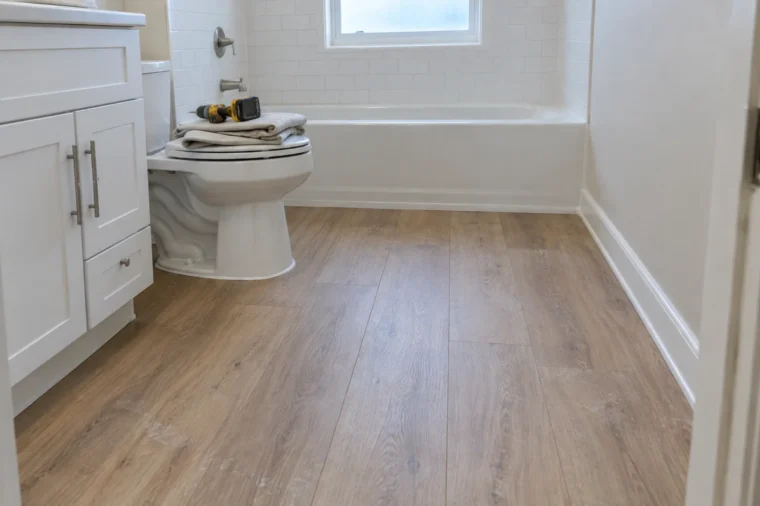
Not repairable in place. Fibreboard swelling is permanent. A single plank can be cut out and glued in; a peaked row means the expansion gap has been lost and the perimeter needs opening up, which is a partial re-lay. If several planks have gone, the water source is still there — find it before touching the floor.
Cracked or hollow tile
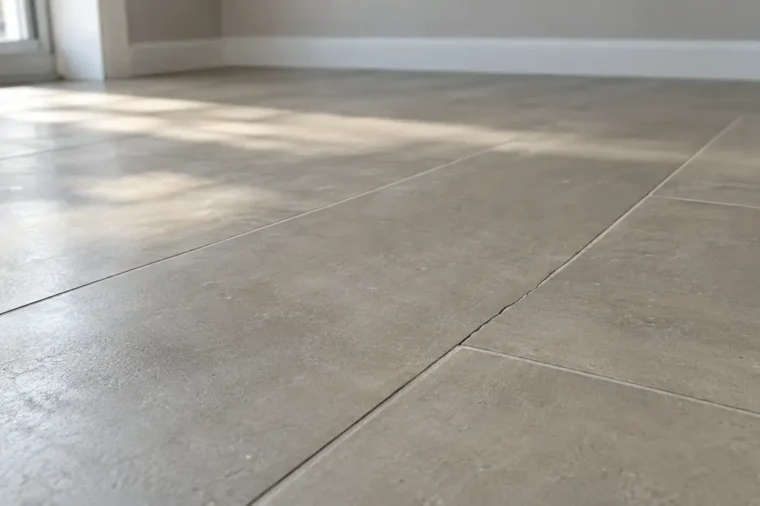
Tap across the floor. A hollow ring means the tile has debonded from the substrate. One or two, from a dropped pan, is a replacement-tile job. A hollow pattern following a line, or cracks running through several tiles in a straight run, usually means substrate movement — and every replacement tile will crack in the same place. That is a tear-out with an uncoupling membrane, not a repair. Our tile flooring page covers how that assembly is built.
Scratches and worn finish
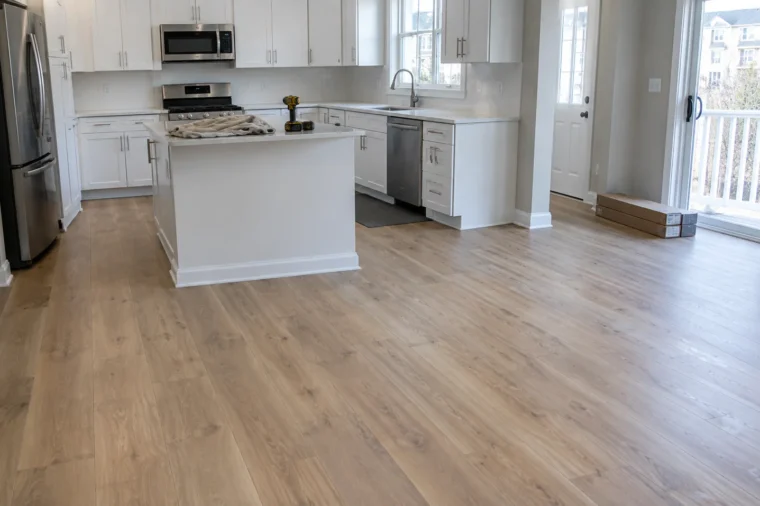
On hardwood, this is the best case: a screen-and-recoat refreshes a whole floor for a fraction of a sand-and-finish, provided the wear has not gone through to bare wood. On laminate and LVP there is no refinishing — the wear layer is the product. Damaged planks are swapped.
What does a floor repair cost?
| Job | Typical range | Worth it when |
|---|---|---|
| Replace a few click-lock planks | $250–$600 call-out | Damage is local and you kept spare material |
| Re-secure a squeaky area | $200–$500 | Point squeaks, sound subfloor |
| Replace cracked tiles | $200–$500 plus tile | Impact damage, no substrate movement |
| Screen and recoat hardwood | $1.50–$3.00 /sq ft | Finish worn, wood not exposed |
| Sand and refinish hardwood | $4.00–$8.00 /sq ft | Enough thickness left, floor worth keeping |
| Replace the floor | $5.00–$12.00 /sq ft | Subfloor work needed, or damage is widespread |
Typical DC-metro market ranges, not FIXO quotes. Small repairs carry a minimum call-out, which is why a $180 patch is rarely $180.
Why a floor repair rarely matches perfectly
The reason repairs disappoint is rarely workmanship. It is that flooring is manufactured in batches, and batches differ. A plank from a new run of the same product name will often be a shade off, and the floor around it has been fading and wearing for years besides. Three things help:
- Take the replacement from a closet or under an appliance, and put the new plank there instead, where nobody looks.
- Stop at a doorway. Replacing a whole room and terminating at a transition strip always reads better than a patch in the middle of a run.
- Keep spares. Two or three cartons in the basement is the cheapest insurance in the house.
Where FIXO fits
We are a flooring installation company. Where we are useful is the replacement side: pulling out a failed floor, correcting the subfloor properly, and installing LVP, laminate, engineered hardwood or tile at a fixed price. Small cosmetic repairs — one squeaky board, a chipped tile, refinishing an existing hardwood floor — are usually better and more cheaply handled by a specialist refinisher or a good handyman, and we will say so rather than sell you a floor you do not need.
If your diagnosis has landed on replacement, the estimator gives you a fixed installed price for LVP or laminate in about a minute, removal included. If it landed on a subfloor question you are not sure about, send us a photo — that one is usually answerable without a visit.
Related reading: waterproof basement flooring if the damage is below grade, and what LVP installation actually costs if you are pricing a replacement.
Floor repair questions, answered
Is a floor repair cheaper than replacing the floor?
Usually, but not always. A localised floor repair runs roughly $200 to $600 as a call-out, against $5.00 to $12.00 per square foot installed for a replacement. Once a repair passes about 40% of replacement cost, the economics stop favouring it.
Can you repair a swollen laminate floor?
Not in place. Fibreboard swelling is permanent, so a single plank can be cut out and glued in, but a peaked row means the expansion gap has closed and the perimeter has to be reopened, which is a partial re-lay.
Why does a floor repair never match perfectly?
Flooring is manufactured in batches and batches differ in shade, while the floor around the patch has been fading and wearing for years. Taking replacement material from a closet and putting the new plank there instead is the reliable workaround.
Does a squeaky floor need replacing?
A single squeak is friction at one fastener and is a straightforward repair. A whole area that feels springy means the subfloor is deflecting, and any new floor laid over it will reproduce the bounce. Wood-assembly guidance from the National Wood Flooring Association treats subfloor flatness and fastening as prerequisites, not options. Where moisture is the suspected cause, the US EPA moisture guidance is the primary source worth reading before any finish work.
 4.9 on Google14 reviews
 Licensed & InsuredVirginia · Maryland · Washington, D.C.
 Workmanship GuaranteedInstallation backed in writing
 Locally OwnedServing NoVA, MD & D.C.