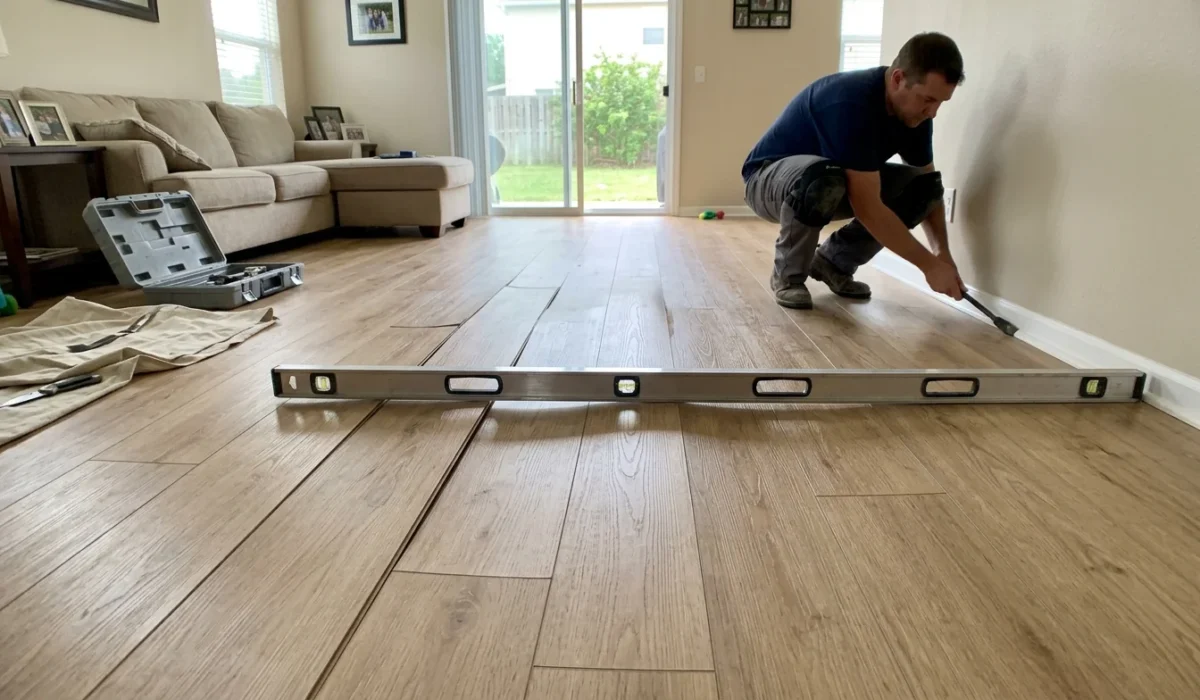
Laminate floor buckling happens when the planks run out of room to expand or when moisture swells the fiberboard core. The floor lifts off the subfloor in a hump or a ridge. If the planks are dry, the fix is to free the floor by restoring the expansion gap. If the planks are swollen from water, they have to be replaced.
Laminate is a floating floor. The planks click to each other and rest on the underlayment without being fastened to the subfloor. That design lets the floor grow in humid weather and shrink in dry weather. Laminate floor buckling starts when something stops that movement or when water gets into the core.
This guide was written by Alvin for FIXO, a flooring installer serving Northern Virginia, Maryland, and Washington D.C. It covers the five causes, how to find yours, what each fix involves, and how to stop the problem from coming back.
In this guide to laminate floor buckling
- What is laminate floor buckling?
- What causes laminate floors to buckle?
- Why is my laminate floor buckling? A 6 step check
- How to fix laminate floor buckling
- Repair or replace a buckled laminate floor?
- Why laminate floor buckling is common in Northern Virginia
- How to prevent laminate floor buckling
- Laminate floor buckling FAQs
Key takeaways
- Laminate floor buckling has five causes: a missing expansion gap, a pinned floor, moisture, an uneven subfloor, and skipped acclimation or humidity swings.
- Location tells you the cause. A buckle at a wall points to the gap. A buckle near an appliance points to water.
- Dry planks under pressure can usually be saved. Swollen planks cannot.
- Pergo’s laminate instructions call for a 3/8 inch expansion space on all sides.
- Most cases trace back to installation day, so a correct installation is the best prevention.
What Is Laminate Floor Buckling?
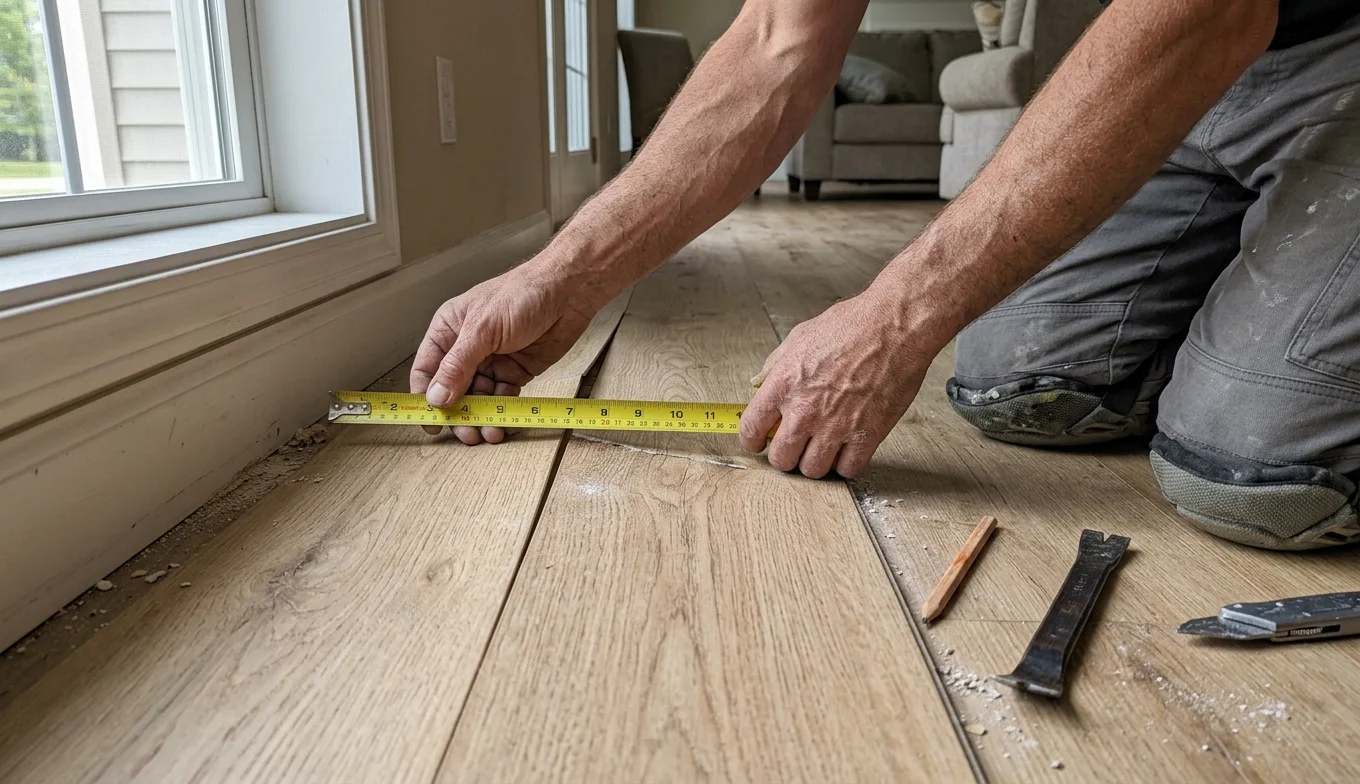
Laminate floor buckling is when planks lift away from the subfloor because the floor is under pressure or the core has swollen. Homeowners describe it in different ways, and each word points to a slightly different problem.
| What you see | Common name | Most likely cause |
|---|---|---|
| A hump where planks have lifted off the subfloor | Buckling | No expansion gap, or a pinned floor |
| A raised ridge where two planks meet | Peaking | Planks pushing against each other |
| A laminate floor bulging upwards in one spot | Buckling or swelling | Pressure, or water under that area |
| Plank edges raised and thicker than the center | Swelling | Water in the fiberboard core |
| A soft blister on the surface of one plank | Bubbling | Water under the wear layer |
| A plank that curves, bows, or rocks | Warping | Moisture on one side, or an uneven subfloor |
| A floor that flexes or moves when walked on | Bouncing | Uneven subfloor, or planks lifted by pressure |
| Seams opening between planks | Gapping or separating | Dry air, or damaged locking joints |
What Causes Laminate Floors to Buckle?
Five causes explain most laminate floor buckling. The first two are installation faults, the third is water, and the last two are about site conditions.
1. No Expansion Gap Around the Room
A missing laminate flooring expansion gap is the best known cause of laminate flooring buckling. The floor needs open space around its full perimeter, hidden under the baseboard or quarter round, so it can expand.
Pergo’s laminate installation instructions call for a 3/8 inch space on all sides, including around pipes and other fixed objects. Mannington’s laminate guide sets a minimum of 5/16 inch at all walls and fixed vertical surfaces.
When the planks touch the drywall, a door jamb, or a fireplace hearth, the floor expands in humid weather and has nowhere to go. It pushes upward, and laminate floor buckling is the result.
2. The Floor Is Pinned Down
A floating floor has to move as one sheet. Pergo’s instructions state that floor movement must not be constrained by glue, nails, screws, hardware, or other fixed obstructions. A pinned floor leads to laminate floor buckling in the same way a missing gap does. Common ways a floor gets pinned:
- Baseboards or quarter round nailed down into the planks
- Door frames that were not undercut, leaving the plank wedged tight
- Transition strips screwed through the laminate
- Kitchen cabinets or an island set on top of the floating floor
- Long runs with no T molding to break them up
T molding rules change by brand. Pergo requires one in rooms 50 feet or larger and in doorways under 32 inches. Mannington requires one past 40 linear feet or 1,600 square feet, and in doorways under 4 feet. Check the guide for your product.
3. Moisture and Water Damage
Water causes a different kind of laminate floor buckling. Laminate has a high density fiberboard (HDF) core, which is a wood product. When it absorbs water it swells, and it does not shrink back when it dries.
Common moisture sources:
- A leaking dishwasher, refrigerator line, or toilet supply line
- Wet mopping or steam mops
- Vapor rising through a concrete slab with no vapor barrier
- A damp basement or crawl space under the floor
Laminate floor swelling starts at the plank edges closest to the water. Our guide on whether laminate flooring is waterproof explains what water resistant and waterproof labels cover.
4. An Uneven Subfloor
Click lock joints are made to sit flat. Over a hump or a dip, the joints flex with each step until they loosen. The planks then rock, peak, or separate, and the floor can feel like it moves when you walk on it.
Pergo allows no more than 3/16 inch of unevenness per 10 foot span. Mannington allows 1/8 inch in 6 feet. Laminate floor buckling in the middle of a room, away from any wall or water source, usually points here.
5. Skipped Acclimation and Humidity Swings
Does laminate flooring need to acclimate? It depends on where the cartons have been. Pergo says no acclimation at the job site is required if the flooring was delivered and stored in normal living conditions. Otherwise the rule is 48 hours at 35% to 65% relative humidity and 60°F to 85°F.
Laminate flooring acclimation matters most when cartons come from a cold truck or a humid garage. Planks installed in that state change size after they are locked together. This is also one reason for laminate flooring bowing up during installation.
The same range applies after the install. Pergo covers climate controlled indoor rooms only, so a home left without air conditioning through a humid summer is at risk of laminate floor buckling.
Why Is My Laminate Floor Buckling? A 6 Step Check
You can narrow down the cause of laminate floor buckling in a few minutes. Work through these steps in order. They cover the basics of troubleshooting laminate flooring before you call an installer.
- Find where it is. At a wall or doorway, suspect the expansion gap or a pinned floor. Next to a dishwasher, sink, or exterior door, suspect water. In the middle of the room with no water source, suspect the subfloor.
- Recall when it started. A buckle that appeared in humid weather and eases in winter is an expansion problem. One that appeared suddenly and keeps growing is usually water.
- Look at the plank edges. Edges that are raised, thicker, or darker than the plank face mean the core is wet.
- Press on the buckle. Soft or spongy means the core has broken down. Firm but raised means the planks are under pressure and may still be sound.
- Check the perimeter. Remove one piece of quarter round near the buckle. If the plank touches the wall, you have found the cause.
- Check what crosses the floor. Look for nails through the planks, transitions that are screwed down, tight door frames, and cabinets sitting on the laminate.
| Where and when | Likely cause |
|---|---|
| Along a wall, worse in humid months | Missing expansion gap |
| At a doorway or under a transition strip | Pinned floor or missing T molding |
| Near the dishwasher, refrigerator, or a bathroom door | Water damage |
| Middle of the room, floor flexes underfoot | Uneven subfloor |
| Whole floor, soon after installation | Acclimation or room conditions |
How to Fix Laminate Floor Buckling
To fix laminate floor buckling, deal with the cause first and the planks second. A repair that skips the cause does not last.
| Cause | The fix | Can the planks be saved? |
|---|---|---|
| Missing expansion gap | Remove the trim, cut the edge planks back to the specified gap, refit the trim | Usually yes |
| Pinned floor | Free the floor: nail trim to the wall, undercut door frames, add a T molding where required | Usually yes |
| Water damage | Stop the leak, let the subfloor dry, replace every swollen plank | No |
| Uneven subfloor | Lift the planks in that area, level the subfloor, relay | Often, if the joints are intact |
| Humidity swings | Return the room to the manufacturer’s range and keep it there | Yes, if the joints held |
How to Fix a Missing Expansion Gap
This is the repair most homeowners can do themselves.
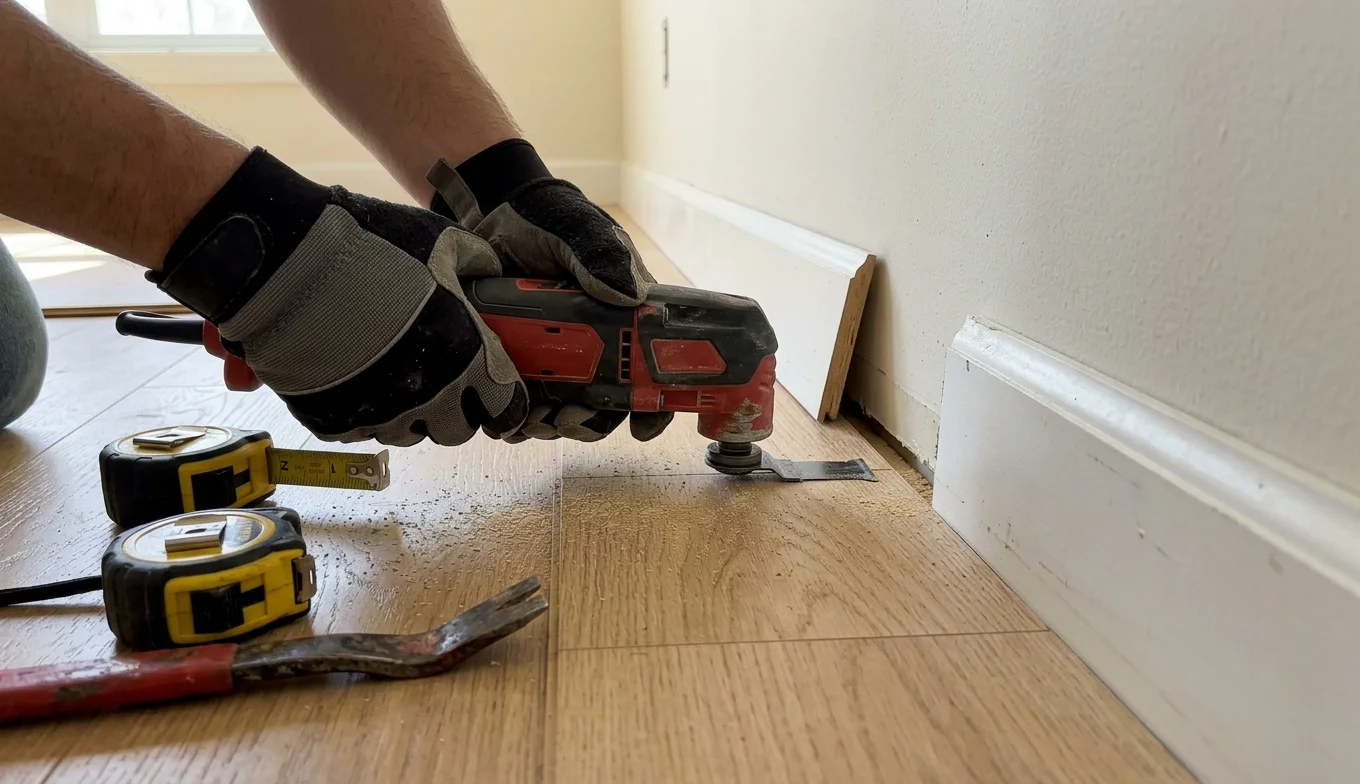
- Remove the baseboard or quarter round along the wall nearest the buckle.
- Mark every plank that touches the wall, a pipe, or a door frame.
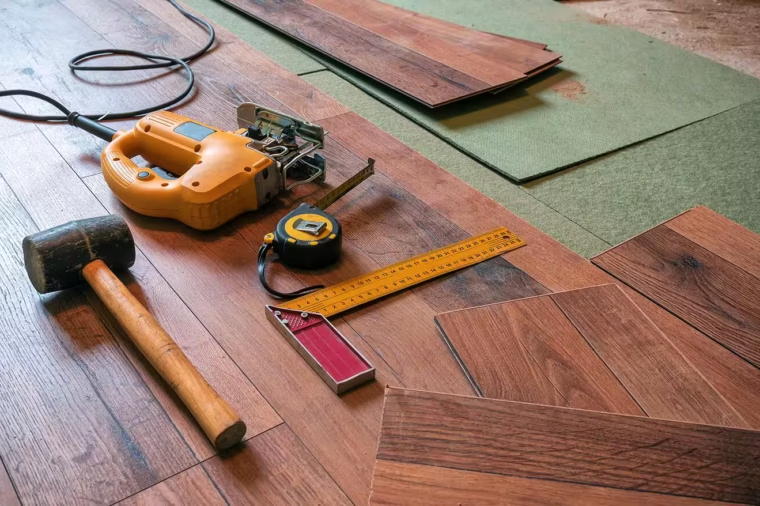
- Cut those planks back with an oscillating multi tool until the gap matches your product’s instructions. For Pergo that is 3/8 inch.
- Check door frames and transition strips along the same run and free anything that is tight.
- Refit the trim. Nail it to the wall, never down into the floor.
How to Fix Laminate Flooring Lifting Due to Water
- Find the source and stop it.
- Lift the affected planks and let the subfloor and underlayment dry fully.
- Replace every plank with swollen edges or a soft core.
- Over concrete, confirm there is a vapor barrier before relaying. Pergo specifies 6 mil polyethylene with seams overlapped 8 inches.
Can you repair swollen laminate flooring without replacing it? No. Swollen fiberboard does not return to its original thickness, and the locking joints no longer close properly.
Will a Buckled Laminate Floor Go Back Down?
Yes, if the planks are dry and the only problem is pressure. Once the gap is restored, the floor relaxes as the room returns to normal humidity. No, if the core has swollen from water. Placing weight on a swollen plank does not flatten it.
Repair or Replace a Buckled Laminate Floor?
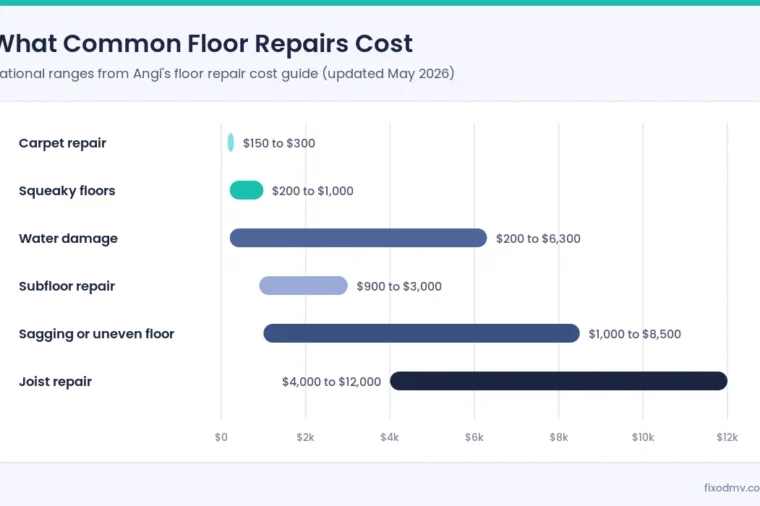
After laminate floor buckling, use these two rules of thumb from our guide on floor repair or replacement:
- Replace the floor if the damage covers more than about 25% of the room.
- Replace it if the repair would cost more than about 40% of a new floor.
Is it expensive to repair laminate flooring? These are typical Washington D.C. metro market ranges, not FIXO quotes:
| Job | Typical range |
|---|---|
| Replacing a few click lock planks | $250 to $600 per visit |
| New laminate, installed | $5 to $9 per sq ft |
Matching is the hidden cost. Laminate cannot be sanded or refinished, and a new carton rarely matches a floor that has aged in sunlight for a few years. Keep your leftover cartons.
Replacement is also the better choice when laminate has buckled in a basement, a full bathroom, or a laundry room. The same failure will return, and waterproof luxury vinyl plank (LVP) suits those rooms better.
Why Laminate Floor Buckling Is Common in Northern Virginia
Northern Virginia works against a floating floor in two ways, and both make laminate floor buckling more likely.
Humid summers and dry, heated winters. A floor here moves between its largest and smallest size every year. A gap that looked adequate in March can be too small in August. That applies from Alexandria and Arlington out to Fairfax, Reston, and Ashburn.
Slabs and finished basements. Many homes in the area have a lower level built on a concrete slab or a finished basement, where moisture moves up through the concrete. Pergo limits concrete to 5 pounds of moisture vapor emission per 1,000 square feet per 24 hours, or 80% relative humidity in the slab. We steer homeowners away from laminate below grade for this reason.
Keep indoor humidity between 35% and 55% all year. That sits inside Pergo’s 35% to 65% range. The U.S. Environmental Protection Agency advises keeping indoor humidity below 60%, ideally between 30% and 50%. A dehumidifier in summer and a humidifier in winter help hold that range.
How to Prevent Laminate Floor Buckling
Most laminate floor buckling is decided on installation day. These are the requirements from two current manufacturer guides.
| Requirement | Pergo laminate | Mannington Charter Collection (2023) |
|---|---|---|
| Expansion gap | 3/8 inch on all sides | 5/16 inch minimum |
| T molding required | Rooms 50 ft or larger; doorways under 32 in | Past 40 linear ft or 1,600 sq ft; doorways under 4 ft |
| Subfloor flatness | 3/16 inch per 10 ft | 1/8 inch in 6 ft |
| Concrete moisture | 5 lbs or less; 80% RH or less | 5 lbs or less; 75% RH or less |
| Room conditions | 35% to 65% RH, 60°F to 85°F | 30% to 65% RH, 65°F to 90°F |
| End joint stagger | At least 12 inches | See guide |
Always follow the instructions that came with your own product. They decide what the warranty covers.
After installation, four habits prevent most laminate flooring problems:
- Clean with a damp, well wrung mop. Pergo’s instructions rule out steamers, jet mops, and floor scrubbers.
- Wipe spills quickly, especially at plank seams.
- Hold indoor humidity in the 35% to 55% range.
- Never nail, screw, or glue anything through the floor.
How FIXO Installs Laminate So It Does Not Buckle
Our laminate flooring installation in Northern Virginia, Maryland, and Washington D.C. is built around the same checks:
- The installer measures your home. The person who checks your subfloor is on the crew that lays the floor.
- Flatness and moisture are checked before you sign. We check the subfloor for flat and look for moisture at the measurement visit.
- Underlayment and a vapor barrier go down where the room calls for them. Our laminate has a 10 mm low swell HDF core, an AC4 wear layer, and a 2 mm pad attached.
- Baseboards come off and go back on. The expansion gap is hidden and the trim is fixed to the wall.
- We say no when laminate is the wrong floor. We will not install it in a bathroom.
Laminate Floor Buckling FAQs
What causes laminate floors to buckle?
Laminate floor buckling has five main causes: no expansion gap at the walls, a floor pinned by trim, door frames, or cabinets, water reaching the fiberboard core, an uneven subfloor, and humidity swings after planks were installed without acclimating.
How do you fix buckling laminate flooring?
Find the cause first. For a missing gap, remove the trim and cut the edge planks back to the gap your manufacturer specifies. For water damage, stop the leak, dry the subfloor, and replace the swollen planks. For an uneven subfloor, lift the planks, level the subfloor, and relay them.
Why is my laminate flooring warping?
Laminate floor warping usually means moisture has reached one side of the plank, from a spill, a leak, or a damp subfloor. Warped planks have changed shape and need replacing. That is different from laminate floor buckling, where sound planks lift because they have no room to move.
Why is my laminate floor lifting at the edges of the room?
A laminate floor lifting near a wall usually means the planks touch the wall or the trim was nailed into them. Remove a piece of quarter round and look. If there is no space between the plank and the wall, the gap needs to be cut back.
Why is my laminate floor moving when I walk on it?
A floor that moves or flexes underfoot is usually sitting over a dip in the subfloor, or it has been lifted slightly by expansion pressure. Check the subfloor flatness and the expansion gap. Left alone, the movement loosens the locking joints.
How do you flatten laminate flooring?
Release the pressure. Restore the expansion gap, free anything pinning the floor, and bring the room back into the 35% to 65% humidity range. Dry planks settle once they can move. Swollen planks do not flatten and must be replaced.
Can you fix a warped laminate floor without replacing it?
Not if the plank itself has changed shape. A single damaged plank can be cut out and a new one fitted, or the rows can be unlocked back to that plank from the nearest wall.
What should you not use on laminate floors?
Do not use steam mops, jet mops, floor scrubbers, or a soaking wet mop. Pergo’s care instructions allow an occasional damp mop with water only, using a well wrung mop.
What is the average lifespan of laminate flooring?
A typical laminate floor lasts 15 to 25 years in a dry room with a sound installation. Laminate floor buckling from a missing gap can shorten that if it is left to damage the locking joints.
Get a Fixed Price on a New Laminate Floor
If laminate floor buckling has left your floor past saving, FIXO can replace it. Answer seven questions and see a fixed installed price in about 60 seconds with our instant flooring quote. An installer measures within 48 hours, and most homes are finished in 1 to 2 days. We are licensed and insured in Virginia, Maryland, and Washington D.C.
 4.9 on Google14 reviews
 Licensed & InsuredVirginia · Maryland · Washington, D.C.
 Workmanship GuaranteedInstallation backed in writing
 Locally OwnedServing NoVA, MD & D.C.