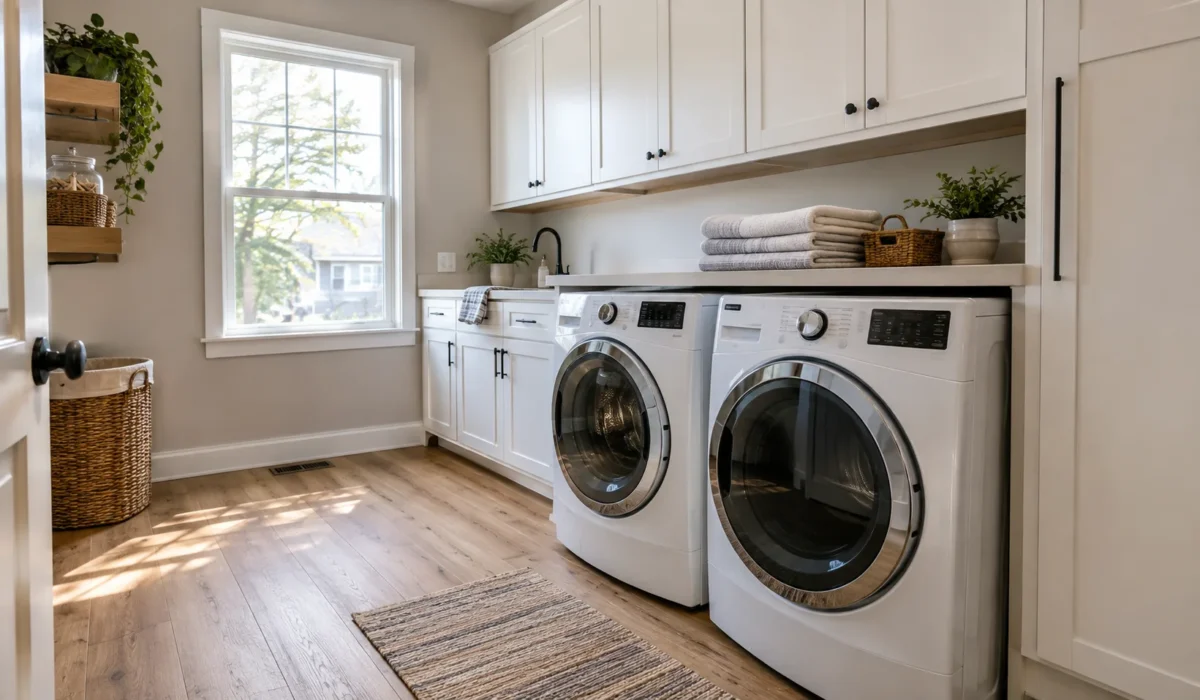
Laundry room flooring has a harder job than any other floor in your house. It sits under a machine that shakes, drains and pushes hot, humid air into a small closed space, usually with live water hookups hiding right behind it. Our crews install floors in laundry rooms across Northern Virginia, Maryland and Washington, DC every week, and the pattern never changes: the right floor shrugs off a decade of laundry days, while the wrong one turns a $15 hose failure into a $5,000 tear-out.
This guide covers the best flooring for a laundry room, what each option really costs installed, the floors to keep away from a washer, and the installation details a good installer plans for before the first plank goes down.
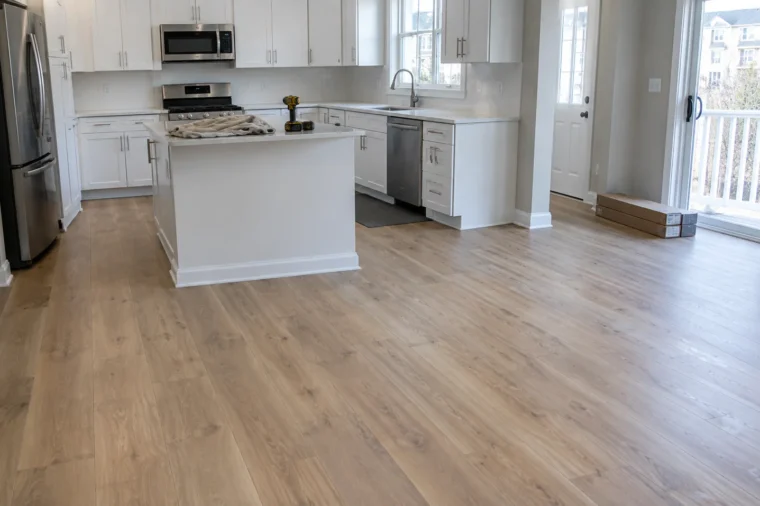
The short answer: waterproof luxury vinyl plank (LVP) is the best laundry room floor for most homes: 100 percent waterproof through its core, warm and quiet underfoot, and a fraction of the cost of tile. Porcelain tile is the most durable upgrade. Avoid solid hardwood, carpet and standard laminate: one leak can ruin all three.
Why laundry rooms destroy the wrong floor
Good flooring for a laundry room has to survive four separate threats that all hit the same small space.
Water, fast and slow. The dramatic failure is a hose burst or washer overflow that dumps gallons of standing water in minutes. The sneaky one is a supply line that drips behind the machine for months, or a drain pump connection that seeps a little with every cycle. Water damage is consistently one of the most common homeowners insurance claims in the United States, and washing machines are a leading cause. The Insurance Information Institute’s claims data shows water damage rivaling wind as the thing homeowners actually file for. Either way, water-sensitive materials lose.
Humidity. Every dryer cycle raises the temperature and moisture level in the room. Floors that absorb moisture respond by swelling, buckling and cupping over time, even if liquid water never touches them.
Vibration and weight. A washer on spin cycle is a 200-plus-pound machine actively trying to walk across the room. That constant vibration works on seams, loosens cheap click joints and dents soft floors under the leveling feet.
Laundry chemicals. Bleach, detergent and spilled cleaners will discolor or eat the finish on floors that were never designed for them. And according to the EPA’s mold guidance, mold can start growing on damp materials within 24 to 48 hours, so a floor that traps a spill underneath it is a mold problem waiting to happen.
Waterproof vs. water-resistant: the difference that decides everything
Waterproof flooring has a core that cannot absorb water, swell or delaminate, even under standing water. Water-resistant flooring only tolerates surface splashes for a limited time before moisture works into the seams and reaches an absorbent core. A laundry room needs waterproof, all the way through.
Here is why this matters in practice: a laundry leak is rarely noticed immediately. It happens mid-cycle while you’re upstairs, or over a long weekend away. A water-resistant floor that handles a wiped-up splash just fine will swell at the seams when water sits on it for six hours. For a laundry room, water-resistant is a polite way of saying not good enough. You want a waterproof laundry room floor that is 100 percent waterproof, not just water-resistant, and that is the single filter we apply before talking about looks, price or anything else.
The best laundry room flooring options, ranked
| Flooring | Waterproof? | Installed cost/sq ft | Comfort and noise | Lifespan | Verdict |
|---|---|---|---|---|---|
| Luxury vinyl plank (LVP) | Yes, fully waterproof | $5 to $8 | Warm, quiet | 15 to 25 yrs | Best overall |
| Porcelain/ceramic tile | Yes (seal the grout) | $12 to $20 | Cold, hard, loud | 30+ yrs | Most durable upgrade |
| Sheet vinyl | Yes, seamless | $3 to $5 | Warm, quiet | 10 to 15 yrs | Budget pick |
| Waterproof laminate | Surface only | $4 to $7 | Warm, moderate | 10 to 20 yrs | Only with caveats |
| Rubber | Yes | $4 to $9 | Softest, quietest | 15 to 20 yrs | Utility-room sleeper |
| Sealed concrete | Yes | $3 to $8 | Coldest, hardest | Lifetime | Basement option |
| Solid hardwood | No | $10 to $18 | Warm | Fails early here | Avoid |
| Carpet | No | $3 to $6 | Soft | Fails early here | Avoid |
Typical U.S. market ranges for materials plus professional installation, 2026. Small rooms often price above the per-foot range because of contractor minimums, more in the cost section below.
1. Waterproof luxury vinyl plank (LVP): best overall
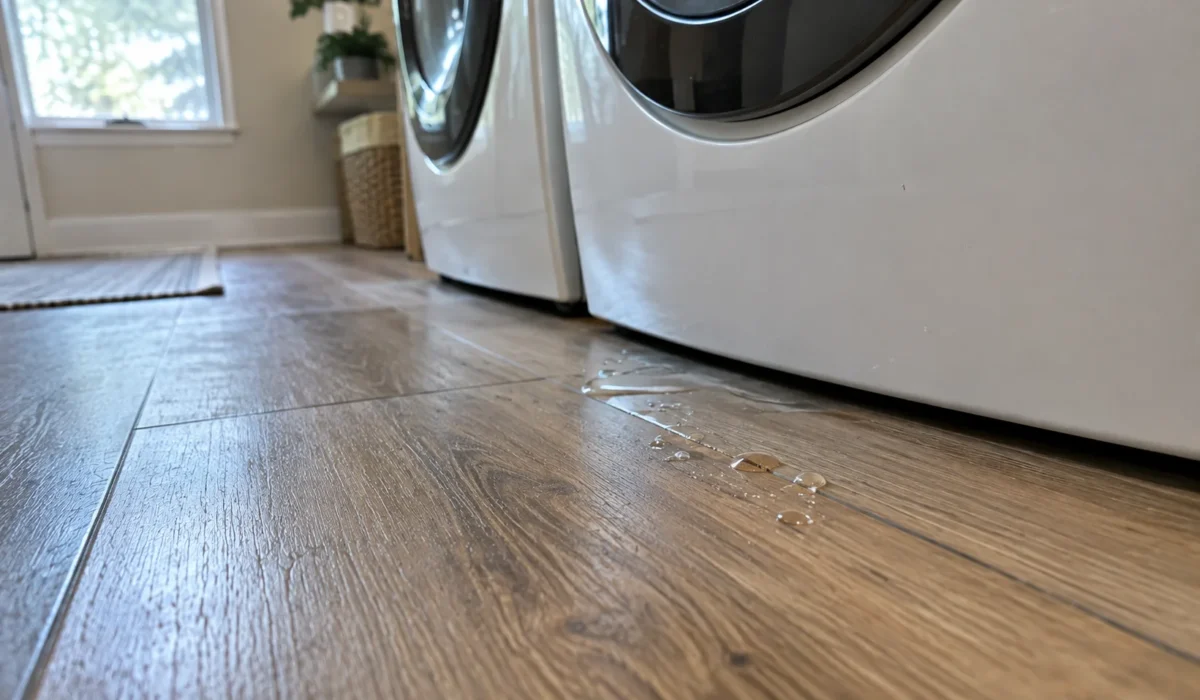
If you take one thing from this guide: waterproof vinyl flooring for a laundry room is the standard for a reason. Modern luxury vinyl plank is built on a rigid core, either SPC (stone-plastic composite) or the softer, thicker WPC, that simply cannot absorb water. A washer can overflow onto it, you can extract the water, dry the room, and the floor is fine. No swelling, no warping, no tear-out.
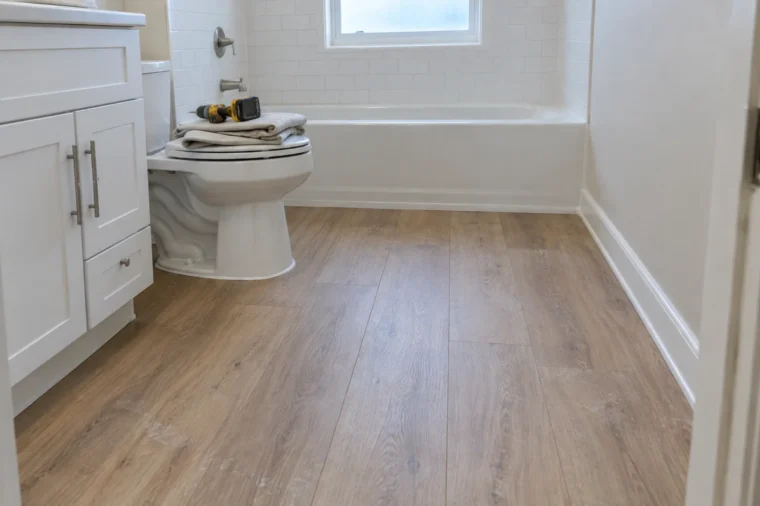
Beyond being fully waterproof, LVP is quiet and warm underfoot, a real difference from tile when you’re standing at the machine folding clothes, and today’s wood-look planks are convincing enough that most visitors can’t tell they aren’t real wood. Stone-look formats are available too if you want the tile aesthetic without the cold.
What to look for when choosing vinyl flooring in a laundry room:
- A rigid core. SPC is denser and more dent-resistant under heavy appliances; WPC is a touch softer and warmer. For laundry rooms we usually recommend SPC.
- A wear layer of at least 12 mil (20 mil for the most durable option). The wear layer is what stands between dropped detergent jugs, dragged baskets and the printed design underneath.
- Textured, low-gloss finishes, which hide scuffs and offer better grip when the floor is wet.
The one caution: LVP is waterproof, but it isn’t a magic seal for the room. Water that gets past the perimeter can still reach the subfloor. That’s an installation problem, not a product problem, and we cover it in the installation section. FIXO installs waterproof LVP with fixed, upfront pricing. See our LVP flooring installation service for what’s included.
2. Porcelain and ceramic tile: the most durable upgrade
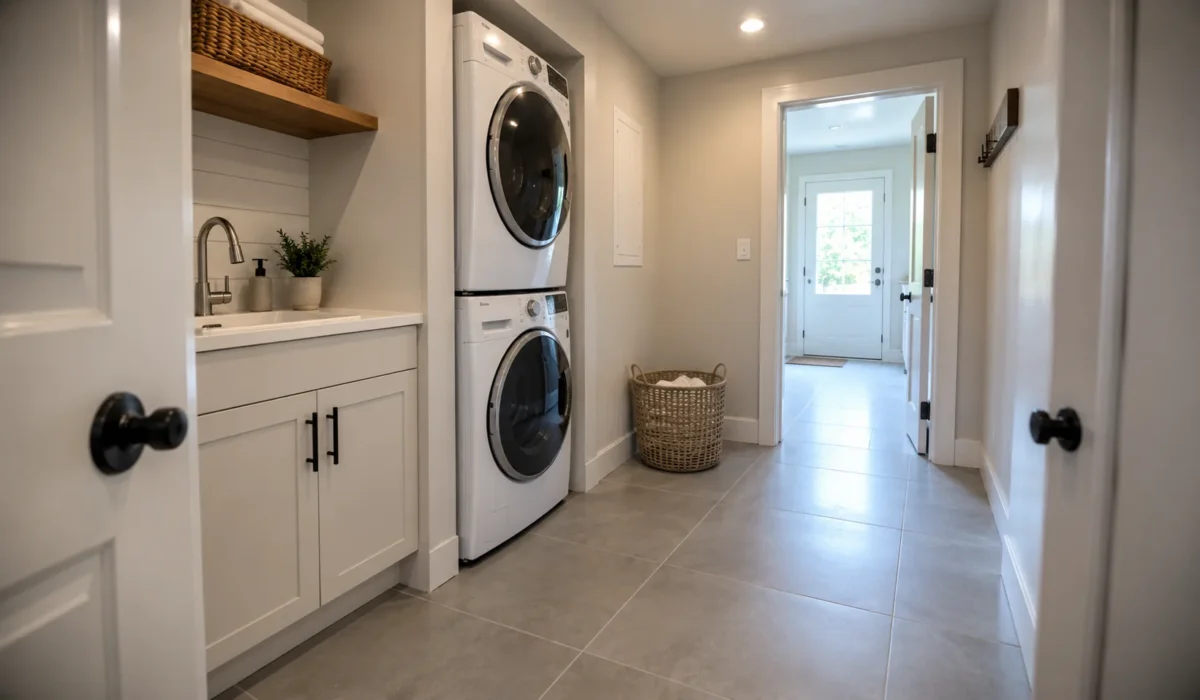
Porcelain tile is the only floor on this list that will genuinely outlast your washer, your dryer and probably the next two sets after them. It’s impervious to water, immune to laundry chemicals, and can’t be dented by a heavy appliance vibrating on it for a decade. If you’re doing a full laundry room remodel and want a high-end look, tile delivers it.
The honest trade-offs, from an installer who sells both: tile is cold and hard underfoot, it’s the loudest option under a spin cycle (a vibration mat under the machine helps), and anything glass you drop on it dies on impact. Grout is the one moisture path, and it needs to be sealed and occasionally resealed, or dark rings appear near the water hookups. Choose a tile with a slip-resistance rating of DCOF 0.42 or higher; a glossy tile plus a puddle is how laundry day sends people to urgent care.
Tile is also the most involved installation: proper subfloor prep, backer board or an uncoupling membrane, then mortar and grout curing time. It’s a multi-day project where LVP is typically done in one. Our tile flooring installation page covers the process.
3. Sheet vinyl: the cheapest waterproof floor
Sheet vinyl doesn’t get much love in flooring showrooms, but for laundry rooms it has one killer feature: in a typical room it installs as a single piece, which means no seams at all. No seams means nowhere for water to sneak through, so the whole floor behaves like a shallow tray. For a small laundry closet, that’s the most watertight surface you can put down, and at $3 to $5 per square foot installed it’s the most affordable option here.
The trade-offs: sheet vinyl is thinner and easier to gouge than rigid-core LVP, edges can lift or curl years down the road if the adhesive lets go, and the resale perception is a notch below plank floors. But if you’re on a budget, or flooring a rental property’s laundry area, it’s a smart, honest choice, not a compromise to apologize for.
4. Waterproof laminate: only with strict caveats
Can you use laminate flooring in a laundry room? Only if you’re precise about what you buy and how it’s installed. Standard laminate is the classic laundry room casualty: its core is a dense fiberboard, essentially compressed wood, so when water finds a seam, the core swells, the edges peak, and the plank never goes back down. We’ve replaced more failed laminate in laundry rooms than every other floor combined.
The newer generation of waterproof laminate is a different product: sealed edges, water-repellent cores, surface protection rated for 24 to 72 hours of standing water. That’s real progress, but read the fine print: most warranties cover topical water only, and several explicitly exclude appliance leaks. The waterproofing lives in the surface and edges, not all the way through the core the way it does with vinyl.
Our honest take: if you love the laminate look and feel (it’s harder and more scratch-resistant than vinyl underfoot), a true waterproof laminate installed with a fully sealed perimeter can work in a main-level laundry room. In a basement, or anywhere flooding is plausible, choose LVP instead. We’ve written a full breakdown in Is Laminate Flooring Waterproof?, and you can compare specs on our laminate flooring installation page.
5. Rubber flooring: the utility-room sleeper
Almost nobody puts rubber flooring on their laundry room shortlist, and that’s a miss for the right house. Rubber tiles or rolls are waterproof, absorb appliance vibration better than anything else on this list (your washer gets noticeably quieter), and are comfortable to stand on through a big folding session. For a basement laundry-utility combo (washer, dryer, utility sink and storage), rubber is quietly the most practical surface there is.
Why it’s ranked fifth: the look is utilitarian, color options are limited, and some recycled-rubber products have a noticeable odor at first. It suits a working utility space more than a showpiece laundry room off the kitchen. (FIXO doesn’t install rubber flooring; we include it because it’s the right answer for some homes, and a guide that only lists what we sell wouldn’t be much of a guide.)
6. Sealed or stained concrete: the basement option
If your laundry room is in the basement, the cheapest waterproof floor might be the one already there. A properly cleaned, sealed and optionally stained concrete slab is impervious to water, costs less than any new floor covering, and handles floor drains gracefully. Pair it with an anti-fatigue mat at the machines and it’s a perfectly livable utility floor. The downsides are the obvious ones (cold, hard and industrial-looking), and sealing is a job worth doing right, since a bad seal coat peels. If you’re finishing the space into real living area, step up to LVP over the slab; our guide to the best waterproof basement flooring covers that decision in depth.
Flooring to avoid in a laundry room
Solid hardwood. Hardwood flooring in a laundry room is the most expensive mistake on this list. Wood and standing water are enemies: one unnoticed leak causes cupping, buckling and staining, and even without a leak, years of dryer humidity slowly work on the boards. There are waterproof hardwood floors on the market now (real wood veneers over waterproof cores) and they’re better, but you’re paying hardwood prices for a floor that still has a wood surface to stain and a warranty full of appliance-leak exclusions. Save the hardwood budget for the rooms where it shines.
Engineered wood. Some flooring retailers recommend engineered wood flooring for laundry rooms because its plywood base handles humidity better than solid wood. Handling humidity is not the same as surviving a washer overflow. The top layer is still real wood; the core still absorbs water at the seams; it can still delaminate after a soak. As installers, we won’t put it in a laundry room, full stop.
Carpet. Carpet in a laundry room holds moisture, breeds mold under the pad and traps detergent spills you can never fully extract. Even in a basement where carpet is tempting for warmth, keep it out of the laundry zone.
Standard (non-waterproof) laminate. Covered above, but worth repeating as a warning: the wood-fiber core swells on contact with water and the damage is permanent. If a laminate floor doesn’t explicitly say waterproof, with a written standing-water rating, it does not belong in the same room as a washer or utility sink.
What laundry room flooring costs in 2026
| Floor type | Installed cost/sq ft | Typical 8×10 room (80 sq ft) |
|---|---|---|
| Sheet vinyl | $3 to $5 | $340 to $650 |
| Waterproof laminate | $4 to $7 | $420 to $800 |
| Luxury vinyl plank | $5 to $8 | $500 to $900 |
| Rubber | $4 to $9 | $420 to $950 |
| Porcelain tile | $12 to $20 | $1,100 to $1,800 |
Typical U.S. market ranges, 2026, materials plus professional installation. DC-metro labor tends toward the upper end.
Three things the per-square-foot number hides:
Small-room minimums. Most laundry rooms are 35 to 100 square feet. Trip charges, setup and disposal don’t shrink with the room, so many contractors price small jobs at a $500 to $900 minimum regardless of the math. Bundling the laundry room with a hallway, mudroom or bathroom floor almost always gets you a better effective rate.
What’s under the old floor. Demo and removal of the existing floor, leveling a wavy subfloor, or a moisture barrier over a concrete slab each add real dollars, usually $1 to $3 per square foot when needed. A quote that doesn’t mention the subfloor is a quote that will grow later.
The appliances. Someone has to disconnect the water hookups, move a washer and dryer out, and reinstall them without kinking a supply line. Confirm it’s in the price. It’s included in ours. If you’d rather skip the estimate dance entirely, FIXO’s instant quote tool gives you a fixed, guaranteed price online in about 60 seconds.
Match the floor to where your laundry room is
The best flooring for a laundry room isn’t just about materials, it’s about where the room sits in the house. This is the part most flooring guides skip.
Second-floor laundry rooms
Upstairs laundry is wonderful to live with and unforgiving when something leaks, because everything below the leak is finished living space. Three rules: choose a fully waterproof floor (LVP or tile; this is not the place for laminate caveats), have a drain pan installed under the washer with a plumbed drain line where code and layout allow, and add a quality underlayment rated for sound, because spin-cycle noise telegraphs straight through an upstairs floor into the room below. It’s also worth asking your installer to caulk the floor perimeter, so the room can hold a small leak long enough for you to find it.
Basement laundry rooms
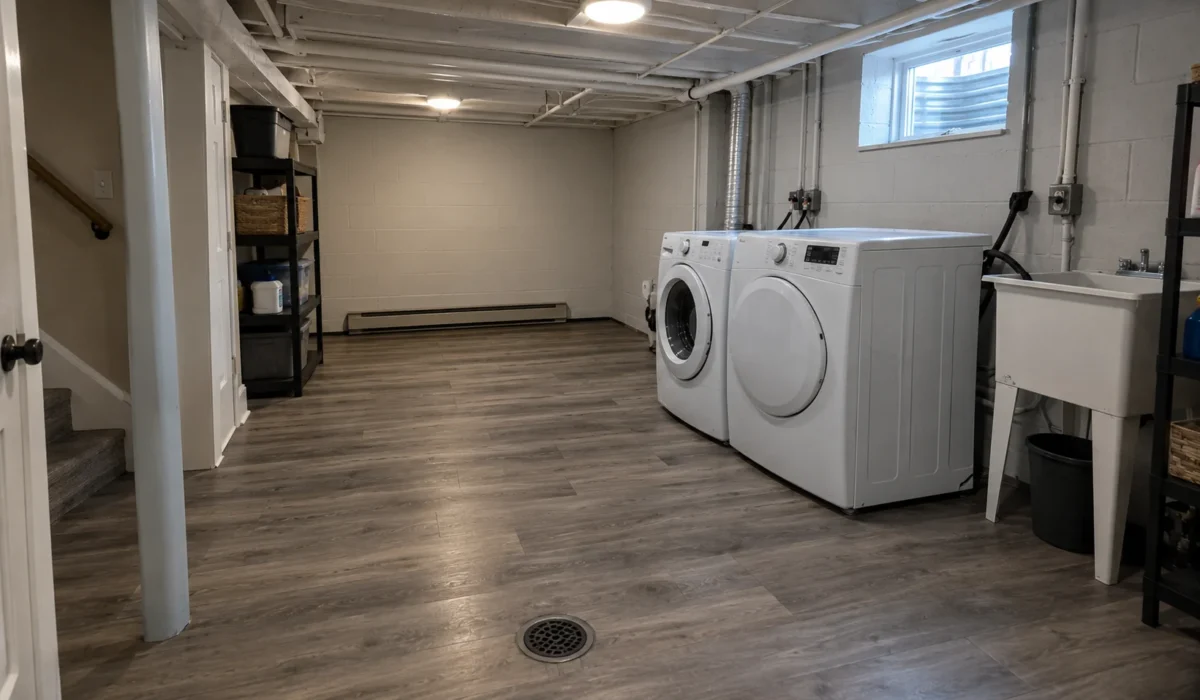
Below-grade rooms flip the problem: the moisture threat comes from under the floor as well as above it. Concrete slabs wick ground moisture upward, which rules out anything wood-based entirely. Before we install over a slab, we test its moisture, level low spots, and use either a vapor-barrier underlayment or LVP rated for direct-to-slab installation. If your basement has a floor drain, keep it. A floor pitched to a working drain has saved more basements than any flooring product ever will.
Laundry closets and stacked units
For a small laundry closet with stacked machines, seamless matters more than anything. A single piece of sheet vinyl, no seams in a splash zone barely bigger than the machine itself, is often the smartest floor in the house, and the whole job can come in under a few hundred dollars.
Laundry-mudroom combos
When the laundry room doubles as the entry from the garage, the floor also has to handle grit, wet boots and dog traffic. That pushes the answer toward textured, stone-look LVP or matte porcelain tile, durable enough for the mudroom job, waterproof enough for the laundry job, with slip resistance for both.
Installation details that prevent a flood later
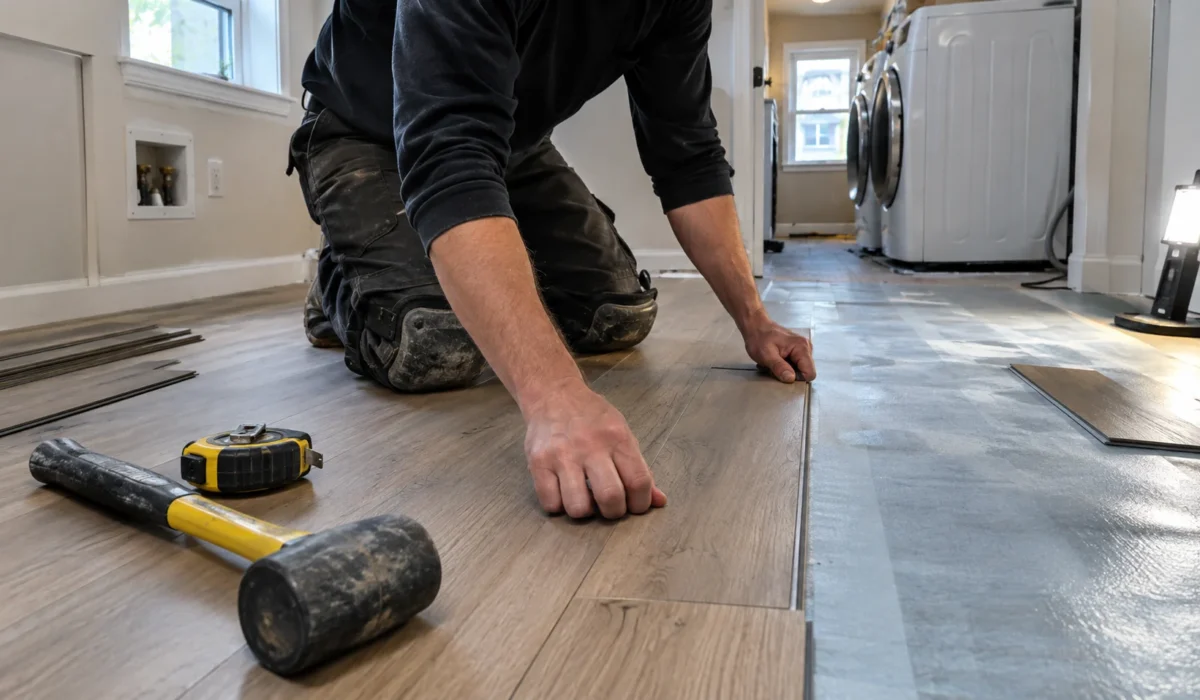
Two identical floors can have completely different outcomes in a laundry room depending on what happened during installation. These are the details our crews build into every laundry room job, and the ones to ask about if you’re hiring anyone else:
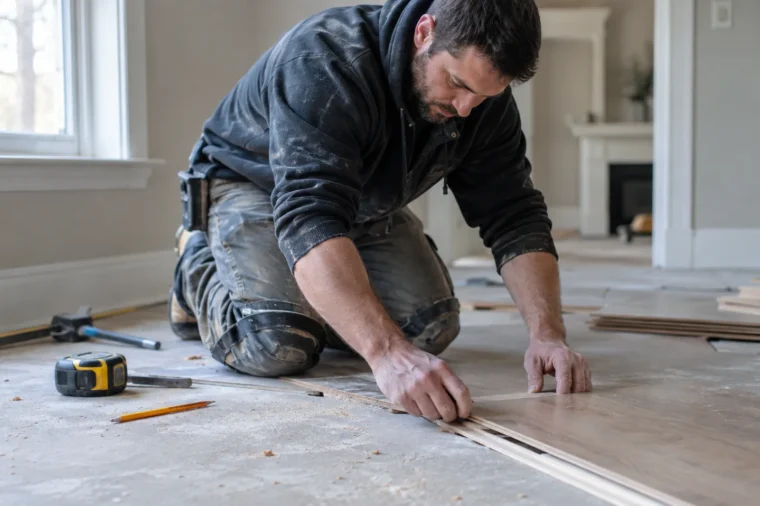
- Level and sound subfloor first. A washer on an out-of-level floor walks, bangs and stresses plank joints. We check flatness and fix dips before flooring goes down, not after the machine starts wandering.
- Moisture barrier over concrete. Any slab installation gets a vapor barrier or a slab-rated underlayment. Skipping this is the most common shortcut we find when we tear out someone else’s failed floor.
- A sealed perimeter. A bead of quality silicone where the floor meets the baseboard turns a waterproof floor into a shallow basin that can hold a minor leak on top, where you’ll see it, instead of letting it run under the floor, where you won’t.
- Smart transitions. The doorway threshold is where laundry room water escapes into the hallway or the room next door. A properly detailed transition strip, sealed underneath, is a two-dollar part that protects the floors in adjacent rooms.
- Anti-vibration pads and careful reinstallation. We put vibration pads under the leveling feet, reconnect the water hookups with the machine’s shutoff valves accessible, and check the drain hose is secured before we leave. While the machines are out, it’s the perfect moment to upgrade rubber supply hoses to braided stainless steel, the single cheapest flood insurance you can buy.
DIY or pro?
An honest split, since not every laundry floor needs us.
Reasonable DIY: loose-lay or click-together sheet vinyl and LVP in a small, square laundry closet with a flat subfloor and machines you can move yourself. Take your time on the perimeter seal and the threshold.
Hire a professional flooring installer: tile (mortar, cuts, curing, grout, it punishes beginners), any slab that needs leveling or moisture treatment, second-floor rooms where a mistake costs you a ceiling below, and any room where the machines need disconnecting and you’re not confident around water hookups. A crew does a typical laundry room in a day, appliances out and back, mess gone.
If you’re weighing the two, get the fixed price first. It’s free, takes a minute, and it makes the decision concrete: price your laundry room online.
Keeping your laundry room floor looking new
Whatever you install, five habits stretch its life. Sweep or vacuum grit weekly; it works like sandpaper under laundry-basket traffic. Wipe detergent and bleach spills promptly; even waterproof floors can stain or dull where chemicals sit. Use a pH-neutral cleaner on LVP and vinyl (skip steam mops; heat is the one thing vinyl dislikes), and reseal tile grout every year or two. Slide furniture pads under machine feet if you ever reposition appliances; drag marks are the most common damage we see on newer floors. And once a year, pull the machines forward and look behind them. A slow drip you catch in month one is a rag; in month twelve it’s a subfloor repair.
Laundry room flooring in Northern Virginia, Maryland and Washington, DC
If you’re local to us, a few notes from our job sheets. The DC area’s housing stock is hard on laundry floors: older colonials and ramblers in Alexandria, Arlington and Fairfax often have basement laundry on slabs that need moisture work; condos and townhomes in Tysons, Reston and Ashburn frequently have upstairs laundry closets where sound-rated underlayment and drain pans matter; and humid mid-Atlantic summers make dryer-season moisture swings worse than the national average. FIXO installs waterproof LVP, laminate and tile across Northern Virginia, Maryland and Washington, DC: one crew, fixed online pricing, most laundry rooms done in a day.
Laundry room flooring: questions, answered
What is the best flooring for a laundry room?
Waterproof luxury vinyl plank (LVP) is the best flooring for a laundry room in most homes. It’s 100 percent waterproof through its core, warm and quiet underfoot, durable under heavy appliances, and costs $5 to $8 per square foot installed. Porcelain tile is the more durable choice if comfort matters less to you.
Is vinyl plank flooring good for a laundry room?
Yes, rigid-core vinyl plank is the single most recommended laundry room floor. Its SPC or WPC core can’t absorb water, so overflows and leaks don’t swell or warp it. Choose a plank with at least a 12-mil wear layer and have the perimeter sealed during installation.
Can you put laminate flooring in a laundry room?
Only true waterproof laminate, and only with a sealed perimeter. Standard laminate swells permanently when water reaches its wood-based core. Check the warranty for appliance-leak exclusions before buying. In basements or flood-prone spots, choose LVP instead of laminate.
Is it OK to put hardwood floors in a laundry room?
We advise against it. Solid hardwood cups, buckles and stains when exposed to leaks, and constant dryer humidity degrades it even without one. If you want the wood look in a laundry room, wood-look waterproof LVP delivers it without the risk.
What is the cheapest waterproof laundry room floor?
Sheet vinyl, at roughly $3 to $5 per square foot installed. In small laundry rooms it installs as one seamless piece, making it exceptionally watertight for the money. In a basement, sealing the existing concrete slab can cost even less.
Do I need a floor drain or drain pan in a laundry room?
They’re not required everywhere, but for second-floor laundry rooms a washer drain pan (ideally plumbed to a drain line) is cheap protection for the finished rooms below. In basements, an existing floor drain is worth keeping and pitching the floor toward. Local plumbing codes vary, so confirm requirements with your installer or plumber.
How much does it cost to install laundry room flooring?
Most homeowners pay $340 to $900 for vinyl-based floors in a typical laundry room, and $1,100 to $1,800 for porcelain tile, including installation. Small rooms often hit contractor minimums, so bundling the laundry room with adjacent floors usually lowers the effective price.
The bottom line
Pick a floor that’s waterproof all the way through, install it with a sealed perimeter and the subfloor prep your room needs, and your laundry room flooring becomes the one surface in the house you never think about again. For most homeowners that means waterproof LVP; for the long-haul remodel it means porcelain tile; on a tight budget it means seamless sheet vinyl. And if you’re in Northern Virginia, Maryland or Washington, DC, you don’t have to guess what any of it costs: get your fixed price online in 60 seconds and have a floor that laughs at laundry day by this time next week.
 4.9 on Google14 reviews
 Licensed & InsuredVirginia · Maryland · Washington, D.C.
 Workmanship GuaranteedInstallation backed in writing
 Locally OwnedServing NoVA, MD & D.C.