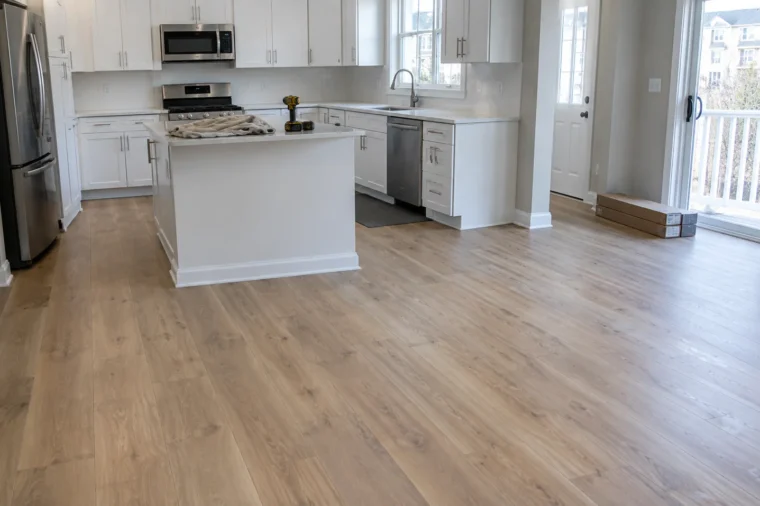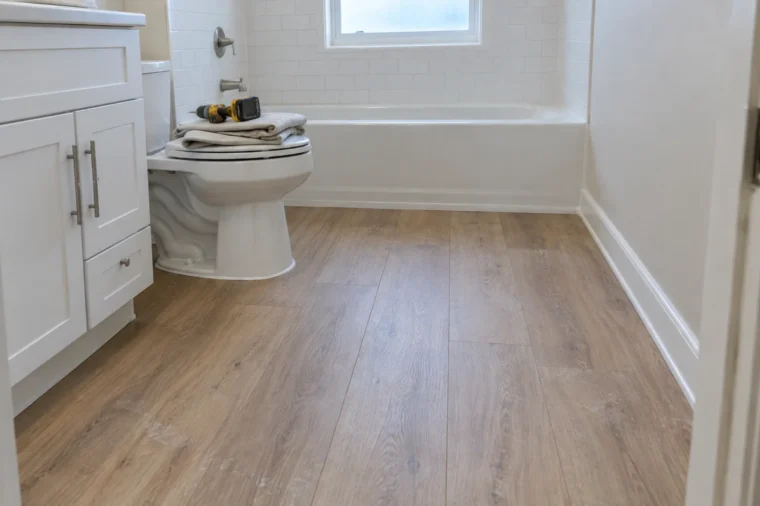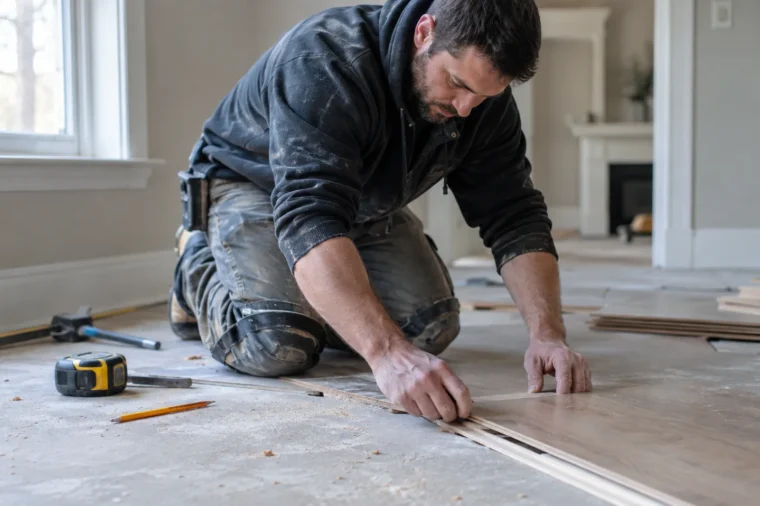
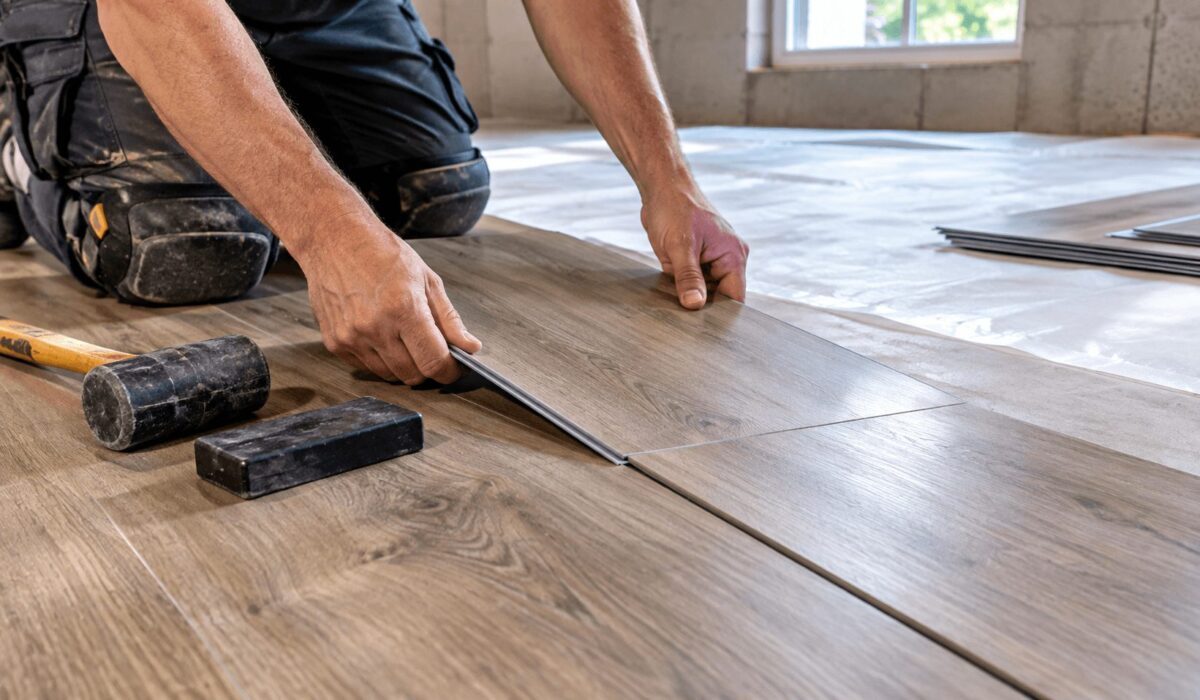
Choosing the best waterproof basement flooring is the single most important decision you’ll make when finishing a basement in Northern Virginia, Maryland or Washington, DC. Basements are below-grade spaces: the floor sits on a concrete slab that is in constant contact with ground moisture, and no paint or sealer changes that. Our crews install floors in DMV basements every week, and the pattern is always the same: homeowners who pick the right waterproof floor enjoy a dry basement living space for decades, while those who pick the wrong one are ripping it out within two or three years.
This guide covers what we’ve learned from hundreds of local installations: which floors survive basement moisture, how to test your slab before spending a dollar, what each option costs installed in the DMV, and the region-specific problems national guides never mention.
Waterproof vs. water-resistant: the difference that decides everything
Waterproof flooring has a core that cannot absorb water, swell or delaminate, even under standing water. Water-resistant flooring only tolerates surface spills for a limited time before moisture reaches the core. In a basement, where moisture arrives from below as well as above, that difference is everything.
The confusion is deliberate. Manufacturers label products water-resistant knowing most buyers read it as waterproof. A water-resistant laminate with sealed edges might survive a knocked-over glass, but it will not survive months of vapor pushing up through a concrete slab. When you compare products, ignore the word on the box and look at what the core is made of, and whether the warranty still applies below grade. A floor with a genuinely waterproof core (stone-plastic composite, porcelain, solid polymer) can sit in water, dry out and go back into service. Anything with raw wood fiber in the core cannot.
Why basements need waterproof flooring
Even a basement that has never flooded is a wet environment. Concrete looks solid, but it’s porous, closer to a hard sponge than a sheet of glass. Moisture reaches your floor three ways:
- Vapor transmission. Water vapor from the soil migrates up through the slab continuously, every day, whether you can see it or not.
- Capillary action. Concrete wicks liquid water from damp soil the way a paper towel wicks a spill, pulling it up through the slab and in through foundation walls.
- Hydrostatic pressure. After heavy rain, saturated soil physically pushes water against the foundation and through any crack or seam. This is the force behind most sudden basement flooding in the DMV.
On top of what comes through the slab, basement air works against you. Cool slab temperatures meet humid summer air and create condensation, the classic cold-slab problem, which keeps relative humidity in many DMV basements above 60% from May through September.
Put a moisture-sensitive floor over that and the failure sequence is predictable: wood-based cores absorb vapor and start buckling or peaking at the seams; trapped moisture underneath creates ideal mold growth conditions; within months you notice the musty odor that almost always means mold or mildew where you can’t see it. Left alone it progresses to visible floor buckling, cupped boards and water damage that costs far more to fix than the right floor would have cost to install. If you’re wondering whether a specific laminate can cope, we’ve covered what the waterproof label on laminate actually promises separately.
Test your basement’s moisture before you buy flooring
We tell every customer the same thing: spend a weekend on moisture testing before you spend thousands on flooring.
The plastic sheet test (free, DIY)
- Cut a 2 ft × 2 ft square of clear polyethylene sheeting (a plastic drop cloth works).
- Tape it flat to the bare concrete, sealing all four edges completely.
- Wait 24-48 hours.
- Check underneath. Condensation droplets or a dark, damp patch means significant vapor is coming up through your slab.
A damp result doesn’t rule out flooring, it rules out certain floorings, and makes a vapor barrier non-negotiable. For a precise number, professional moisture testing uses moisture meters and a calcium chloride test to measure the slab’s moisture vapor emission rate, the figure flooring manufacturers reference in their warranties, standardised by ASTM.
Warning signs your basement already has a problem
- Efflorescence, white, chalky mineral deposits on concrete. It’s the residue left when moisture evaporates, and proof water is moving through your foundation.
- Persistent condensation on cold-water pipes, windows or ductwork.
- A musty odor that returns after cleaning.
- Rust at the base of steel columns or appliance feet, or peeling paint low on foundation walls.
When remediation comes first
If you have recurring liquid water (puddles after storms, a flood-prone basement, visible seepage), flooring is step two. Moisture remediation ranges from grading and gutter fixes to a sump pump, interior French drains or perimeter drainage. Those solve the water at its source; the floor then keeps the space durable. For airborne humidity, a properly sized dehumidifier is the backbone of basement humidity control, we recommend one in nearly every finished DMV basement, because guidance from the US EPA treats controlling moisture as the precondition for preventing mold in any finished space. When FIXO does an express measure visit, our team checks slab condition and flags moisture red flags before we confirm your quote, we’d rather delay an install than put a floor over a problem.
The best waterproof basement flooring options, compared
Here is the honest comparison, based on what we install and what we’ve seen fail.
| Flooring | Waterproof? | Typical installed (DMV) | Best for |
|---|---|---|---|
| Rigid core LVP | 100% waterproof | $5.00-$8.00 /sq ft | Almost every basement |
| Porcelain tile | 100% waterproof | $12-$20 /sq ft | Bathrooms, laundry, luxury finishes |
| Waterproof laminate | Top-down only | $5.50-$9.00 /sq ft | Dry, tested slabs |
| Engineered hardwood | Water-resistant | $10-$16 /sq ft | Dry basements, real-wood lovers |
| Carpet / solid hardwood | No | , | Not below grade |
Luxury vinyl plank (LVP): best overall for DMV basements
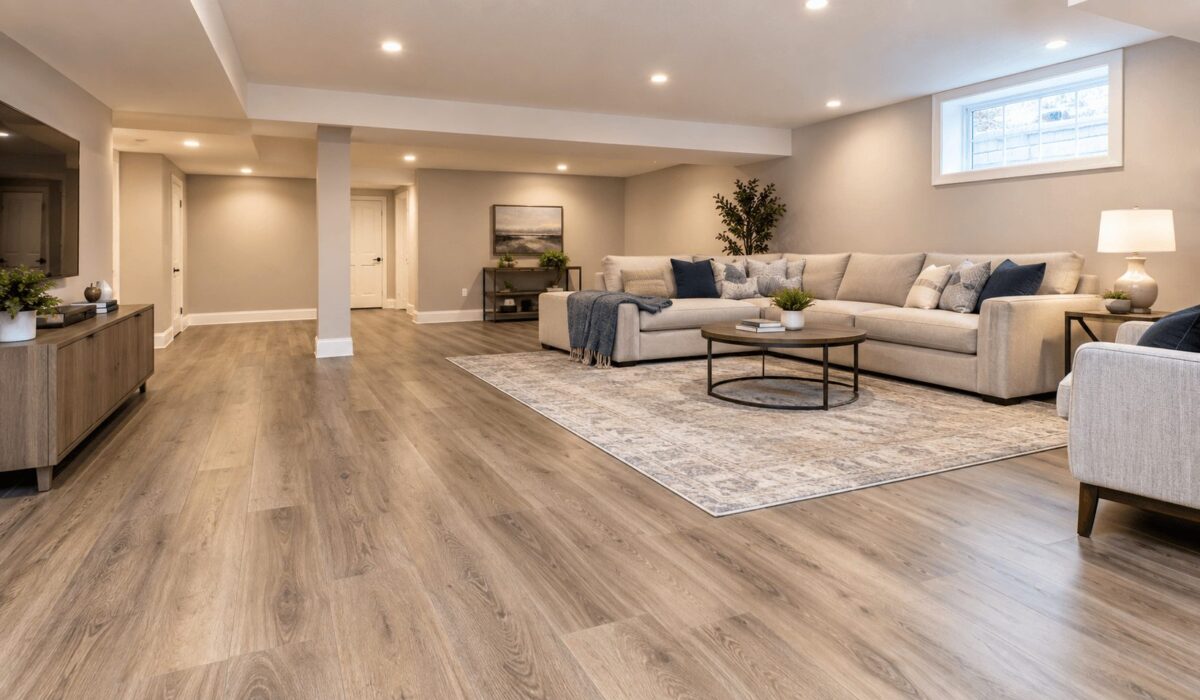
Luxury vinyl plank, and its tile-format sibling luxury vinyl tile (LVT), is the best basement flooring for the vast majority of homes we work in, and it isn’t close. Modern rigid core LVP is built around SPC (stone plastic composite): limestone powder fused with PVC into a dense, 100% waterproof core made entirely of inorganic materials. There is nothing in the plank for water to swell or mold to feed on, so mildew resistance is built into the material rather than added as a coating. (WPC construction, a wood-polymer core with more cushion underfoot, is the softer alternative; we typically steer basements toward SPC.)
- Truly waterproof. Waterproof vinyl plank flooring can sit under standing water during a flood, be dried out, and go back into service.
- Handles imperfect slabs. The dimensional stability of an SPC core means it won’t move dramatically with temperature swings, and its rigidity bridges minor slab imperfections.
- Fast, clean install. Click-lock planks go down as a floating floor, no glue, no nails. That is how our crews finish most basements in 1-2 days.
- Looks like wood. Today’s wood-look vinyl plank carries realistic wood grain and texture most guests can’t tell from hardwood.
- Comfortable and quiet. With the right pad it adds sound dampening, modest insulating properties, and a noticeably warmer basement floor than bare concrete.
- Easy to live with. A 20 mil wear layer makes it stain-resistant and genuinely low maintenance, sweep and damp-mop, done. Realistic lifespan: 15-25 years.
Drawbacks: it isn’t real wood, and cheap builder-grade vinyl plank (thin wear layers, hollow cores) gives the category a bad name. Buy quality or don’t bother: our LVP installation service uses rigid core plank rated for below-grade use.
Porcelain and ceramic tile: most durable
Porcelain tile is the other 100% waterproof option, and it’s what we install in basement bathrooms and laundry areas. Ceramic tile is the budget-friendlier cousin: slightly softer and more porous, but still excellent below grade. FIXO tile installs include a decoupling membrane and waterproofing as standard, which isolates the tile from minor slab movement. The trade-offs are cost and temperature: tile amplifies cold basement floors unless you pair it with a radiant heat system. Where tile wins outright is wet rooms and high-end finishes.
Waterproof laminate: budget wood look, with caveats
Modern waterproof laminate has come a long way. The better products seal their HDF core with tight edges and waterproof coatings, and carry an AC rating (AC4, AC5) that rivals commercial floors. The caveat: laminate’s moisture resistance is top-down, designed for surface spills, while the core is still wood fiber. Over a slab with high vapor readings it remains riskier than LVP. We only recommend it over a tested, dry slab with a proper vapor barrier underneath.
Engineered hardwood: real wood, with conditions
Engineered hardwood, a real wood veneer over a stable core, is the only way to get genuine wood into a basement, and select products are warrantied below grade. It needs a dry slab, a full moisture barrier underlayment, and several days to acclimate in the space before installation. It offers unmatched warmth and resale appeal, but it is water-resistant at best, never waterproof. If your slab tested damp, it’s off the list.
Flooring to avoid in a basement
- Wall-to-wall carpet. A sponge with moisture-wicking fibers sitting on a damp slab, and the recipe for hidden basement mold.
- Solid hardwood. Solid planks move with moisture; below grade they cup, gap and buckle. Every manufacturer voids the warranty in basements.
- Standard (non-waterproof) laminate. The swollen-seam failures of the 2000s. Still sold, still failing.
Other options we’re honest about: an epoxy coating gives a seamless surface that’s great for garages and workshops; rubber flooring is the specialist choice for serious gyms; carpet tiles with waterproof backing are a modular compromise for playrooms; polished concrete is the ultra-budget industrial look. They can all work in the right basement, but FIXO doesn’t install them, so we won’t pretend to be your best resource there. What we do install covers what most DMV homeowners actually want in a finished basement.
What waterproof basement flooring costs in the DMV
National cost guides are nearly useless here: labor in Northern Virginia, suburban Maryland and DC runs above the national average, and old slabs add prep work. These are typical DC-metro market ranges, not FIXO quotes; your exact number depends on the slab and the extras.
| Flooring | Materials | Installed (materials + labor) |
|---|---|---|
| Rigid core LVP | $2.50-$5 /sq ft | $5.00-$8.00 /sq ft |
| Waterproof laminate | $2-$4 /sq ft | $5.50-$9.00 /sq ft |
| Porcelain/ceramic tile | $3-$8 /sq ft | $12-$20 /sq ft |
| Engineered hardwood | $4-$9 /sq ft | $10-$16 /sq ft |
For a typical 700 sq ft DMV basement, that puts a quality LVP project at roughly $3,500-$5,600 all-in. Your total moves with three things: slab condition (leveling and prep), floor removal and haul-away, and extras like stairs and baseboards, not the brand name on the box.
Two pieces of budgeting advice from years of installs. First, budget-friendly basement flooring is about avoiding re-dos, not chasing the lowest bid: the cheapest floor installed twice costs more than the right floor installed once. Second, think long-term value, a properly finished basement is one of the better projects for resale, because buyers in this market specifically ask whether basement floors are waterproof.
Here’s where we’re different from every free estimate contractor: you don’t book an appointment to learn your price. FIXO’s instant estimator gives you a fixed installed price online in about 60 seconds, square footage, flooring choice, stairs, baseboards, done.
Installation requirements that make or break a basement floor
Get the slab right first
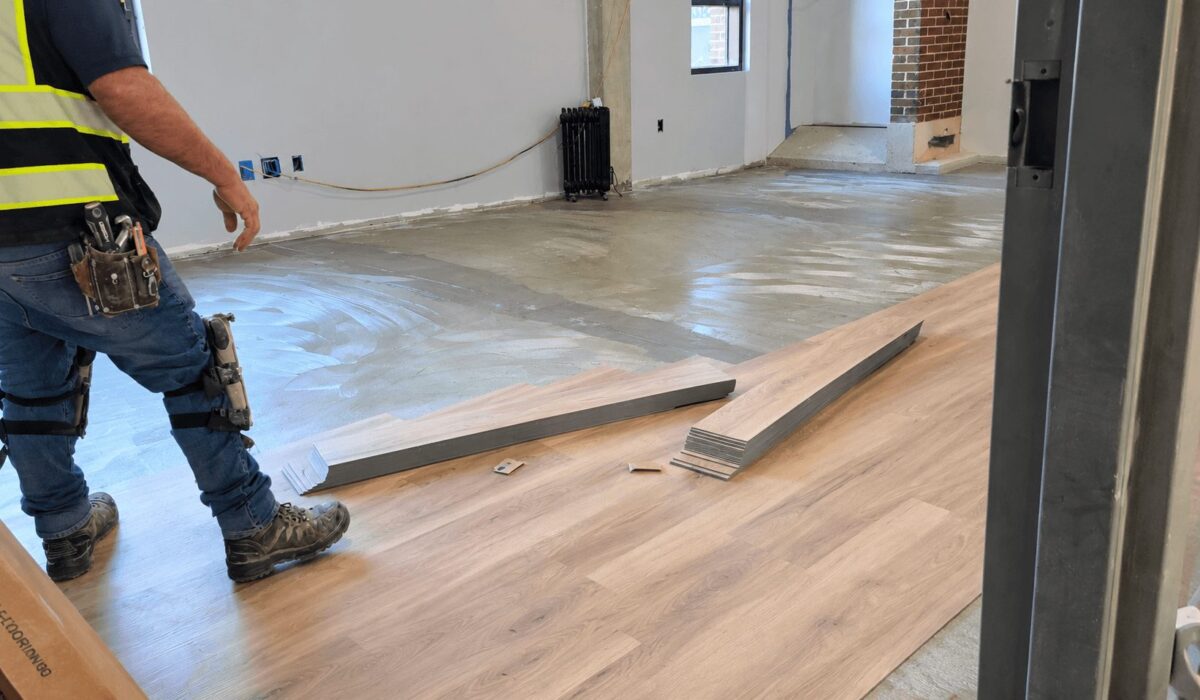
Subfloor preparation starts with an honest look at the concrete. A cracked or uneven slab must be corrected before anything goes over it, flooring bridges small dips, but a slab out of flat beyond about 3/16 inch over 10 feet causes clicking joints and premature wear. Proper concrete slab preparation means a self-leveling compound for low spots and concrete grinding for high ridges. Skipping this step is the #1 DIY failure we get called to fix. (Some finishing companies also sell raised plastic subfloor panels that create an air gap and thermal break against the cold slab; they add height and cost, and with a true waterproof floor plus a proper barrier they’re rarely necessary in our experience.)
Vapor barrier and underlayment
Over concrete, a vapor barrier is cheap insurance: typically 6-mil polyethylene sheeting or an all-in-one moisture barrier underlayment that combines the vapor layer with a cushioning pad. Even waterproof floors benefit: the barrier stops vapor condensing on the underside of the planks, keeps the assembly dry, and adds warmth and quiet. Never skip the underlayment spec your manufacturer requires; it’s usually a warranty condition.
Movement, transitions and details
Floating floors expand and contract with temperature, so expansion gaps (usually 1/4 to 3/8 inch at every wall and fixed object) are non-negotiable; baseboards and shoe molding hide them. Transition strips handle doorways cleanly. Tile is different: it’s a glued-down installation (thin-set over membrane) with its own prep standards, and its own expensive mistakes to avoid.
DIY or professional?
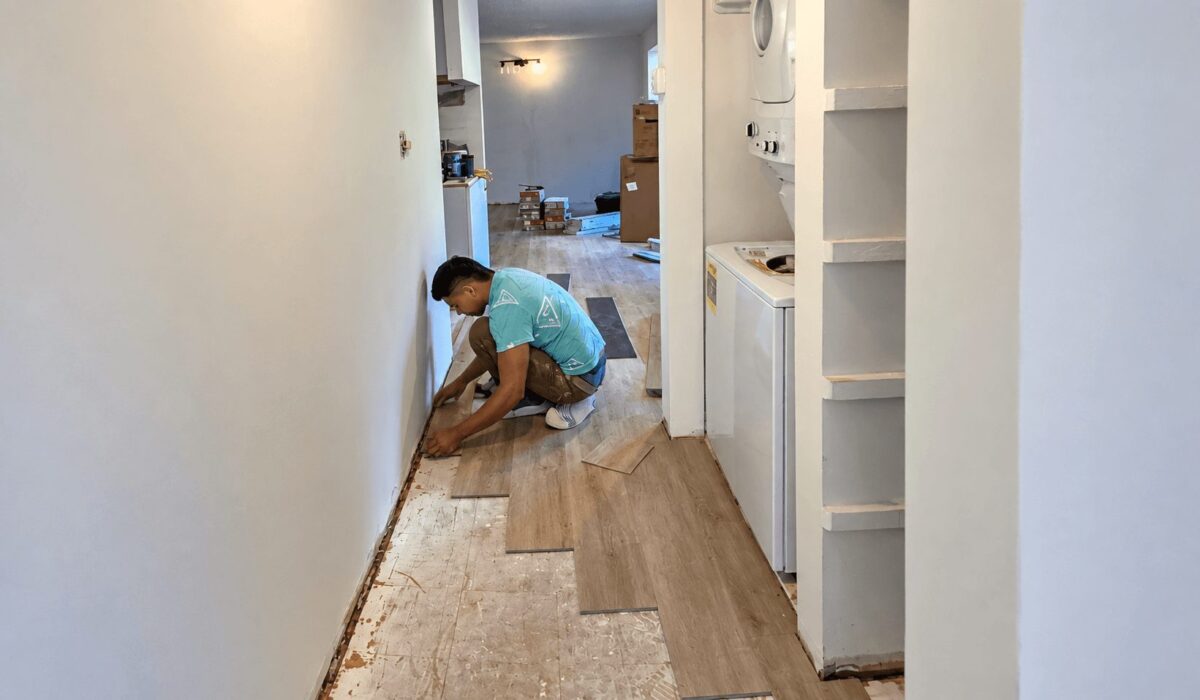
The honest answer: a handy homeowner can float click-lock LVP in a simple rectangular room. What raises the difficulty in real basements is everything else: slab correction, moisture handling, stairs, columns, mechanical closets and bathroom tie-ins. As part of a broader basement finishing or remodeling project, professional installation also protects the manufacturer warranty. FIXO crews typically complete a full basement in 1-2 days, including floor removal, prep and baseboards.
Why DMV basements are different
This is the part national guides can’t tell you, because they’ve never worked here.
- Clay-heavy soil. Much of Northern Virginia and suburban Maryland sits on clay that drains poorly and swells when saturated, which means more hydrostatic pressure against foundations after storms than sandy-soil regions ever see, and more sudden seepage in basements that were always dry.
- Mid-Atlantic humidity. DMV summers routinely push outdoor humidity past 70%. Basements run cooler than the rest of the house, so that air condenses below grade. A dehumidifier isn’t optional equipment here; it’s standard.
- Older housing stock. DC rowhouses and the region’s huge inventory of 1950s-70s ramblers and split-levels were built with thin slabs and often no vapor barrier underneath at all. These slabs transmit far more moisture than modern construction, which is why we test rather than assume.
- Flood-prone pockets. Parts of Alexandria and Old Town, low-lying Arlington neighborhoods, and creek-adjacent areas across Montgomery and Fairfax counties see repeated storm flooding. If you’re in one, a fully waterproof floor isn’t a preference; it’s the only sensible choice. We install across all of these areas; see our DMV service areas.
Best basement flooring by room use
- Family / media room: LVP throughout: warm enough, quiet with pad underlayment, and it shrugs off spilled drinks and pet accidents.
- Home gym: rigid LVP handles equipment weight; drop heavy free weights on rubber mats placed over it.
- Bedroom or guest suite: LVP with a premium acoustic pad gives warmth and quiet; add area rugs for softness without carpet’s mold risk.
- Home office: SPC’s dense core resists the dents that chair casters leave in softer floors.
- Playroom: LVP plus washable foam play mats beats carpet on every count, especially cleanup.
- Bathroom & laundry: this is where porcelain tile with full waterproofing earns its price.
Get a fixed price for your basement floor in 60 seconds
You now know more about the best waterproof basement flooring than most contractors will ever tell you. The next step doesn’t require a sales visit: use FIXO’s instant estimator, answer seven quick questions about your basement, and get a fixed, honest installed price online. If the numbers work, we schedule an express measure, confirm slab condition, and most DMV basements are finished within 1-2 days of install start.
Best waterproof basement flooring: questions, answered
What is the best waterproof flooring for a basement?
Rigid core LVP (SPC luxury vinyl plank) is the best waterproof flooring for most basements. Its stone-plastic core is 100% waterproof, it installs floating over minor slab imperfections, it’s warm and quiet underfoot compared to tile, and it costs a fraction of porcelain. Porcelain tile is the better pick specifically for basement bathrooms and laundry rooms.
How much does it cost to waterproof a 1,200 sq ft basement?
For flooring, a 1,200 sq ft basement in the DMV runs roughly $6,000-$9,600 installed for rigid core LVP ($5.00-$8.00 /sq ft) or $14,400-$24,000 for porcelain tile. If the question is waterproofing the basement itself (drainage, sump pump, French drains), that’s separate remediation work, typically $3,000-$15,000+ depending on the system. The estimator gives you an exact flooring number for your square footage in about a minute.
Can I install waterproof basement flooring over concrete?
Yes, concrete is the ideal base, and it’s how nearly every basement install works. The slab must be clean, dry (test it first) and flat within about 3/16 inch over 10 feet, with low spots corrected using a self-leveling compound. Add a 6-mil vapor barrier or combination moisture-barrier underlayment, then float click-lock LVP or laminate on top. Tile is thin-set directly to the prepared slab over a decoupling membrane.
Can you waterproof your basement floor?
You can’t make the slab itself fully waterproof from above, because moisture moves through concrete by vapor transmission and capillary action no matter what you coat it with. What you can do is manage it: fix liquid water at the source (grading, gutters, sump pump, drainage), install a vapor barrier over the slab, control air moisture with a dehumidifier, and choose flooring with a waterproof core so the moisture that does arrive has nothing to damage.
What is the best flooring to put over concrete in a basement?
Rigid core luxury vinyl plank: 100% waterproof, tolerant of minor slab imperfections, comfortable underfoot, and fast to install as a floating floor. Porcelain tile is best for wet rooms, and waterproof laminate is a solid budget wood-look alternative over a slab that has tested dry.
What flooring is 100% waterproof?
Only floors with fully inorganic or sealed polymer cores: rigid core LVP/LVT (SPC or WPC), porcelain and ceramic tile, and epoxy coatings. Waterproof laminate resists water from the top but still has a wood-fiber core; engineered hardwood is water-resistant at best. The test: if a floor could sit under standing water for days and be reinstalled after drying out, it’s truly waterproof.
 4.9 on Google14 reviews
 Licensed & InsuredVirginia · Maryland · Washington, D.C.
 Workmanship GuaranteedInstallation backed in writing
 Locally OwnedServing NoVA, MD & D.C.