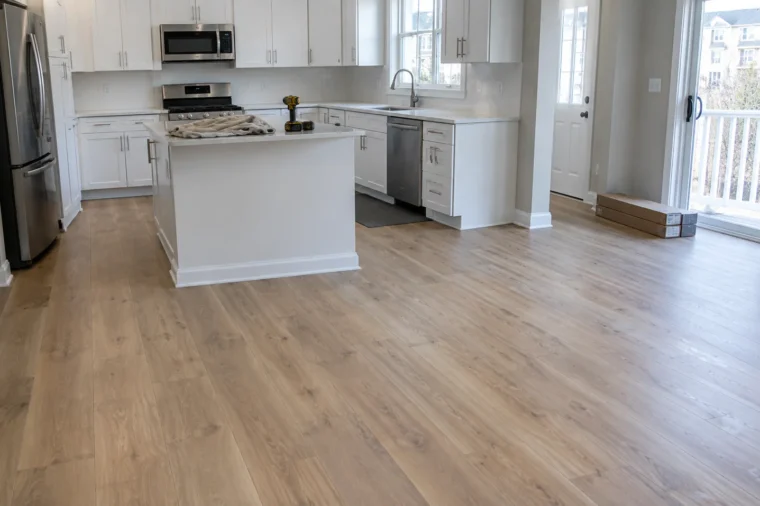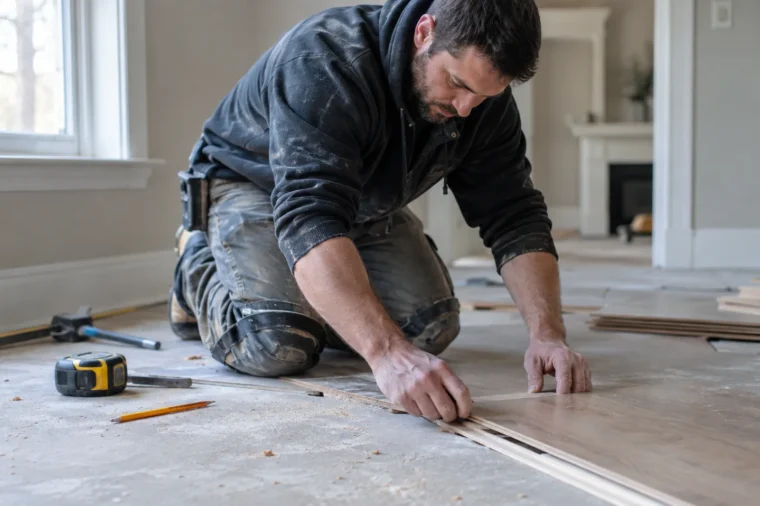
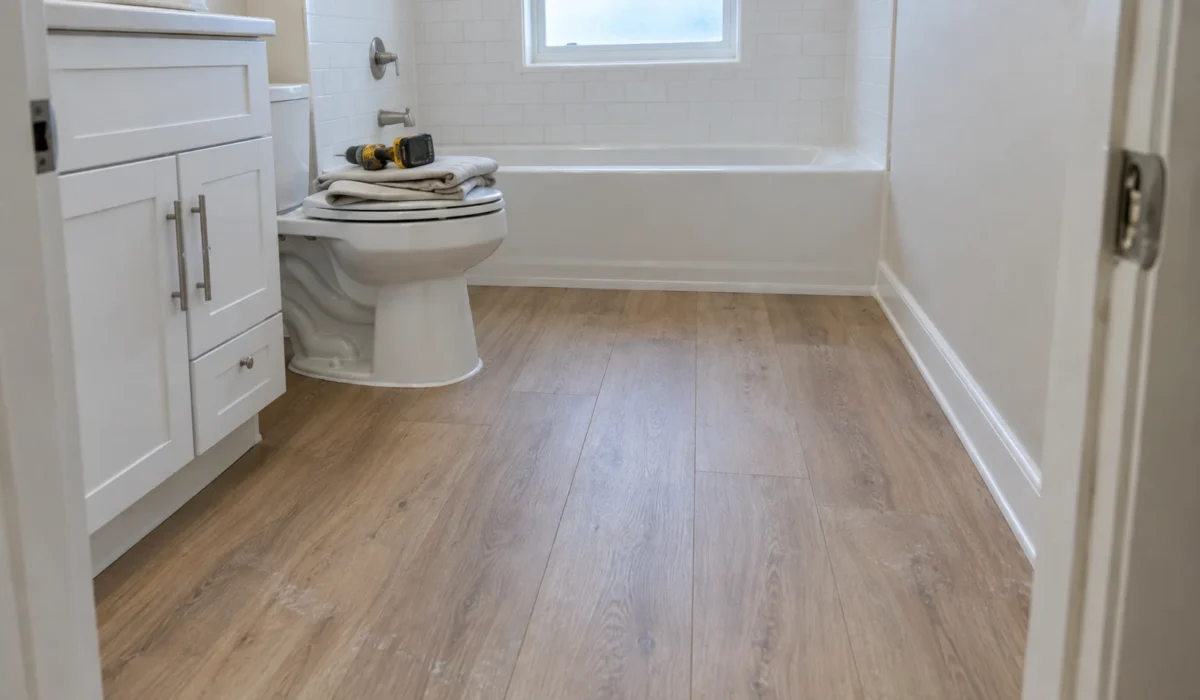
The best flooring for a bathroom is porcelain tile if you want the longest life and true waterproofing, and rigid-core waterproof luxury vinyl plank (LVP) if you want a warmer, cheaper floor that still shrugs off splashes. Sheet vinyl is the budget pick. Skip hardwood, laminate, and carpet. In a Northern Virginia, Maryland, or DC bathroom, expect roughly $6 to $12 per square foot installed for LVP and $12 to $25 for porcelain tile.
Picking the best flooring for bathroom use comes down to one question most guides skip: what happens to the floor on the day something goes wrong? A toilet supply line lets go at 2 a.m. A kid leaves the tub running. The exhaust fan quits and the room stays damp for a week. The right floor survives that day. The wrong one swells, lifts, or grows mold underneath, and you find out six months later.
I’ve pulled up enough failed bathroom floors across Fairfax, Arlington, Bethesda, and DC to have strong opinions. This guide covers the four floors that actually work, the three that fail, the specific product specs and installation details that separate a 20-year bathroom floor from a 3-year one, and what each option typically costs installed in the DMV. By the end you’ll know exactly what to order and what to ask your installer.
In this guide
- What makes a floor right for a bathroom
- Best flooring for bathroom use: the four options that actually work
- Is vinyl plank flooring good for bathrooms?
- Best waterproof flooring for bathroom by type of bathroom
- Bathroom flooring to avoid
- Bathroom flooring cost in Northern Virginia, Maryland, and DC
- Tile vs. LVP for a bathroom: how to decide
- DIY or hire a pro? And what to ask before you sign
- Frequently asked questions
- The bottom line on bathroom flooring
What makes a floor right for a bathroom
A bathroom floor has to pass four tests: it must be waterproof (not water-resistant), it must be safe to stand on wet and barefoot, it must sit on a flat and dry subfloor, and it must be comfortable enough that you don’t dread it in January. Everything else is style.
Waterproof vs. water-resistant
Waterproof means the material itself cannot absorb water, so a puddle left overnight does nothing. Water-resistant means the surface sheds water for a while, but the core or the seams will eventually take it in. Porcelain tile and vinyl are waterproof materials. Laminate, engineered hardwood, and solid hardwood are water-resistant at best, no matter what the box says.
There’s a second layer to this that matters more than the label. A waterproof plank does not make a waterproof floor. Water that runs to the edge of the room, down around the toilet flange, or under the tub apron gets to the subfloor regardless of what’s on top. The perimeter and the fixtures are where bathroom floors fail, so the installation details in this guide matter as much as the material.
Slip resistance when the floor is wet
The best bathroom flooring is one you can stand on soaking wet without thinking about it. Look for a manufacturer DCOF (dynamic coefficient of friction) rating on any tile or vinyl you’re considering. The current national standard, ANSI A326.3, sets a minimum wet DCOF of 0.42 for interior wet areas and 0.50 for interior wet plus areas, the category for floors where people walk barefoot, which is exactly what a bathroom is. Polished porcelain and honed marble often fall short of that. Matte or textured porcelain, and most embossed LVP, clear it comfortably.
Smaller tiles help too. A 2-inch hex or a 12-by-24 tile laid with more grout lines gives your feet more grip than a 24-by-48 slab, which is part of why mosaics are standard on shower floors.
The subfloor underneath decides how long the floor lasts
Most bathroom flooring problems I get called about trace back to the subfloor, not the finish material. Common issues in DMV housing stock: 1960s to 1980s colonials with soft, water-stained plywood around the toilet, split-levels with a bathroom over an unconditioned garage, and older DC rowhouses with subfloors that dip a half inch toward the drain.
Tile needs a stiff, flat base. Industry guidelines call for the floor framing to deflect no more than L/360 (span in inches divided by 360) under load, and for the surface to be flat within 1/4 inch over 10 feet for standard tiles and 1/8 inch over 10 feet for large-format tile. LVP is more forgiving on stiffness but not on flatness: rigid-core planks telegraph every hump and dip, and the click joints crack over a void.
Any soft or discolored plywood around the toilet gets cut out and replaced before anything goes down. That’s a $150 to $400 line item on most quotes and it’s the best money you’ll spend on the project.
Best flooring for bathroom use: the four options that actually work
Here’s how the four viable bathroom floors compare on the things that matter. Prices are typical installed ranges for a DMV bathroom in 2026 and include material, labor, and basic prep; small rooms run toward the high end because of minimum charges and cutting waste.
| Flooring | Waterproof? | Barefoot comfort | Installed cost (DMV, per sq ft) | Typical lifespan | Best for |
|---|---|---|---|---|---|
| Porcelain or ceramic tile | Yes, fully | Cold unless heated | $12 to $25 | 30+ years | Primary and family baths, resale, radiant heat |
| Rigid-core LVP or LVT | Yes (plank); perimeter must be sealed | Warm, slightly soft | $6 to $12 | 15 to 20 years | Powder rooms, kids’ baths, budget remodels, over uneven floors |
| Sheet vinyl | Yes, with no seams in most rooms | Warm, soft | $5 to $9 | 10 to 15 years | Rentals, basement baths, tight budgets |
| Natural stone tile | Only when sealed | Cold unless heated | $18 to $35+ | 30+ years with upkeep | High-end primary baths where you’ll maintain it |
Porcelain tile: the standard for a reason
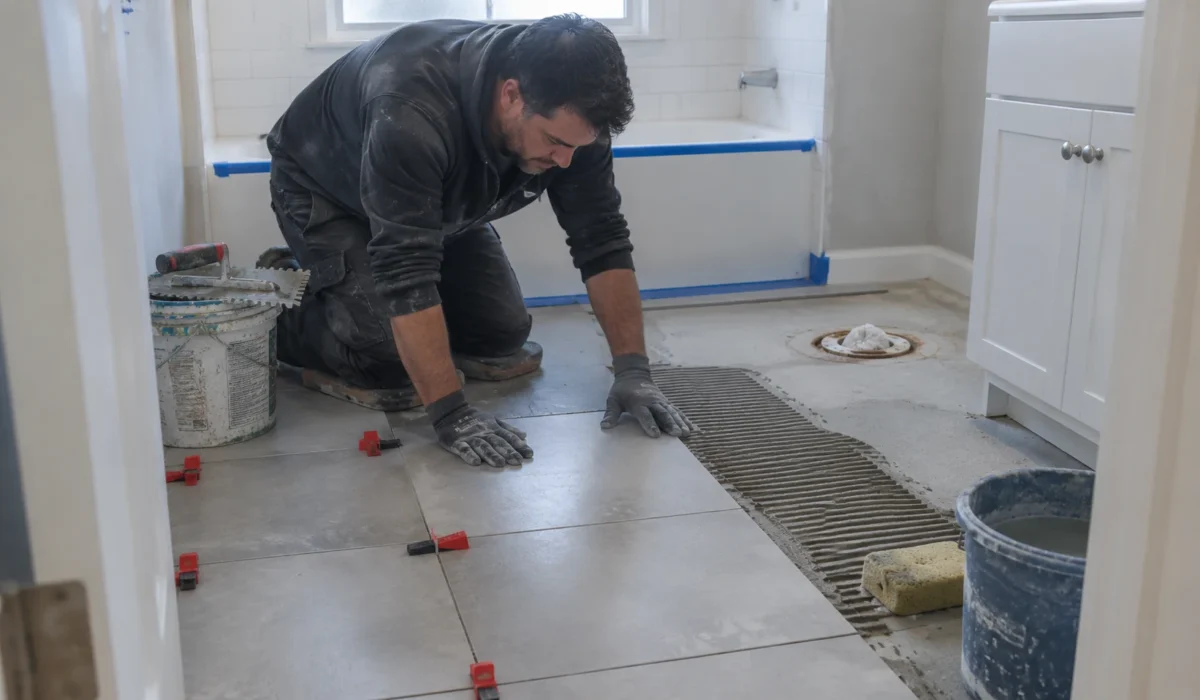
Porcelain tile is the best bathroom flooring for anyone planning to stay in the house or sell it. It absorbs less than 0.5% water by weight, it doesn’t care about standing water or humidity, and a properly installed porcelain floor will outlast the vanity, the toilet, and probably the next owner.
Ceramic tile is the softer, cheaper cousin. It’s fine for a low-traffic hall bath, but for a family bathroom or anywhere you’ll drop a shampoo bottle, porcelain’s density is worth the extra $2 to $4 per square foot.
The trade-offs are real. Tile is cold underfoot, which in a north-facing bathroom in February is not a small thing. Grout is the weak point: cement grout stains and needs sealing every year or two, while epoxy grout costs more up front and needs nothing. And tile is unforgiving of a bad subfloor. Over a wood subfloor it needs cement backer board or an uncoupling membrane, thin-set, and a day or two of cure time before you can walk on it.
Two details that separate a good tile job from an average one: a wet DCOF rating of 0.42 or higher on the spec sheet, and 100% silicone (not grout) at every change of plane, meaning where the floor meets the tub, the shower curb, and the wall.
Rigid-core waterproof LVP and LVT: warm, forgiving, and cheaper
Luxury vinyl plank is the best waterproof flooring for bathroom remodels on a budget, and it’s what I recommend for most powder rooms and kids’ baths. The plank itself is 100% waterproof if you buy a rigid core (SPC or WPC), it’s warm and quiet underfoot, and it can go down in a morning over a subfloor that would need a day of prep before tile.
LVT is the same material in a tile shape, often with a groutable edge. If the rest of your main floor is wood-look LVP, running the same plank into the bathroom gives you one continuous floor with no transition strip. If the hall is carpet or real hardwood, a tile-look LVT reads more natural than a plank that almost matches.
The real limits: a floating LVP floor has a void underneath, so water that gets past the perimeter can spread. It scratches more easily than porcelain. And it adds less resale value than tile in a primary bathroom, where buyers in Arlington or Bethesda still expect stone or porcelain. The full checklist for making LVP work in a bathroom is in the next section.
Sheet vinyl: the budget floor that’s better than its reputation
Modern sheet vinyl comes in 12-foot rolls, so a typical 5-by-8 bathroom has no seams at all. That makes it the most water-tight surface on this list short of a tanked shower pan. It’s warm, soft, cheap, and fast to install.
It’s also the floor most likely to look cheap if you buy the wrong pattern, and it can’t be spot-repaired: a gouge from a dropped razor or a dragged vanity means replacing the whole sheet. It’s probably the best flooring for bathroom rentals: I’d use it in a rental unit, a basement half bath, or a hall bath you plan to redo properly in five years. I wouldn’t put it in a primary bath you’re investing in.
Natural stone: beautiful, demanding
Marble, slate, travertine, and limestone are all porous. They work in a bathroom only if they’re sealed on install and resealed every one to three years, and even then, honed marble will etch from a dropped bottle of acidic cleaner. Polished stone gets dangerously slick when wet.
If you love the look and you’ll do the maintenance, a honed or tumbled stone with a wet DCOF over 0.42 is a legitimate choice for a primary bath. If you want the look without the upkeep, marble-look porcelain has gotten good enough that most people can’t tell the difference from standing height.
Is vinyl plank flooring good for bathrooms?
Yes, vinyl plank flooring is good for bathrooms, provided you buy a rigid-core product with a warranty that names bathrooms, seal the whole perimeter and the toilet flange with silicone, and install it over a flat, dry subfloor. Nearly every LVP bathroom failure I’ve seen came from skipping one of those three, not from the plank itself.
The specs to check before you buy
- Core type: SPC (stone plastic composite) or WPC (wood plastic composite) rigid core. Both are waterproof. Avoid flexible glue-down planks under 4 mm and peel-and-stick tiles; they’re fine for a closet, not a wet room.
- Wear layer: 12 mil minimum for a powder room or guest bath, 20 mil for a family bath or anywhere with kids and a dog. Wear layer matters more than total plank thickness.
- Warranty language: Read it. Many waterproof warranties exclude bathrooms, or exclude any damage from standing water. A product that names bathrooms in the residential warranty is the one to buy.
- Surface texture: An embossed or matte finish for grip. Glossy planks get slick.
- Radiant heat rating: If you’re adding electric floor heat, check the plank is rated for it and note the maximum surface temperature, typically around 80 to 85 degrees Fahrenheit.
Click-lock (floating) vs. glue-down in a bathroom
Floating click-lock LVP is faster, cheaper, and what most installers default to. It’s the right call for a powder room or a low-use guest bath.
Glue-down LVP bonds every plank to the subfloor, so there’s no void for water to travel through and no chance of a plank lifting at the toilet. It costs more in labor and needs a cleaner, flatter subfloor. For a busy family bath with a tub that gets splashed daily, I’d pay the difference.
Either way, the perimeter gets sealed.
The installation details that make or break it
Leave a 1/4-inch expansion gap at every wall, then fill it with 100% silicone before the baseboard or shoe molding goes on. Do the same where the floor meets the tub apron and the shower base.
The toilet is the single most common water-entry point in a bathroom floor. Pull it, run the planks under it with a small gap around the flange, seal the gap with silicone, and reset the toilet with a new wax ring or waxless seal. If the new floor is thicker than the old one, the flange may now sit below the finished floor and need an extender. Don’t caulk the entire toilet base; leave a small gap at the back so a future leak shows itself instead of pooling underneath.
Run the exhaust fan. A bathroom fan should move at least 1 cubic foot per minute per square foot of floor area, with a 50 CFM minimum, per Home Ventilating Institute guidelines. In DMV summers, when outdoor humidity sits above 70% for weeks, an undersized or unused fan is what turns a waterproof plank floor into a swollen baseboard and a mildew smell.
Best waterproof flooring for bathroom by type of bathroom
The best flooring for bathrooms changes with the room, because a powder room and a kids’ tub bath don’t see the same water. Here’s what I’d put in each.
Powder room (half bath). No tub, no shower, minimal water. This is where LVP shines: warm, quick, and cheap. It’s also the one room where a bold patterned porcelain or encaustic-look tile makes sense, because the square footage is tiny and the floor becomes the design.
Kids’ or family bath. Tub splashes, wet towels on the floor, and nobody wiping up. Porcelain tile with epoxy grout is the durable answer. If budget says vinyl, choose 20-mil glue-down LVP or single-sheet vinyl over a floating floor.
Primary bath. This is the room buyers judge. Porcelain or natural stone, ideally with electric radiant heat under it, is the move if you’re staying five-plus years or selling in a competitive market like McLean or Chevy Chase. Large-format porcelain in a 12-by-24 or 24-by-24 keeps grout lines to a minimum.
Basement bathroom. Concrete slabs in the DMV wick moisture year-round. Test the slab first (a plastic-sheet test taped down for 72 hours will show condensation if there’s a problem). Tile over a properly prepped slab is ideal. Rigid-core LVP with a vapor-barrier underlayment is the practical alternative, and it’s what our guide to best waterproof basement flooring recommends for most basement remodels.
Small bathroom (under 40 square feet). Fewer grout lines and a lighter color make the room read larger. A 12-by-24 porcelain laid in a straight or one-third offset, or a wide-plank LVP run the long way, both work. Avoid busy mosaics on the main floor; save them for the shower.
Bathroom flooring to avoid
Three floors show up in bathrooms constantly and fail constantly.
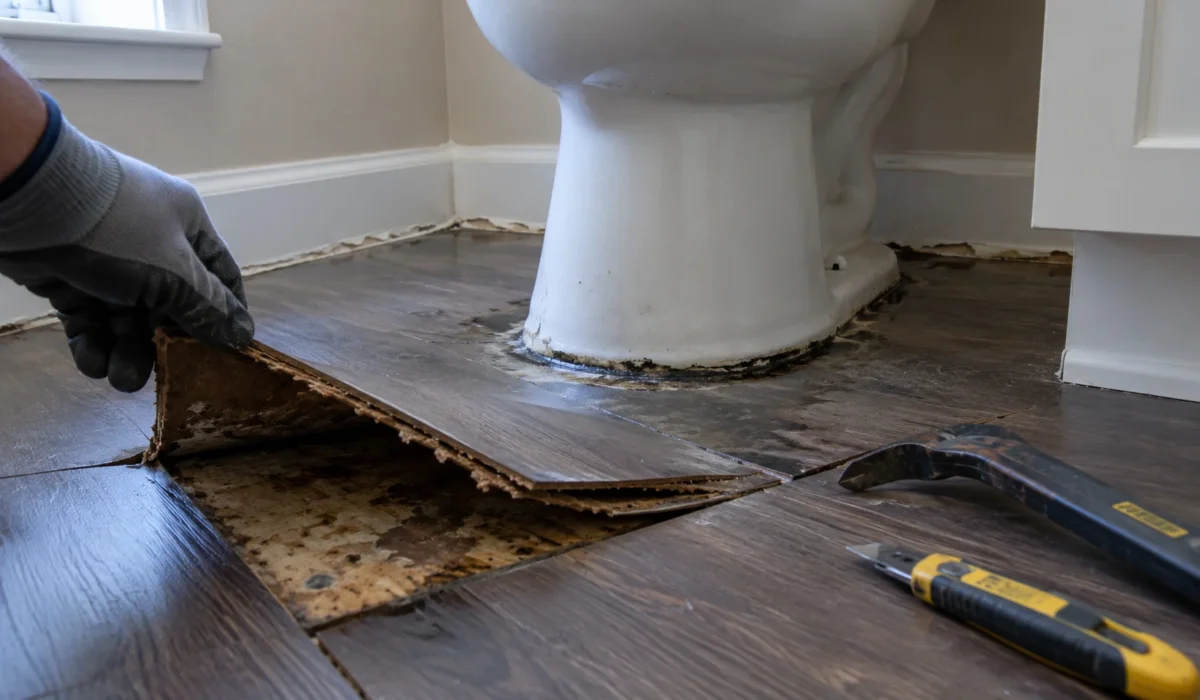
Solid and engineered hardwood. Wood moves with humidity. In a bathroom it cups, gaps, and eventually rots at the toilet. Site-finished hardwood with a marine-grade finish can survive a powder room with disciplined owners, but I wouldn’t put it in any bathroom with a tub or shower. If you want wood in the bathroom, use wood-look LVP or porcelain.
Laminate, including laminate sold as waterproof. The surface sheds water, but the core is compressed wood fiber. Water that reaches an edge or a seam swells it, and it doesn’t shrink back. Some newer laminates carry a waterproof label that covers surface spills for 24 to 72 hours, which is not the same as a waterproof floor. Our breakdown of what the waterproof label on laminate actually promises goes into the warranty language, but the short version is: keep it out of any room with a drain.
Carpet. Holds moisture, grows mildew, and can’t be cleaned properly. Even indoor-outdoor carpet in a bathroom is a mold farm. A washable bath mat over a hard floor gives you the warmth without the problem.
Bathroom flooring cost in Northern Virginia, Maryland, and DC
The best flooring for bathroom budgets is the one you can afford to install correctly, so it helps to know the real numbers. Bathrooms cost more per square foot than any other room in the house because the rooms are small, the cuts are many, and there’s a toilet in the way. Here’s what homeowners in the DMV typically pay in 2026, installed.
| Item | Typical DMV range |
|---|---|
| Rigid-core LVP or LVT, installed | $6 to $12 per sq ft |
| Sheet vinyl, installed | $5 to $9 per sq ft |
| Porcelain or ceramic tile, installed | $12 to $25 per sq ft |
| Natural stone tile, installed | $18 to $35+ per sq ft |
| Remove old tile floor | $2 to $5 per sq ft |
| Remove old vinyl or laminate | $1 to $2 per sq ft |
| Pull and reset toilet (new wax ring) | $150 to $300 |
| Subfloor patch or replacement | $150 to $400 for a typical repair |
| Electric radiant heat mat (under tile) | $10 to $20 per sq ft, plus thermostat |
For a common 5-by-8 hall bath (40 square feet), that works out to roughly $450 to $800 for LVP and $800 to $1,500 for porcelain tile once you add the toilet pull and a typical small-room minimum, before any subfloor surprises. Most installers carry a minimum charge for small rooms, which is why the per-square-foot number in a bathroom looks higher than the same product in a 300-square-foot living room.
Timelines are short. An LVP bathroom is typically a half day to one day, including pulling and resetting the toilet. A tile bathroom is typically two to three days: one for prep and backer board, one for setting, and grout the next morning, with light foot traffic after 24 hours and the toilet reset once the grout has cured.
If you’d rather see your own number than a range, the FIXO instant quote prices LVP for your square footage in about a minute, with removal, baseboards, and delivery included and the price fixed before anyone shows up.
Tile vs. LVP for a bathroom: how to decide
If you’re still torn on the best flooring for bathroom remodels in your house, use this rule. Choose porcelain tile if you’re staying long-term, remodeling a primary bath, planning radiant heat, or selling in a neighborhood where buyers expect it. Choose rigid-core LVP if the room is a powder room or kids’ bath, the budget is tight, the subfloor is uneven, or you want the same floor running from the hallway straight through the door.
The decision I see people get wrong most often is putting cheap LVP in a primary bath to save $600 on a $15,000 remodel. The floor is the surface you touch every morning; it’s the wrong place to economize in that room. The reverse mistake is tiling a 20-square-foot powder room with a $9-per-foot marble when a good LVT would have looked nearly identical and cost a third as much.
DIY or hire a pro? And what to ask before you sign
LVP in a powder room with no toilet complications and a flat subfloor is a reasonable weekend project for a confident DIYer with a jigsaw and a tapping block. Anything involving a toilet flange extender, subfloor repair, or a tub apron is where a pro earns the fee.
Tile is not a beginner project in a bathroom. The layout, the backer board, the thin-set coverage, the deflection check, and the silicone at every change of plane are each a place to get it wrong in a way that shows up two years later.
Before you hire anyone for bathroom floor installation, ask:
- Will you pull and reset the toilet, and is a new wax ring or seal included?
- How do you handle the flange if the new floor is thicker than the old one?
- What’s your plan if the plywood around the toilet is soft when you open it up?
- For tile: backer board or uncoupling membrane, and what deflection are you assuming?
- For LVP: is the perimeter sealed with silicone, and is the product’s warranty valid in bathrooms?
- Is the price fixed, or does it change when you find something?
An installer who answers those six without hesitating is one you can trust with the room, whatever you decide is the best flooring for bathroom use in your home. FIXO DMV installs bathroom floors across Northern Virginia, Maryland, and DC with a fixed price agreed before the job starts, and our tile flooring installation and LVP flooring installation pages cover exactly what’s included in each.
Frequently asked questions
What is the best flooring for a bathroom that gets a lot of use?
Porcelain tile is the best flooring for a bathroom with heavy daily use. It’s fully waterproof, dense enough to resist chips from dropped bottles, and lasts 30 years or more. Pair it with epoxy grout so you never have to seal it, and pick a matte or textured finish with a wet DCOF of 0.42 or higher for grip.
Is LVP or tile better for a bathroom?
Tile is the best bathroom flooring for longevity, resale, and radiant heat; LVP is better for warmth, comfort, cost, and speed of installation. Tile typically costs about twice as much installed. Use tile in a primary or family bath you’ll keep for years, and LVP in a powder room, a kids’ bath, or any remodel where the budget or the subfloor argues against tile.
Does vinyl plank need to be glued down in a bathroom?
No, but glue-down is the safer choice for a busy bathroom. Floating click-lock LVP works well in a powder room when the perimeter and the toilet flange are sealed with silicone. Glue-down removes the void beneath the planks, so water that gets past the edge has nowhere to travel, which matters more in a bath with a tub or shower.
What flooring should you avoid in a bathroom?
Avoid solid hardwood, engineered hardwood, laminate (including products labeled waterproof), and carpet. Wood-based cores swell when water reaches an edge or a seam and don’t recover. Carpet holds moisture and grows mildew. If you want a wood look, use wood-look porcelain tile or rigid-core LVP instead.
Can you put new flooring over old bathroom tile?
Sometimes. Rigid-core LVP can go over sound, flat, well-bonded tile if the grout lines are skim-coated with a leveling compound first, but the added height can leave the toilet flange too low and create a lip at the door. New tile over old tile is possible but rarely recommended. In most bathrooms, removing the old tile ($2 to $5 per square foot) gives a better result.
What is the warmest bathroom flooring?
Sheet vinyl and rigid-core LVP are the warmest bathroom floors underfoot because vinyl doesn’t pull heat from your feet the way tile and stone do. If you want tile and warmth, an electric radiant heat mat under porcelain adds $10 to $20 per square foot but makes the floor the most comfortable in the house.
How long does bathroom floor installation take?
Plan on one day for vinyl and three for tile. You can usually use an LVP or sheet vinyl bathroom the same evening, toilet included. With tile, the room is out of service until the grout has cured, which means no shower and no toilet for roughly 48 to 72 hours after setting, so line up a second bathroom or a neighbor before demo day.
The bottom line on bathroom flooring
The best flooring for bathroom use is porcelain tile when you’re investing in the room for the long haul, and rigid-core waterproof LVP when you want a warm, affordable floor that installs in a day. Sheet vinyl covers the budget end. Keep hardwood, laminate, and carpet out of any room with a drain.
Whichever you pick, the floor lasts as long as its weakest edge. Insist on a flat, dry subfloor, a sealed perimeter, and a properly reset toilet, and either material will still look right in fifteen years.
If you’re in Northern Virginia, Maryland, or DC and want a fixed number for your bathroom, FIXO will price it online in about a minute, bring samples to your door, and have the floor down in one to two days. Get your instant quote or call (757) 589-6859, any day from 8am to 8pm.
 4.9 on Google14 reviews
 Licensed & InsuredVirginia · Maryland · Washington, D.C.
 Workmanship GuaranteedInstallation backed in writing
 Locally OwnedServing NoVA, MD & D.C.