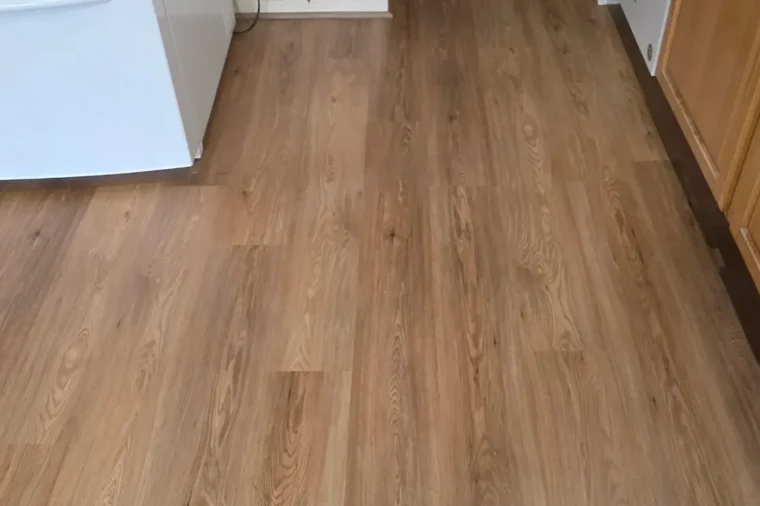
The best waterproof flooring for most homes is rigid core luxury vinyl plank (LVP): fully waterproof, warm underfoot, wood-look, and about $5 to $11 per square foot installed in the DMV. Porcelain tile is the most waterproof and longest lasting. Sheet vinyl is the cheapest. “Waterproof” laminate resists water only for a rated time. And no floor is truly waterproof as a system: water that gets past the edges or seams can still reach the subfloor.
“Waterproof” is now printed on almost every box in the flooring aisle, and it doesn’t always mean the same thing. This guide explains what waterproof flooring really is, compares every type side by side with DMV prices, shows which one fits each room, and covers the installation details that decide whether a waterproof floor actually protects your home.
In this guide waterproof-flooring
- Waterproof vs water-resistant: what the label really means
- Types of waterproof flooring compared
- Rigid core LVP: SPC vs WPC
- Best waterproof flooring by room
- A waterproof floor isn’t a waterproof room
- What happens when waterproof flooring floods
- How to read a waterproof flooring label and warranty
- Waterproof flooring cost
- Frequently asked questions
Waterproof vs water-resistant: what the label really means
- Waterproof means the material itself won’t swell, warp or break down when wet, even with standing water. Rigid core vinyl, porcelain tile and sheet vinyl qualify.
- Water-resistant means the surface sheds spills for a limited time. Standard laminate and engineered hardwood are water-resistant at best.
- “Waterproof” laminate sits in between: sealed edges and treated cores resist water for a rated period, often 24 to 72 hours, if spills are cleaned up. It’s a big improvement over old laminate, but it isn’t the same as vinyl or tile. Our guide on whether laminate flooring is waterproof explains the fine print.
Types of waterproof flooring compared
| Flooring | How waterproof | Look | Feel | Installed cost (DMV) | Typical life |
|---|---|---|---|---|---|
| Rigid core LVP / LVT | Fully waterproof plank | Wood or stone | Warm, slight give | About $5 to $11 per sq ft | 15 to 25 years |
| Porcelain tile | Fully waterproof (seal or epoxy the grout) | Stone, wood-look, concrete | Hard, cold | About $12 to $24 per sq ft | 30+ years |
| Sheet vinyl | Fully waterproof, few or no seams | Varies; less realistic | Soft | About $4 to $8 per sq ft | 10 to 20 years |
| Hybrid resilient | Waterproof core, hard top layer | Wood | Firm | A bit more than LVP | 15 to 25 years |
| Waterproof laminate | Resists water for a rated time | Most realistic wood texture | Firm | About $5 to $9 per sq ft | 15 to 25 years if kept dry underneath |
| Sealed or epoxy concrete | Fully waterproof | Industrial | Hard, cold | Varies by system | Decades |
| Rubber | Fully waterproof | Utility | Cushioned | Varies | Long |
For a broader look at waterproof options room by room, Angi’s waterproof flooring guide has national price data.

Rigid core LVP: SPC vs WPC
Vinyl flooring has come a long way from peel-and-stick tiles. Today’s waterproof planks have a rigid core in one of two types:
- SPC (stone plastic composite): a dense limestone-and-PVC core. Thinner, harder, more dent resistant and more stable in temperature swings. Feels firmer.
- WPC (wood plastic composite): a foamed core that’s thicker and softer. Quieter and warmer underfoot, but dents more easily under heavy furniture.
Both are fully waterproof. What matters more for lifespan is the wear layer: 12 mil for light use, 20 mil for kitchens, families and pets, and 28 mil or more for commercial use. Learn more in what is LVP flooring and our guide to how waterproof LVP really is.
Best waterproof flooring by room
| Room | Best choice | Read more |
|---|---|---|
| Kitchen | Rigid core LVP or porcelain tile | Best flooring for a kitchen |
| Bathroom | Porcelain tile or rigid core LVP | Best flooring for a bathroom |
| Basement | Rigid core LVP; porcelain if it has flooded | Best waterproof basement flooring |
| Laundry room | Porcelain tile, LVP or sheet vinyl | Laundry room flooring |
| Homes with pets | Rigid core LVP, 20 mil wear layer | Best flooring for dogs and pets |
| Mudroom and entry | Porcelain tile or LVP with a walk-off mat | |
| Living areas (whole main level) | Rigid core LVP for one continuous floor | LVP vs laminate vs engineered hardwood |
A waterproof floor isn’t a waterproof room
A waterproof plank stops water from damaging the plank. It doesn’t stop water from running through the expansion gap at the walls, down the seams, or under the edge into the subfloor. A slow leak under a waterproof floor can rot plywood for months before anyone notices. To protect the room, not just the floor:
- Seal the perimeter in wet rooms with 100% silicone at tubs, toilets and the base of sink cabinets, as the manufacturer allows.
- Use a vapor barrier over concrete. Slab moisture rises from below no matter what’s on top.
- Add leak sensors under the sink, behind the toilet, next to the water heater, at the washing machine and the dishwasher.
- Replace braided supply lines on old toilets, sinks and washers, the most common slow leaks.
- Get the subfloor flat. Dips flex the locking joints and open gaps at the seams.
What happens when waterproof flooring floods
| Floor | After a burst pipe or flood |
|---|---|
| Porcelain tile | Survives; dry it out and clean the grout |
| Sealed concrete | Survives; dry it out |
| Rigid core LVP | Planks survive, but usually need lifting so the subfloor can dry; click-lock planks can often be reinstalled |
| Sheet vinyl | Surface survives; water trapped beneath may require removal |
| Waterproof laminate | Often replaced once water sits longer than the rated time |
| Engineered or solid hardwood | Usually replaced |
How to read a waterproof flooring label and warranty
- “100% waterproof” vs “waterproof for 72 hours”. The second is a time limit, not a material property.
- Topical water only. Many warranties cover spills from above but exclude flooding, leaks from below, and plumbing failures.
- Installation rules. Warranties usually require a vapor barrier over concrete, flatness within spec, and an expansion gap. Skip one and coverage can be void.
- Wear layer and core. Check the mil rating for vinyl and the AC rating for laminate, not just the word “waterproof.”
- Room limits. Some “waterproof” laminates still exclude full bathrooms.
Waterproof flooring cost
For a 300 sq ft kitchen and family room in Northern Virginia, expect roughly:
- Sheet vinyl: about $1,200 to $2,400
- Rigid core LVP: about $1,500 to $3,300
- Waterproof laminate: about $1,500 to $2,700
- Porcelain tile: about $3,600 to $7,200
Removal, leveling and stairs are usually extra. See LVP flooring installation cost and tile flooring installation cost for full breakdowns.
Waterproof flooring installation with FIXO
FIXO installs waterproof rigid core LVP and porcelain tile across Northern Virginia, Maryland and DC. Our laminate is water-resistant, not waterproof, so we don’t put it in bathrooms, laundry rooms or below-grade basements; where a room gets wet, we install LVP or tile instead. You see a fixed price in about 60 seconds with the instant quote, an installer checks your subfloor within 48 hours, and most installs finish in 1 to 2 days. You can also follow FIXO on GitHub.
Frequently asked questions
What is the best waterproof flooring?
Rigid core luxury vinyl plank is the best waterproof flooring for most homes. It’s fully waterproof, warm and comfortable, looks like wood, and costs much less than tile. Porcelain tile is the best choice where water stands for long periods, such as full bathrooms and basements that have flooded.
What is the cheapest waterproof flooring?
Sheet vinyl is the cheapest waterproof flooring, at about $4 to $8 per square foot installed in the DMV. Entry-level rigid core LVP costs a little more and looks far more like real wood.
Is waterproof flooring really waterproof?
The material is, but the floor as a whole isn’t sealed. Water can run through seams, the expansion gap at the walls, or under edges and reach the subfloor. Sealing the perimeter in wet rooms and fixing leaks quickly protects the subfloor.
Is SPC or WPC better?
Both are fully waterproof. SPC is denser, more dent resistant and more stable in temperature swings, so it’s better for busy homes and sunrooms. WPC is thicker, softer and quieter underfoot, so it’s more comfortable in bedrooms and living areas.
Is waterproof laminate as good as vinyl?
Not for water. Waterproof laminate resists spills for a rated time and has the most realistic wood texture, but its core can still swell if water sits too long. Rigid core vinyl is waterproof all the way through, so it’s safer in kitchens, bathrooms and basements.
Can waterproof flooring go in a bathroom?
Yes. Porcelain tile and rigid core LVP are both good bathroom floors. Seal the perimeter at the tub and toilet with silicone, and choose a product whose warranty allows full bathrooms.
Final Thoughts
Waterproof flooring has made wet rooms, basements and pet-filled homes far easier to floor well. For most DMV homes, rigid core LVP is the right answer, with porcelain tile where water stands and sheet vinyl on a tight budget. Read the label carefully, and remember that sealing the edges and fixing leaks matters as much as the plank you choose.
Ready for a price? Get a fixed price in 60 seconds or call (757) 589-6859, any day from 8am to 8pm.
 4.9 on Google14 reviews
 Licensed & InsuredVirginia · Maryland · Washington, D.C.
 Workmanship GuaranteedInstallation backed in writing
 Locally OwnedServing NoVA, MD & D.C.