Vinyl plank flooring on stairs works well when every tread and riser is glued down and finished with a matching stair nosing. Floating click installs are not used on stairs. Under the International Residential Code, each flight still has to keep risers no taller than 7-3/4 inches, treads at least 10 inches deep and no more than 3/8 inch of variation between steps, so the added thickness matters. In the DC area, plan on roughly $45 to $120 per step installed.
Carpeted stairs are often the last thing left when a home switches to luxury vinyl plank. Running the same planks up the staircase ties the levels together and ends the vacuuming of 13 dusty treads. It is also the most detailed part of any LVP job, because every step is a custom cut, every edge is on display and the result has to be safe underfoot.
This guide covers whether LVP suits your stairs, the nosing options, the building code limits, prep, how the install works, what it costs and how to keep it from being slippery. Alvin wrote it for FIXO, which installs LVP and stair flooring across the DC region, including Northern Virginia and suburban Maryland.
What this stair guide covers
Key takeaways
- Stairs are glued, not floated. Manufacturers and building practice treat stair installs as glue-down work.
- Every tread needs a nosing, either a separate stair nose piece or a one-piece tread cap with the nose built in.
- Adding flooring can change the first and last step height, so the 3/8 inch variation limit needs checking before work starts.
- Textured, matte planks and a well-gripping nosing make vinyl stairs far less slippery than glossy products.
- In the DC area, LVP stairs with matching nosing usually cost about $45 to $120 per step.
Is Vinyl Plank Flooring Good on Stairs
For most homes, yes. It suits busy family stairs, basement stairs and any staircase that connects two LVP floors. It is a weaker choice where you want the warmth and refinishing potential of real wood.
| Advantages | Drawbacks |
|---|---|
| Matches the LVP on the floors above and below | Glossy products can feel slippery |
| Waterproof and easy to clean | A damaged tread is harder to swap than a floor plank |
| Resists scratches from pets and shoes | Poor gluing leaves a hollow sound |
| Costs less per step than hardwood treads | Cannot be sanded and refinished |
Stair Parts and Terms
A few terms come up in every stair flooring quote.
- Tread: the flat part you step on.
- Riser: the vertical face between treads.
- Nosing: the rounded front edge of each tread.
- Skirt board: the trim along the side of a closed staircase that treads and risers butt against.
- Return: on an open-sided stair, the finished end of a tread that is exposed to view.
- Landing: the flat platform partway up or at the top, which needs its own nosing at the edge.
Stair Nosing Options
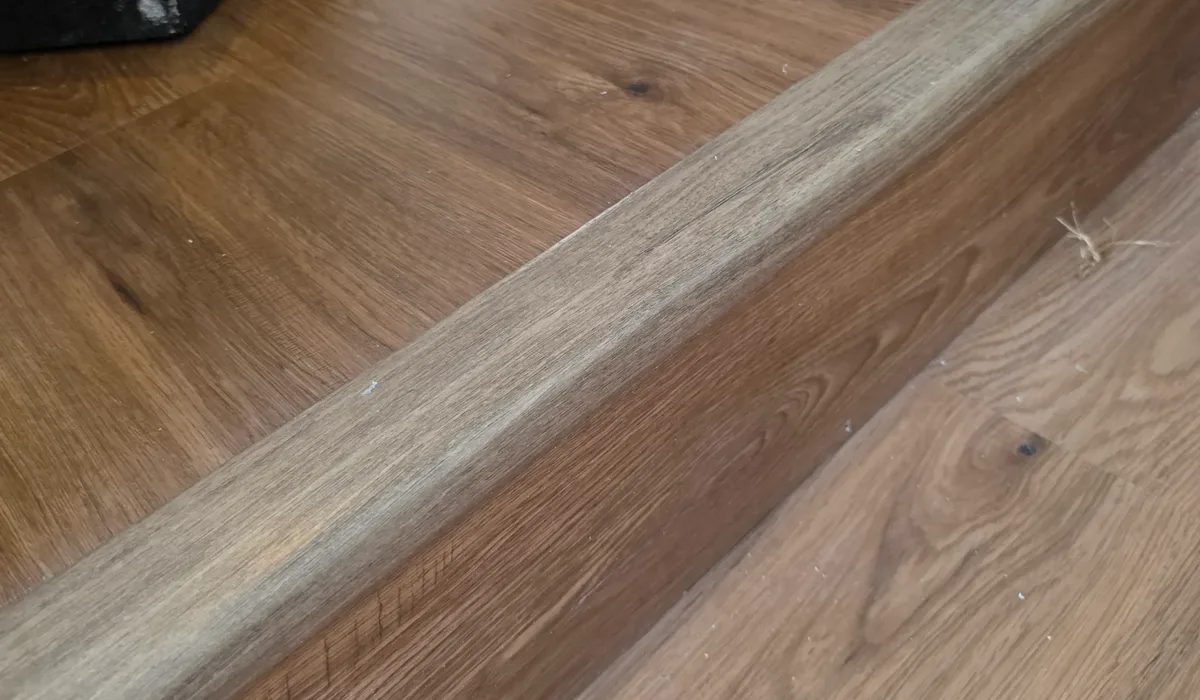
The nosing is what makes LVP stairs look finished, and it is the piece that takes the most wear. Most LVP lines sell matching profiles.
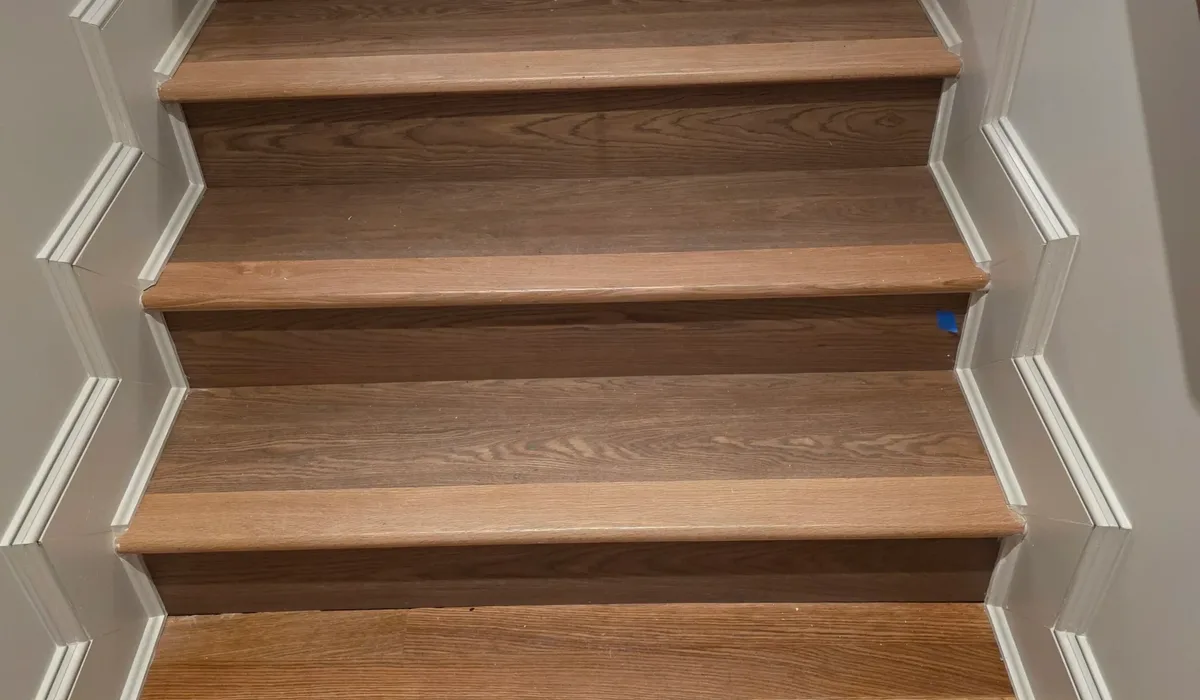
Flush Stair Nose
A flush nose locks into the edge of the plank and sits level with the tread surface. It gives a clean, built-in look and is the standard choice at landings and the top step, where the floor runs straight to the edge.
Overlap Stair Nose
An overlap nose sits on top of the plank and covers its edge. It is a little more forgiving of uneven treads and slightly easier to fit, but it leaves a small lip you can feel underfoot.
One-Piece Stair Tread
Some LVP lines offer full treads with the nose molded in. They are faster to install and have no seam across the step, but they cost more per step and are not made for every product.
Building Code Limits
New flooring adds thickness to every tread, and stairs have tight rules. The International Residential Code, which Virginia, Maryland and DC base their residential codes on, sets these limits in section R311.7.5:
- Maximum riser height of 7-3/4 inches.
- Minimum tread depth of 10 inches.
- A nosing of 3/4 to 1-1/4 inches where treads are less than 11 inches deep.
- No more than 3/8 inch difference between the tallest and shortest riser, or deepest and shallowest tread, in a flight.
The InterNACHI summary of stair rise and run shows how these are measured. The rule that catches people is the 3/8 inch variation. If you cover the treads but the floor at the bottom stays the same, the bottom riser gets taller while the others stay equal. When new flooring goes on both the upper and lower floors too, both ends rise by a similar amount and the flight stays even. An installer should check this before cutting anything.
Preparing Carpeted Stairs
Most stair conversions in DMV homes start with carpet, and those stairs were built to be covered.
- Strip everything. Carpet, pad, tack strip and every staple come out.
- Check the treads. Builder-grade treads under carpet are often plywood, particleboard or rough pine. They need to be solid and screwed tight, with squeaks fixed now.
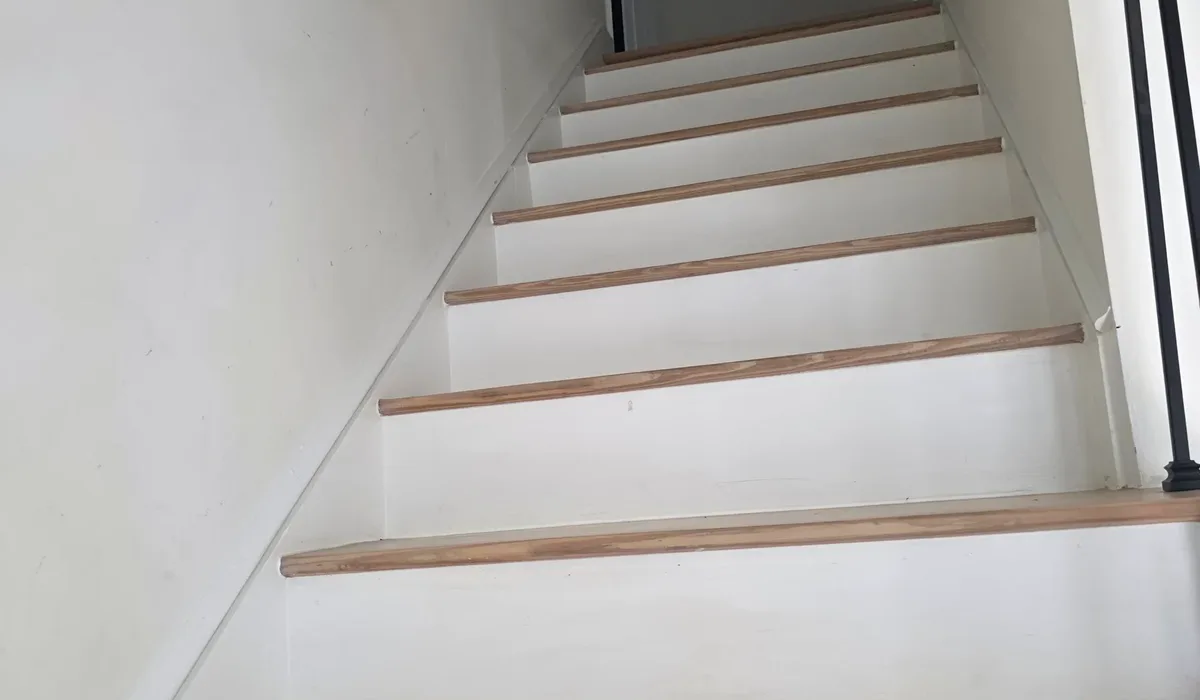
- Trim the bullnose. On many carpeted stairs, the original rounded lip of each tread overhangs the riser. On a cap-over job, that lip is trimmed off level with the riser face, giving the new nose a tight seat.
- Flatten and sand. High spots and old glue are sanded so the adhesive bonds fully.
- Clean. Dust is vacuumed off, since it weakens the adhesive bond.
How Vinyl Plank Flooring on Stairs Is Installed
Systems differ, so the product’s stair instructions come first, but most jobs follow this pattern.
Glue, Do Not Float
On stairs, planks are bonded to each tread and riser with the adhesive the manufacturer specifies, often a premium construction adhesive. Beaulieu’s flush stair nose installation guide notes that floating floors are not allowed on stairs, so the planks are glued, and that no expansion gap is needed between treads and risers. The same guide has the first 12 to 16 inches of the upper floor glued where it meets the top stair nose, so the floating floor cannot pull away from it.
Measure Every Step
No two treads are exactly the same width or depth, especially in older homes. Each tread and riser is measured and scribed to the skirt boards on its own, rather than cut from one template.
Install Risers, Treads and Nosings
A common sequence is riser first, then the tread plank, then the nosing on the front edge, working one step at a time. Some systems start from the top step and work down so you are never kneeling on fresh glue. Open-sided stairs need mitered returns at the exposed ends, which take extra time.
Finish the Landing
The top landing and any midway landing get a flush nose where they meet the drop. The landing floor then ties into the rest of the level.
Let It Cure
Most adhesives need around 24 hours before heavy use. Light foot traffic is usually fine sooner, but follow the label.
Matching Floors and Stairs
The stairs are the most visible place in the house for a color mismatch.
- Order nosings with the planks. Matching stair noses are made in the same color but can vary between production runs, so buy them in the same order.
- Pick planks for the nosing. Installers often choose the planks closest in shade to the nosing for each step.
- Consider painted risers. White or painted risers with LVP treads are a popular look, use fewer planks and hide small color differences.
- Run grain front to back or side to side. Planks usually run the width of the tread, which looks most natural from the bottom of the stairs.
Keeping Vinyl Stairs Safe
The most common worry about vinyl stairs is slipping, especially in socks.
- Choose a textured or embossed plank with a matte finish rather than a glossy one.
- Use nosings with a grooved or textured top, and confirm every nose is fully bonded with no movement.
- Keep the treads clean and dry. Dust and polish both make vinyl slicker.
- Add clear anti-slip strips or stair runners if young children or older relatives use the stairs.
- Make sure the handrail is solid and the staircase is well lit, top and bottom.
What Vinyl Stairs Cost Per Step
Stairs are priced per step, not per square foot, because the labor is in the cutting and fitting. In FIXO’s wood stair installers guide, LVP or laminate stairs with matching nosing run about $45 to $120 per step in the DC area in 2026, so a typical 13-step flight lands around $585 to $1,560.
The price rises for open-sided stairs with returns, winders and curved bottom steps, damaged treads that need replacing, and one-piece tread caps. Landings are usually priced like floor area. A straight flight is typically finished in a day. The LVP installation cost calculator includes a stairs line so you can see it alongside the rest of the floor.
Vinyl Plank Flooring on Stairs FAQs
Can you put vinyl plank flooring on stairs?
Yes. LVP works well on stairs when each tread and riser is glued down and finished with a matching stair nose. Most LVP lines sell nosings and some sell one-piece stair treads.
Do you glue vinyl plank on stairs?
Yes. Floating installs are not used on stairs. Planks are bonded to treads and risers with the adhesive the manufacturer specifies, and the floor at the top landing is usually glued near the stair nose.
Is vinyl plank flooring slippery on stairs?
Glossy products can be. Textured, matte planks with a grooved stair nose are much safer, and anti-slip strips or a runner help in homes with young children or older adults.
How much does it cost to put LVP on stairs?
In the DC area, LVP stairs with matching nosing typically cost about $45 to $120 per step installed. A 13-step flight usually lands between about $585 and $1,560, with open sides and winders costing more.
What stair nose should I use with LVP?
A flush stair nose gives the cleanest look and is standard at landings. An overlap nose is a little more forgiving on uneven treads. One-piece treads with a built-in nose are fastest but cost more.
Will LVP on stairs meet building code?
It can, as long as the finished flight keeps risers at or under 7-3/4 inches, treads at least 10 inches deep, and no more than 3/8 inch variation between steps. Check the first and last step heights before installing.
Planning Your Staircase
Vinyl plank flooring on stairs is a smart way to finish an LVP project, as long as it is glued properly, nosed on every step, checked against the code limits and chosen with a textured finish. Plan the stairs at the same time as the floors so the colors, nosings and heights all line up.
FIXO covers stairs as their own itemized line on every LVP quote, with matching nosings. See our LVP flooring installation service, our stair installation guide, or use the instant quote form to add your step count to your price.
 4.9 on Google14 reviews
 Licensed & InsuredVirginia · Maryland · Washington, D.C.
 Workmanship GuaranteedInstallation backed in writing
 Locally OwnedServing NoVA, MD & D.C.