Vinyl flooring installation in Northern Virginia typically lands between $4 and $9 per square foot once installed, and most homes are finished in one or two days. Fairfax County lists replacing flooring material as work that needs no building permit, but Virginia requires a DPOR-licensed contractor for home improvement jobs over $1,000. The details that change the price are the type of vinyl, what has to come up first, how flat the subfloor is and whether a condo or HOA has rules of its own.
Northern Virginia packs a lot of housing styles into a short drive. A 1958 rambler in Annandale, a 1980s townhouse in Reston, a new single-family home in Ashburn and a high-rise condo in Ballston all take vinyl differently. Get the prep and the product right for the house, and luxury vinyl plank will look sharp and shrug off spills for years. Get them wrong, and the planks click, gap or bounce within a season.
This guide walks through vinyl flooring installation in Northern Virginia in nine steps, from choosing a product to the final walkthrough. It also covers local rules, costs, and how to compare vinyl flooring installers. Alvin wrote it for FIXO, whose two-person crews lay vinyl in homes from Arlington and Alexandria out to Loudoun and Prince William counties.
What this Northern Virginia vinyl guide covers
- Types of vinyl flooring
- Vinyl by Northern Virginia home type
- Permits, licenses and HOA rules
- 9 steps of a vinyl installation
- What vinyl flooring costs here
- How long the job takes
- Vinyl in basements
- Vinyl compared with laminate and hardwood
- Mistakes that shorten a vinyl floor’s life
- Choosing vinyl flooring installers
- Care after installation
- FAQs
- Planning your project
Key takeaways
- Most Northern Virginia homeowners choose rigid core luxury vinyl plank because it is waterproof, quick to install and comes with matching stair parts.
- Fairfax County’s permit page lists replacement of flooring material as exempt, though structural, plumbing and electrical changes are not.
- A Virginia home improvement job over $1,000 calls for a contractor licensed by DPOR, and you can check the number online.
- Planned prep, not the planks, decides how long the floor lasts: flatness, moisture control and a proper expansion gap.
- FIXO’s planning range for installed LVP in the DC area runs from about $4 to $9 per square foot, depending mostly on plank grade.
Types of Vinyl Flooring
Vinyl is a family of products, not a single floor. Knowing which one you are being quoted helps you compare prices fairly.
| Type | How it installs | Best fit |
|---|---|---|
| Rigid core luxury vinyl plank (SPC or WPC) | Clicks together and floats | Main levels, basements, kitchens, whole homes |
| Glue-down luxury vinyl plank or tile | Bonded to the subfloor with adhesive | Stairs, commercial spaces, rooms with rolling loads |
| Luxury vinyl tile (LVT) | Click or glue-down, square or rectangular | Bathrooms, laundry rooms, stone-look designs |
| Sheet vinyl | Rolled out, glued or loose-laid | Small bathrooms and laundry rooms, budget rentals |
Rigid core luxury vinyl plank is what most homeowners mean when they say vinyl today. SPC cores are dense and dent-resistant. WPC cores are a little thicker and softer underfoot. For a full rundown of the layers, see our luxury vinyl plank explainer.
Vinyl Flooring Installation in Northern Virginia by Home Type
The region’s houses fall into a few broad groups, and each one brings its own prep.
1950s and 60s Ramblers and Split-Levels
Annandale, Springfield, Falls Church and parts of McLean are full of mid-century brick ramblers and split-levels. These houses often hide 9 by 9 inch vinyl tiles or old sheet goods under carpet. Tiles from that era sometimes contain asbestos, so have a sample tested before anyone scrapes them. Many installers float new luxury vinyl plank over sound, well-bonded old tile instead of tearing it out.
1970s and 80s Colonials and Townhouses
Reston, Burke, Centreville and Herndon have large planned communities from this period. Townhouses usually mean narrow stairs, three levels and a walk-out basement. Subfloors are often OSB panels with swollen edges near kitchens and baths, which need sanding before vinyl goes down.
Newer Loudoun and Prince William Homes
Ashburn, Brambleton, South Riding, Leesburg and Bristow have many homes built in the last 25 years. Builder-grade carpet and laminate are the usual tear-outs. The finished basements here are good candidates for waterproof vinyl, as long as someone tests the slab for moisture before the planks go down.
High-Rise Condos
Rosslyn, Ballston, Crystal City and Tysons have concrete towers with association rules on sound control. Expect to need a sound-rated underlayment, written approval and booked elevator time before vinyl flooring installation in Northern Virginia condos can start.
Permits, Licenses and HOA Rules
Permits
Fairfax County’s when is a permit required page lists replacement of flooring material and replacement of tiles among residential work that needs no permit. The county notes that the list is not exhaustive, and moving walls, plumbing or wiring is different. Arlington, Loudoun and Prince William counties, along with Alexandria and the City of Fairfax, each have their own building office, so check yours if the job goes beyond a floor swap.
Contractor Licensing
Virginia’s Department of Professional and Occupational Regulation licenses contractors, and a home improvement job over $1,000 needs a licensed firm. Ask every bidder for their license number and check it on the DPOR license lookup before you sign anything.
Lead-Safe Work
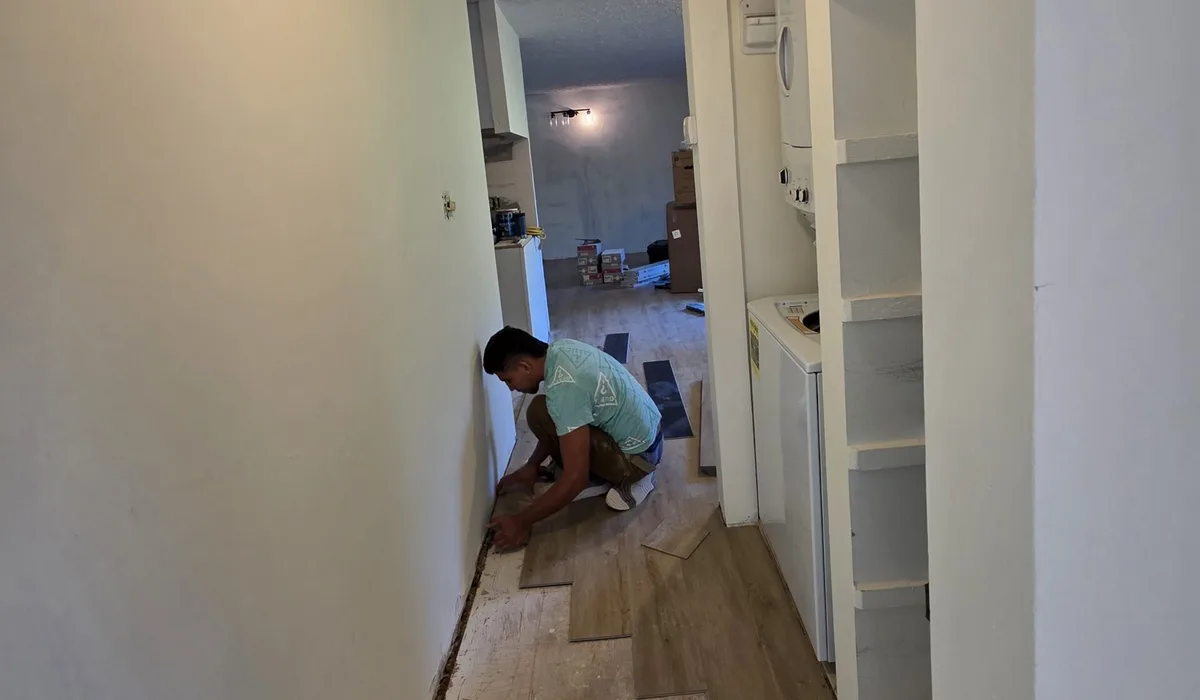
Much of inner Northern Virginia was built before 1978. Pulling baseboards, door casings or painted trim in those homes can disturb lead paint. Under the EPA’s lead renovation rule, contractors paid to disturb painted surfaces in pre-1978 homes must be certified and follow containment and cleanup practices.
HOAs and Condo Boards
Many Loudoun and Fairfax communities require architectural approval only for exterior changes, but condo associations almost always regulate hard floors. Get the written flooring policy, required sound rating and work hours before you order material.
9 Steps of a Vinyl Installation
A well-run job for vinyl flooring installation in Northern Virginia follows the same order whether it is one bathroom or a whole house.
1. Measure and Inspect
An installer measures every room, counts stairs and doorways, and checks the subfloor for flatness, squeaks and moisture. This visit is where surprise costs should come out, not on install day. At FIXO, the person who measures is on the crew that installs.
2. Choose the Plank
Pick the core, wear layer and look in the room’s own light. A 12 mil wear layer handles most homes, while 20 mil suits big dogs, rentals and busy mudrooms. Our wood-look vinyl guide helps with choosing a realistic look.
3. Store the Material
Rigid core products need far less acclimation than wood, but the boxes should still sit flat in the conditioned house, away from heat vents and direct sun, for whatever time the manufacturer lists.
4. Clear and Protect
Furniture moves out, and doorways, stair rails and walls get covered. In occupied townhouses, the crew usually works one level at a time so the family keeps a usable floor.
5. Remove the Old Floor
Carpet, pad, tack strip, staples and loose vinyl come up and are hauled away. Old adhesive ridges get scraped, because every bump telegraphs through a thin plank.
6. Prepare the Subfloor
Loose panels are screwed down, high spots sanded and low spots filled. A common rigid core tolerance is 3/16 inch under a 10-foot straightedge. For the methods, read our subfloor leveling before flooring guide.
7. Lay the Underlayment
On concrete, a vapor barrier is laid first unless the maker approves the plank straight on the slab. In condos a sound mat goes down to meet the building’s rating. Planks with an attached pad usually need nothing else over a wood subfloor.
8. Install the Planks
Rows are planned so the last row is not a sliver and end joints are staggered. The luxury vinyl plank locks together row by row, with the maker’s expansion space left at every wall, and is trimmed at door casings, which are undercut so the planks slide beneath them.
9. Trim, Transitions and Walkthrough
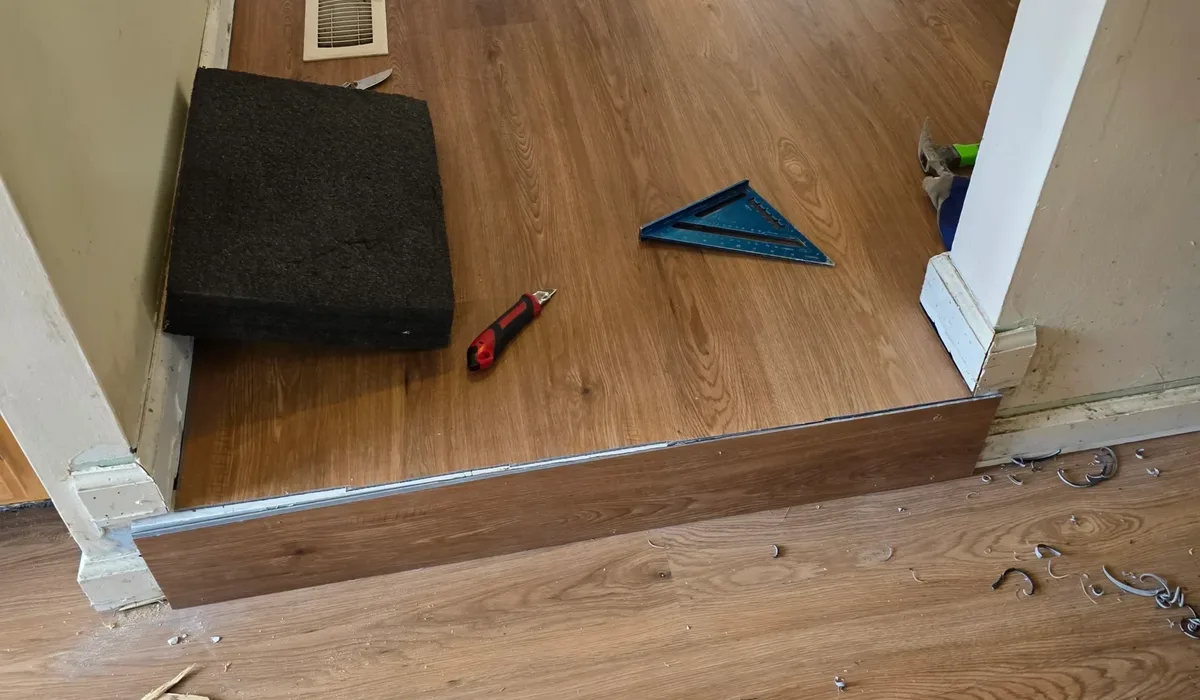
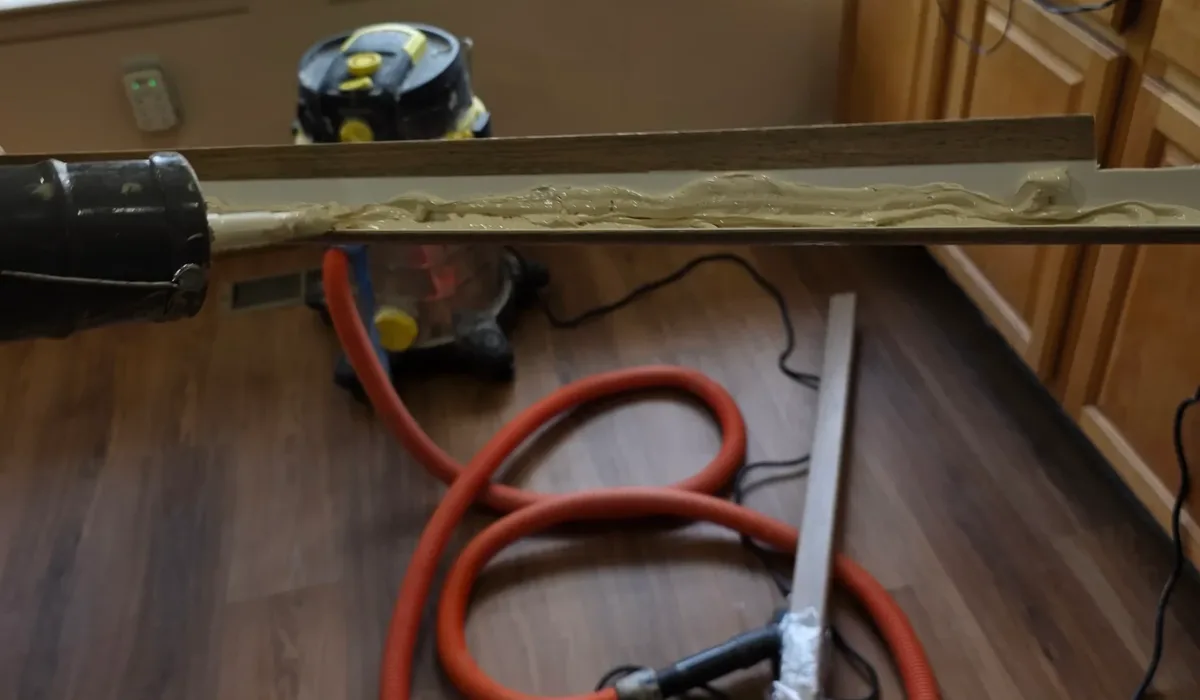
Thresholds, reducers and stair nosings go in, baseboards or shoe molding cover the gap, and the floor is vacuumed. A good crew walks the floor with you before leaving. If stairs are part of the job, see our guide to vinyl plank flooring on stairs.
What Vinyl Flooring Costs in Northern Virginia
For vinyl flooring installation in Northern Virginia, plank grade moves the total more than anything else. The figures below are drawn from the DC-area numbers in our LVP flooring installation cost guide.
| Plank grade | Wear layer | Typical installed price |
|---|---|---|
| Entry or rental grade | 6 to 8 mil | About $4.00 to $5.50 per sq ft |
| Mid-grade SPC rigid core | 12 to 20 mil | About $5.00 to $7.00 per sq ft |
| Premium wide plank | 20 to 30 mil | About $6.50 to $9.00 per sq ft |
Old floor removal, leveling, new baseboard, transitions and stairs sit on top of those figures. Stairs with matching nosing usually add about $45 to $120 per step. Plug your own room sizes into the LVP installation cost calculator for a closer number.
How Long the Job Takes
On a typical vinyl flooring installation in Northern Virginia, a single main level of about 600 square feet is ready to walk on by evening. Whole-house jobs that include stairs generally run two days. Add a day when a self-leveling compound needs to cure, or when old tile has to come out. Condo jobs can stretch if the building limits work hours or elevator time.
Vinyl Flooring Installation in Northern Virginia Basements
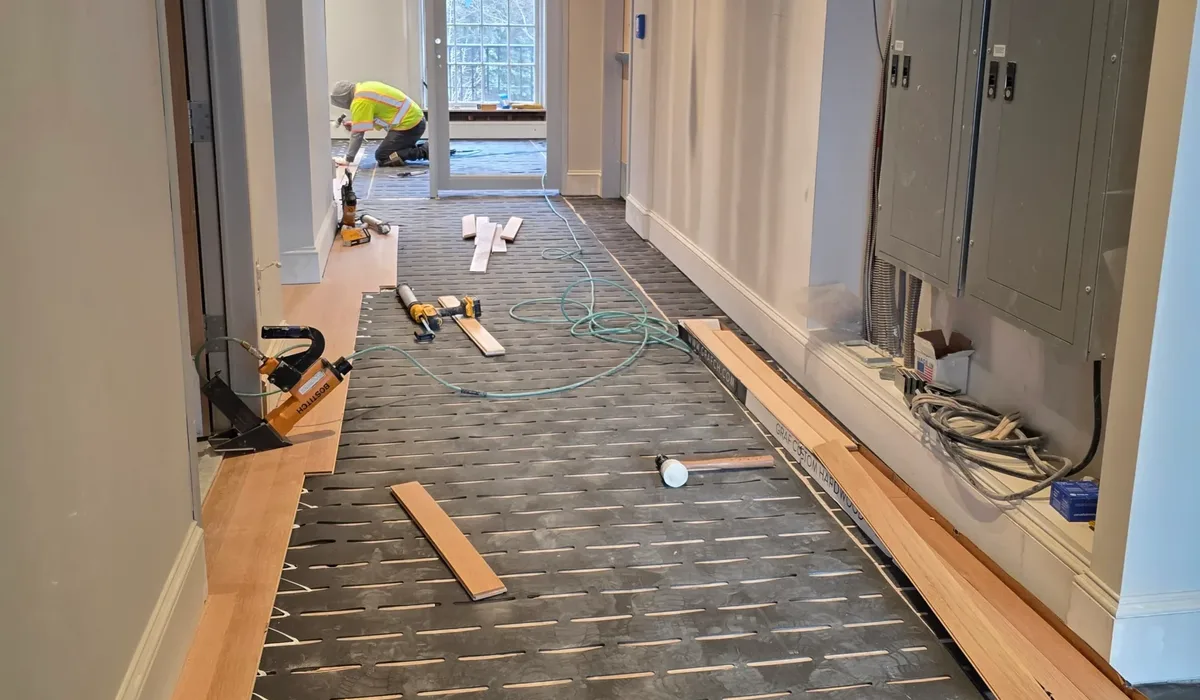
Basements are where vinyl earns its keep in this region. Summer humidity, heavy thunderstorms and clay soils mean many lower levels see some dampness, even in newer Loudoun homes. Rigid core vinyl will not swell or rot, but the slab under it still needs attention.
- Look for water first. Efflorescence, rust on nail heads, musty smells and stained drywall all point to moisture that should be fixed before any floor goes in.
- Test the slab. Manufacturers usually reference a relative humidity probe test or a calcium chloride test. A taped plastic sheet left overnight is only a rough first look.
- Add a vapor barrier. A 6 mil poly sheet, or underlayment that has a barrier built in, stops slab moisture from rising into the floor.
- Check the sump pump. If the house has one, make sure it runs and has a backup before finishing the room.
- Keep headroom in mind. Thin SPC planks keep the build-up low where ceilings are already tight.
Done this way, vinyl flooring installation in Northern Virginia basements gives a warm, finished room that a minor leak will not ruin. Our waterproof basement flooring guide compares vinyl with tile and other options below grade.
Vinyl Compared With Laminate and Hardwood
Homeowners often weigh vinyl against laminate and engineered hardwood before deciding.
| Luxury vinyl plank | Laminate | Engineered hardwood | |
|---|---|---|---|
| Water | Waterproof planks | Water-resistant at best | Not for wet rooms |
| Feel underfoot | Softer, quieter | Harder, more realistic texture | Real wood |
| Basements | Excellent | Risky | Usually avoided |
| Can be refinished | No | No | Yes, a limited number of times |
For kitchens, laundry rooms, basements and homes with pets, vinyl usually wins. For formal living and dining rooms, many families still prefer wood. Our LVP vs laminate vs engineered hardwood comparison goes room by room.
Mistakes That Shorten a Vinyl Floor’s Life
- Skipping the flatness check. Dips make click joints flex until they break.
- Pinning the floor. Nailing trim or cabinets through a floating floor stops it from moving, and it buckles in summer.
- No vapor barrier on a slab. Moisture under the planks can lead to mold even though the planks themselves are waterproof.
- Tight gaps at walls. Without the expansion space the maker specifies, the floor peaks at doorways.
- Mixing production runs. Boxes from different lots can differ in shade, so order enough at once and open several boxes as you go.
- Hiring unlicensed help. Without a DPOR license, you lose the protections Virginia gives homeowners.
Choosing Vinyl Flooring Installers
The right vinyl flooring installers make the job feel uneventful, and the wrong ones can turn vinyl flooring installation in Northern Virginia into a string of callbacks. Ask each bidder:
- What is your Virginia DPOR license number?
- Will the person who measures also install?
- Is subfloor leveling included, capped or extra?
- What goes under the planks on my subfloor, and why that product?
- Does the quote list removal, baseboard, transitions and stairs separately?
- How long is your workmanship warranty, and is it written into the contract?
Our longer guide to vinyl flooring contractors covers how to compare quotes line by line. Good vinyl flooring installers welcome these questions, and the answers tell you a lot about how the day will go.
Care After Installation
Vacuum grit and damp-mop with a vinyl-safe cleaner. Avoid steam mops, wax and oil-based soaps. Felt pads under chair legs and a mat by the yard or garage door prevent most scratches. Keep a spare box of luxury vinyl plank in the basement, so a damaged plank can be swapped years later with a perfect match.
Vinyl Flooring Installation in Northern Virginia FAQs
Do I need a permit to install vinyl flooring in Northern Virginia?
Usually not for the floor alone. Fairfax County lists replacing flooring material as residential work that needs no permit. Structural, plumbing or electrical changes do need permits, and other jurisdictions such as Arlington and Loudoun run their own building offices.
Does a vinyl flooring installer need a license in Virginia?
Yes, for jobs over $1,000. Virginia’s DPOR licenses contractors, and you can check any license number on its online lookup before signing.
How much does vinyl flooring installation cost in Northern Virginia?
Expect roughly $4 to $9 a square foot installed, with plank grade the biggest factor. Removal, leveling, new baseboard and stairs are added on top.
Can luxury vinyl plank go over old tile?
Often, yes. Rigid core planks can float over sound, flat, well-bonded tile. Loose or cracked tile should come up, and old vinyl tile from before the 1980s should be tested for asbestos before removal.
How long does vinyl flooring installation take?
A 600 square foot main level is usually walkable the same day. A whole home with stairs typically takes about two days.
Is vinyl a good choice for a Northern Virginia basement?
Yes. Rigid core vinyl does not swell when wet, which makes it one of the best basement floors. Have the slab tested for moisture and lay a vapor barrier unless the maker approves the plank directly on concrete.
Planning Your Project
Vinyl flooring installation in Northern Virginia goes smoothly when the plan matches the house: test old tile, flatten the subfloor, control slab moisture, follow condo rules and hire a licensed crew. Do those things and a vinyl floor will handle kids, pets and wet boots for many years.
FIXO installs vinyl across Fairfax, Arlington, Loudoun, Prince William and Alexandria. Visit our LVP flooring installation service, the Fairfax flooring installation page, or get a fixed price with the instant quote form.