The right vinyl flooring contractors hold the license your jurisdiction requires (DPOR in Virginia, MHIC in Maryland, a Home Improvement Contractor endorsement in DC), test subfloor flatness and moisture before quoting, itemize removal, prep and trim, and put a workmanship warranty in writing. Most DMV vinyl plank projects typically land between $4 and $9 per square foot installed.
You’ve picked a vinyl plank you like. Now three quotes sit on your kitchen counter, and they’re $2,000 apart for the same 600 square feet. Choosing between vinyl flooring contractors is usually harder than choosing the floor, because the things that decide how long it lasts never show up in the sample box.
This guide to vinyl flooring installation in Northern Virginia, Maryland and DC covers what good vinyl flooring contractors actually do, how to vet them, what a fair quote looks like, and which red flags should end the conversation. It was written by Alvin for FIXO, a flooring installer serving Northern Virginia, Maryland and Washington, DC, from the installer’s side of the job.
In this guide to vinyl flooring contractors
Key takeaways
- Check the license for your jurisdiction: DPOR in Virginia for jobs of $1,000 or more, MHIC in Maryland for flooring work, and a Home Improvement Contractor endorsement in DC for contracts of $300 or more.
- Ask how the crew checks flatness and moisture. Most LVP needs a subfloor flat within 3/16 inch over 10 feet.
- Get an itemized quote so removal, prep, trim and stairs can be compared line by line.
- Get the workmanship warranty in writing. It is separate from the manufacturer’s plank warranty.
- Installed LVP in the DC metro typically costs $4 to $9 per square foot.
What Vinyl Flooring Contractors Do (and What They Don’t)
A vinyl flooring contractor measures your rooms, prepares the subfloor, installs the planks or tiles with the right trim, and hauls away the old floor. Most don’t handle plumbing, electrical work or appliance water lines, so ask who covers those before demo day.
A full-service crew usually handles:
- Removing and disposing of carpet, pad, tack strip, old vinyl or laminate
- Flattening the subfloor with patch or self-leveling compound
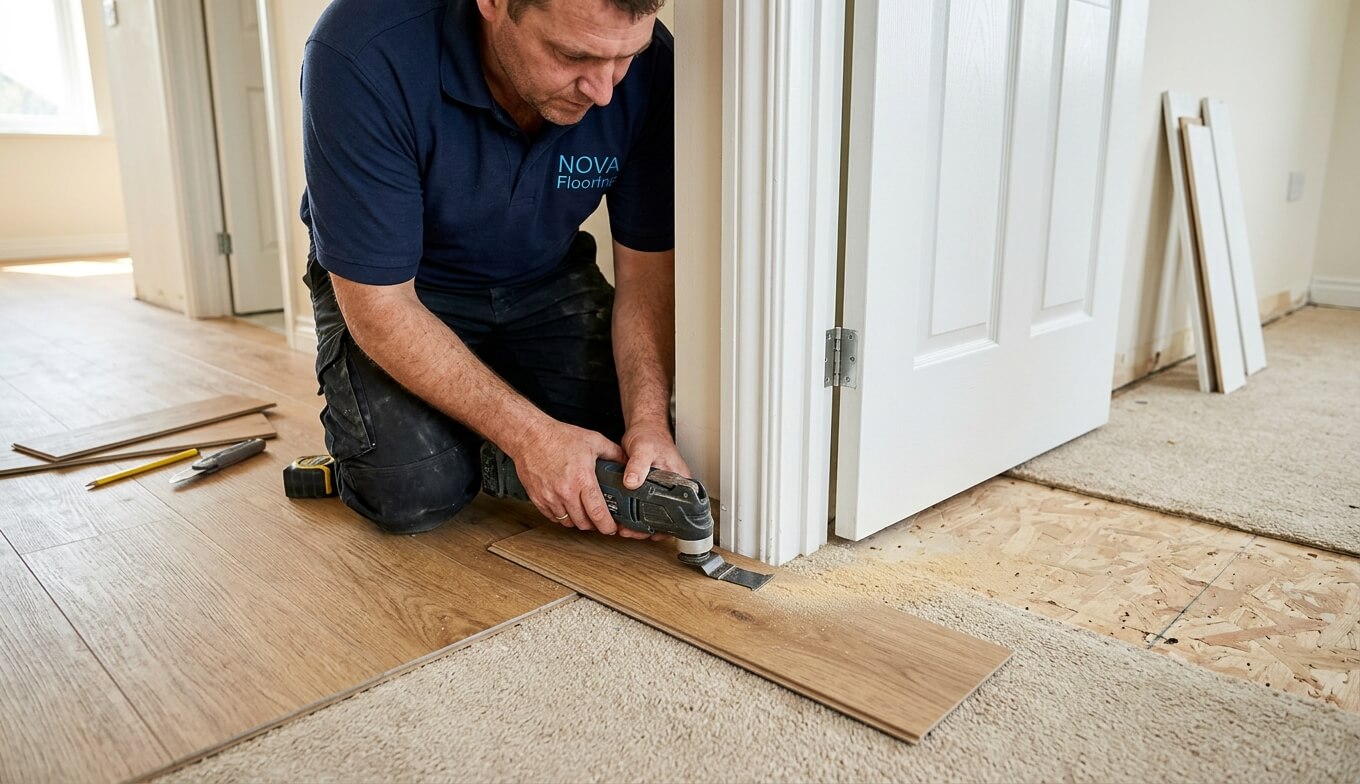
- Undercutting door jambs so planks slide underneath instead of butting against the casing
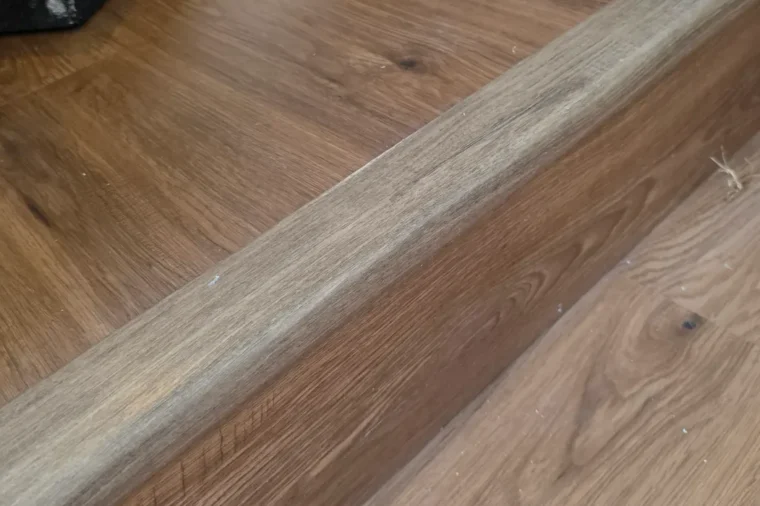
- Fitting transitions, quarter round or resetting baseboards
- Wrapping stair treads and risers with matching nosing
Toilets, refrigerators with ice makers and built-in cabinetry often need a plumber or carpenter, and good vinyl flooring contractors say so upfront.
LVP, LVT and Sheet Vinyl: Know What You’re Hiring For
Luxury vinyl plank (LVP) is the long, wood-look board most DMV homeowners ask for. Luxury vinyl tile (LVT) is the same material cut into stone-look squares or rectangles. Sheet vinyl comes in wide rolls and is glued down, which takes a different skill set.
Most LVP sold today has a rigid core, either SPC (stone plastic composite) or WPC (wood plastic composite). SPC resists dents under heavy furniture better, while WPC feels softer and quieter underfoot. Confirm the contractor has installed your exact product type, not just “vinyl.”
Hiring a Pro vs. DIY Luxury Vinyl Plank Installation
DIY works for a single bedroom on a flat, dry subfloor. Hire a pro when the job covers several rooms, a basement slab, stairs or an older home, because that’s where subfloor prep and trim work decide whether the floor lasts.
Click-lock planks are marketed as DIY-friendly, and in a simple 10×12 bedroom they are. The trouble starts elsewhere. A 1970s split-level in Springfield might have a dip between joists that a floating floor will flex over, and you’ll hear it click every time you cross the room. A basement slab in Silver Spring might feel dry in October and sweat in July.
Pros earn their fee on the parts that don’t look like flooring: reading a straightedge, mixing leveler, scribing around a hearth and building stair nosing that stays put. If your job touches those, professional luxury vinyl plank flooring installation usually costs less than redoing a failed floor.
How to Choose Vinyl Flooring Contractors: A 6-Point Checklist
Verify the license, confirm insurance, ask how they test and prep the subfloor, insist on an itemized quote, get the warranty in writing, and find out who actually shows up. Each check takes a few minutes and filters out most problem hires.
1. Check the License for Your Jurisdiction
Licensing rules for vinyl flooring contractors change as you cross the Potomac, and the thresholds are lower than most homeowners expect.
| Jurisdiction | Who licenses flooring work | When a license is required | How to verify |
|---|---|---|---|
| Virginia | Board for Contractors (DPOR) | Projects of $1,000 or more | DPOR License Lookup |
| Maryland | Maryland Home Improvement Commission (MHIC) | Installing tile, wood or other flooring in an existing home (carpet is exempt) | Maryland Department of Labor license search |
| Washington, DC | DLCP, as a Home Improvement Contractor endorsement on a Basic Business License | Home improvement contracts of $300 or more | DLCP’s SCOUT license search |
In Virginia, some counties add their own layer. Fairfax and Prince William counties, for example, require a local home improvement license for smaller (Class C) contractors doing residential work.
2. Confirm Insurance in Writing
Reputable vinyl flooring contractors will have their insurer send you a certificate of insurance showing general liability coverage, plus workers’ compensation if they have employees. A certificate that comes straight from the insurance agent is worth more than a photo of one. Without coverage, an injury or a damaged water line during the job can turn into your problem.
3. Ask How They Test and Prep the Subfloor
This one question separates vinyl flooring contractors faster than any other. Most LVP manufacturers require the subfloor to be flat within 3/16 inch over 10 feet (or 1/8 inch over 6 feet), and most call for about 48 hours of acclimation in the room. A contractor who can’t tell you their flatness tolerance probably isn’t checking it.
On concrete, ask whether they run a moisture test before installing. The plank itself may be waterproof, but moisture moving up through a slab can still get trapped underneath, which is why below-grade jobs need a vapor barrier.
4. Get an Itemized Quote
A lump-sum number makes comparison impossible. Ask the vinyl flooring contractors you’re comparing to break out:
- Material, with product name, wear layer and core type
- Labor per square foot
- Removal and disposal of the old floor
- Subfloor prep, including how leveling compound is billed
- Transitions, quarter round and baseboard work
- Stairs, priced per step
- Furniture moving
Two quotes that look $1,500 apart are often close once the same line items sit side by side.
5. Separate the Two Warranties
Every vinyl floor carries two warranties. The manufacturer covers defects in the plank, and the contractor covers the installation: gaps, peaking, lifting edges and loose transitions. Good vinyl flooring contractors put the length and scope of their workmanship warranty in the contract. Also ask whether their method follows the manufacturer’s instructions, since skipping required acclimation or flatness prep can put the product warranty at risk.
6. Find Out Who Actually Shows Up
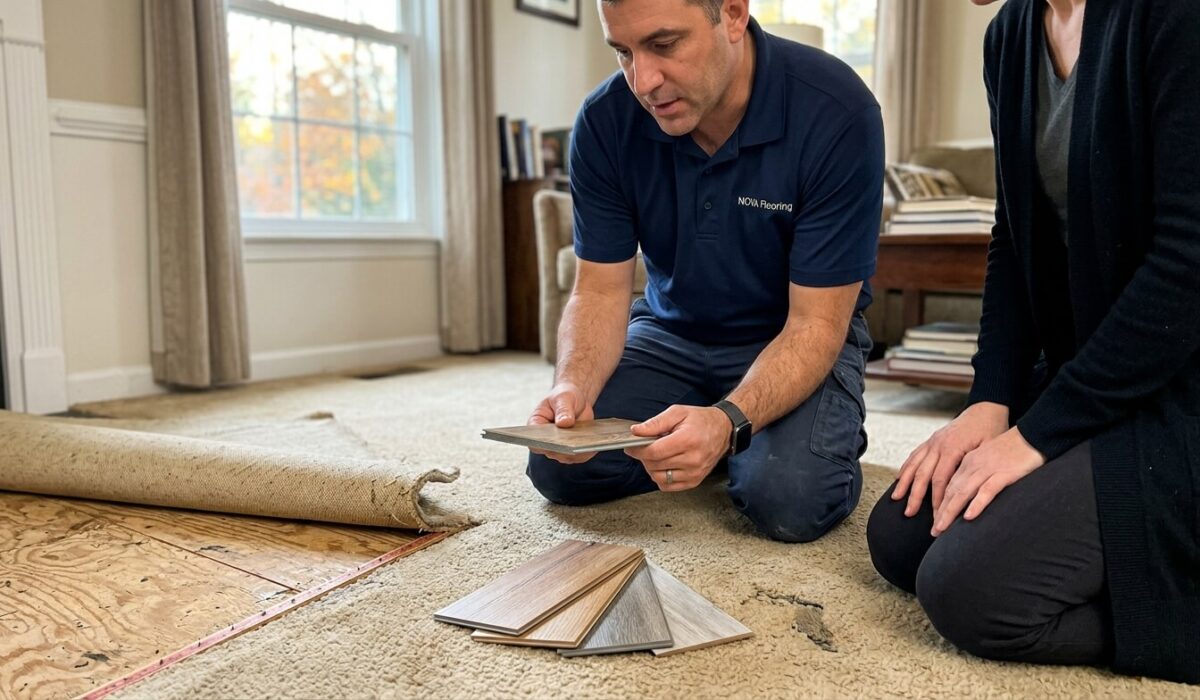
At many companies, a salesperson measures and a subcontracted crew you’ve never met does the work. Details get lost at every handoff. Ask whether the person measuring your home is part of the installing team, and whether the crew is employed or subcontracted.
Questions to Ask Vinyl Flooring Contractors Before You Sign
Bring these questions to every estimate. Experienced LVP flooring installers answer them without hesitation, and a vague answer tells you more than any sales pitch.
- What’s your license number, and can I verify it today?
- Which brand and product are you quoting, and what’s the wear layer in mils?
- How will you check flatness and moisture before you start?
- Will this floor float or be glued down, and why that method for my room?
- Will you install around the kitchen cabinets and island, or under them?
- How much overage are you ordering, and who keeps the leftover boxes?
- What does your workmanship warranty cover, and for how long?
- How many days will the job take, and when can we put furniture back?
Question 5 matters more than it sounds. Most floating floors need room to expand, so they’re installed around fixed cabinets rather than pinned underneath them.
Luxury Vinyl Plank Installation Cost in Northern Virginia
Installed LVP in the DC metro typically costs $4 to $9 per square foot, with complex jobs reaching $12. Labor for a floating click-lock floor in open rooms usually runs about $2 to $3.50 per square foot, and prep, removal and stairs push the total higher.
The cost to install LVP flooring comes from the same handful of pieces in almost every quote:
| Line item | What drives it | Effect on price |
|---|---|---|
| Plank material | Wear layer (about 6 to 30 mil), core type, plank width | Largest single variable |
| Labor | Number of cuts, room shape, floating vs. glue-down | About $2 to $3.50/sq ft for open rooms, floating |
| Removal and disposal | Carpet vs. glued vinyl vs. tile | Glued floors and tile cost the most to remove |
| Subfloor prep | Dips, humps, damaged plywood | Can add noticeably in older homes |
| Trim and transitions | Doorways, baseboards, quarter round | Small per piece, adds up across rooms |
| Stairs | Number of treads, nosing style | Priced per step |
The wear layer is where your money buys durability. Roughly 12 mil suits bedrooms, while 20 mil or more is the safer pick for kitchens, hallways and homes with dogs. For a full line-by-line breakdown with a worked example, see our guide to LVP flooring installation cost in Northern Virginia, MD and DC.
What Happens on Installation Day: Step by Step
Most vinyl flooring contractors follow the same sequence: measure, acclimate, remove, prep, lay out, install and trim. A single 600-square-foot level often finishes in one to two days once the material is on site.
- Final check. The crew confirms square footage and tests moisture.
- Acclimation. Unopened boxes sit in the rooms for about 48 hours at normal living temperature, typically 65 to 85°F.
- Old floor out. Carpet, pad, tack strip and staples come up.
- Subfloor prep. High spots are ground down, low spots filled, and squeaky plywood screwed tight.
- Layout. Rows are planned so you don’t end with a thin sliver at a doorway.
- Installation. Planks go down with a small expansion gap at the walls, typically 1/4 to 5/16 inch, hidden later by trim.
- Trim and transitions. Baseboards or quarter round go back on, and transitions are fitted at doorways and floor changes.
- Walkthrough. You check for gaps and loose planks before the crew leaves.
Floating floors can take foot traffic right away. Glue-down floors often need about 24 hours of light use before heavy furniture goes back.
Red Flags That Rule Out Vinyl Flooring Contractors
Walk away from any contractor who wants most of the price upfront, can’t produce a license number, quotes without seeing your subfloor, or offers to float vinyl over carpet.
- A price over the phone with no visit. Without a flatness and moisture check, the number is a guess.
- “We don’t need to acclimate it.” Many manufacturers require acclimation for warranty coverage.
- Installing over carpet or cushioned vinyl. Manufacturer instructions rule this out because the soft layer lets the locking joints flex and fail.
- A large deposit before materials are ordered. Ask what the deposit covers and when the rest is due.
- No written contract. Without one, you have no record of scope, price or warranty.
DMV-Specific Issues to Raise With Your Contractor
Three local conditions catch homeowners off guard: damp basement slabs, old floors that may contain asbestos, and condo rules on sound underlayment. Raise them at the estimate, not on install day.
Basements on Concrete
Finished basements are common across Fairfax, Loudoun and Montgomery counties, and the slab is the riskiest part of the job. Waterproof vinyl plank flooring won’t swell in a basement, but moisture coming up through concrete still needs somewhere to go. Ask vinyl flooring contractors for a moisture test and a vapor barrier underlayment on every below-grade room. At FIXO, that vapor barrier is standard on basement installs.
Older Homes and Asbestos
If your home was built before the 1980s and still has old sheet vinyl or 9×9-inch tiles, careful vinyl flooring contractors won’t tear them out until a sample has been tested. Asbestos was used in some older vinyl flooring and adhesives, and fibers are released when the material is scraped or broken. Often the cheaper, safer route is to leave a sound, flat old floor in place and install the new one over it.
Condos and HOA Rules
Many condo buildings in Arlington, DC and Bethesda require an approved acoustic underlayment and written sign-off from management before hard flooring goes in. Get your building’s rules in writing and share them with the vinyl flooring contractors you’re comparing before choosing a product, since some attached pads may not qualify.
Frequently Asked Questions
How much do vinyl flooring contractors charge per square foot?
In the DC metro, labor for a floating click-lock vinyl plank floor typically runs about $2 to $3.50 per square foot. With material, removal and trim included, most installed projects land between $4 and $9 per square foot. Older homes that need leveling, glue-down installs and stairs push the total higher, sometimes toward $12.
How long does it take to install luxury vinyl plank flooring?
Most single-level projects of about 500 to 700 square feet take one to two days once the planks have acclimated. Heavy leveling, tile removal or stairs add time, since each tread is cut and fitted by hand. Floating floors can usually be walked on right away, while glue-down floors often need about 24 hours of light use first.
Can vinyl plank flooring go over my existing floor?
Often, yes. Vinyl plank can usually go over ceramic tile, sheet vinyl, hardwood or concrete if the surface is sound and flat within about 3/16 inch over 10 feet. It shouldn’t go over carpet, cushioned vinyl or another floating floor. Deep grout lines on tile may need a skim coat first so they don’t show through the planks.
Is luxury vinyl plank flooring waterproof?
Rigid core LVP planks are waterproof, meaning they won’t swell or warp when wet. The installed floor is a different matter, because water can still seep through seams or around the edges and reach the subfloor. In bathrooms, laundry rooms and basements, a careful installer seals the perimeter where needed and uses a vapor barrier over concrete.
How long does LVP flooring last?
A quality LVP floor typically lasts 10 to 20 years, and the wear layer and installation quality matter more than the brand name. A 20-mil wear layer holds up far better in a busy hallway than a 6-mil one. Vinyl can’t be sanded or refinished, so once the wear layer wears through, the floor gets replaced.
Should I buy the flooring myself or let the contractor supply it?
Buying your own planks can save money during a sale, but it shifts the risk to you. If boxes arrive short, damaged or from mismatched production lots, your install date slips. When the contractor supplies material, those problems are theirs to solve. Some vinyl flooring contractors also limit their workmanship warranty on customer-supplied flooring, so ask before you buy.
Do vinyl flooring contractors need a license in Virginia?
Yes, for any project of $1,000 or more, Virginia requires a contractor licensed through DPOR, and some counties add a local home improvement license for smaller contractors. In Maryland, installing tile, wood or other flooring requires an MHIC license. In DC, home improvement contracts of $300 or more require a licensed Home Improvement Contractor.
Your Next Step With Vinyl Flooring Contractors in the DMV
The best vinyl flooring contractors make the unglamorous parts visible: the license number, the flatness check, the line items and the warranty. If they walk you through those before you ask, you’re probably in good hands. If you have to drag them out, keep looking, even if theirs was the first name that came up when you searched for a vinyl flooring contractor near me.
FIXO installs luxury vinyl plank across Northern Virginia, Maryland and Washington, DC at one fixed price. You’ll see your number in about 60 seconds with our instant flooring quote, and an installer, not a sales rep, measures your home and tests the subfloor within 48 hours. To confirm we cover your neighborhood, check our service areas.
 4.9 on Google14 reviews
 Licensed & InsuredVirginia · Maryland · Washington, D.C.
 Workmanship GuaranteedInstallation backed in writing
 Locally OwnedServing NoVA, MD & D.C.