
Yes, you can put laminate flooring over tile if the tile is flat, firmly bonded and dry, and the room isn’t wet. Laminate floats, so it doesn’t need to be nailed or glued to the tile. The grout lines usually need filling, an underlayment goes down first, and you have to plan for the extra height at doors, appliances and transitions. If the tile is cracked, hollow or uneven, or the room is a bathroom, take the tile out or choose a different floor.
Skipping tile removal saves a day of loud, dusty demolition and a real chunk of the budget. But laminate is a rigid, click-together floor, and it’s unforgiving of what’s underneath. Get the preparation wrong and the grout pattern shows through, joints click and open, or the dishwasher won’t come out again.
This guide covers when laminate over tile works, a 5-minute test you can do yourself, how the installation is done, the height problems nobody mentions until install day, and when removing the tile is the smarter call.
In this guide Laminate Flooring Over Tile
- When laminate over tile works, and when it doesn’t
- The 5-minute test: is your tile ready for laminate?
- How laminate is installed over tile, step by step
- The height problem: doors, appliances and transitions
- Laminate over tile vs removing the tile: cost and trade-offs
- Special cases: slabs, heated tile, kitchens and bathrooms
- Frequently asked questions
When laminate over tile works, and when it doesn’t
| Your tile floor | Laminate over it? |
|---|---|
| Flat ceramic or porcelain, all tiles solid, narrow grout lines | Yes, with underlayment |
| Flat tile with wide or deep grout lines | Yes, after the grout lines are filled |
| Tile with lippage (edges higher than their neighbors) | Only after grinding or leveling |
| A few cracked or loose tiles | After those tiles are fixed or filled |
| Many hollow-sounding or cracked tiles | No; the tile is failing, so remove it |
| Heavily textured natural stone or handmade tile | Only with a full skim coat or self-leveler |
| Bathroom, laundry room or below-grade basement | No; choose waterproof LVP or keep the tile |
| Tile on stairs | No; stairs need treads and nosing |
The principle is simple: laminate flooring needs a flat, stable, dry base. Sound tile can be an excellent base. Failing tile only gets worse under a new floor.
The 5-minute test: is your tile ready for laminate?
- Tap test. Tap tiles with a screwdriver handle or a coin across the room. A dull, hollow sound means a tile has lost its bond. One or two can be repaired; many mean the tile should come out.
- Look for cracks. Cracks running across several tiles in a line often mean the subfloor below is moving. Laminate won’t fix that.
- Straightedge check. Lay a long level or straightedge on the floor in several directions. Most laminate manufacturers allow roughly 3/16 inch of variation over 10 feet. Gaps bigger than that under the straightedge need leveling.
- Grout lines. Run a fingernail across them. Grout set well below the tile surface, or lines wider than about 1/4 inch, should be filled so they don’t print through the laminate.
- Height check. Measure the gap under doors and the clearance at the dishwasher and fridge. You’ll need room for about another 3/8 to 1/2 inch of floor.
If all five pass, laminate over tile is usually a good plan. If two or more fail, compare the cost of fixing the tile against removing it.
How laminate is installed over tile, step by step
- Repair the tile. Re-bond or fill loose tiles, and fill any missing pieces.
- Clean and degrease. Leveling compound and underlayment won’t stick to grime or sealer residue, especially in kitchens.
- Fill the grout lines. Use a cement-based patching or embossing compound to bring grout lines level with the tile face.
- Level high and low spots. Grind lippage and apply self-leveler where the straightedge shows dips.
- Lay the underlayment. Over tile on a concrete slab, use an underlayment with a built-in vapor barrier, because grout and tile don’t stop moisture rising from the slab. Over tile on plywood, a quality acoustic underlayment works. Don’t double up if the laminate already has a pad attached, unless the manufacturer allows it.
- Undercut door jambs. Cut the casings so boards slide underneath instead of being caulked around them.
- Click the laminate together. Leave the expansion gap the manufacturer specifies at every wall, cabinet and pipe.
- Trim and transitions. Baseboard or shoe molding over the gap, reducers or T-moldings where the new floor meets lower floors.
For the full installation process from start to finish, see our step-by-step laminate flooring installation guide.
The height problem: doors, appliances and transitions
Laminate is usually 8 to 12 mm thick, plus a millimeter or two of underlayment. That’s roughly 3/8 to 1/2 inch added on top of a tile floor that already sits higher than the subfloor. Most “can you put laminate over tile” guides skip this, but it’s where projects go wrong.
- Interior doors. Many will need trimming at the bottom to clear the new floor.
- Exterior doors and thresholds. Check that the door still swings and seals.
- The dishwasher. If new flooring runs in front of a dishwasher that sits on the old tile, the dishwasher can get trapped under the counter. Plan the floor so the opening stays clear, or raise the dishwasher. Our kitchen flooring guide explains this trap in detail.
- Fridge and range. Check the space under upper cabinets and the counter height for slide-in ranges.
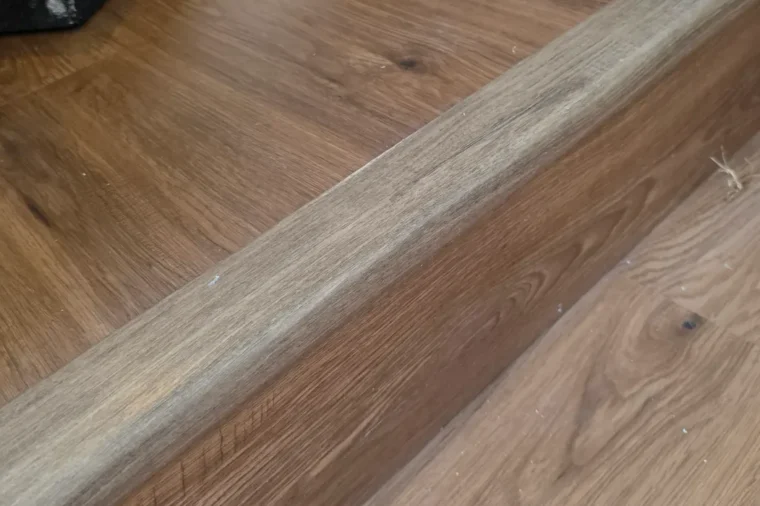
- Transitions to other rooms. Where the tile room meets carpet or hardwood, the step-up may need a reducer strip. A change in level over 1/4 inch should be beveled to avoid a trip edge.
- Stairs and landings. Where the floor meets a staircase, the top step gets taller by the thickness of the new floor. Plan the stair nosing so the riser heights stay consistent.
Laminate over tile vs removing the tile: cost and trade-offs
In Northern Virginia, removing tile usually costs about $2 to $5 per square foot, more than pulling up vinyl, laminate or carpet, because thinset has to be ground off the subfloor. Our tile flooring installation cost guide explains why. On a 300 sq ft kitchen and family room, skipping removal can save roughly $600 to $1,500 and a day of noisy demolition.
| Install over tile | Remove tile first | |
|---|---|---|
| Cost | Lower; grout filling and leveling only | Removal adds about $2 to $5 per sq ft |
| Time | Faster | Adds a day or more, plus dust |
| Floor height | Higher; doors and appliances may need work | Close to the original height |
| Hidden problems | Stay hidden | Subfloor damage is found and fixed |
| Best when | Tile is sound and flat, and height isn’t a problem | Tile is failing, height is tight, or you suspect water damage |
If height is your only concern, a thinner rigid core LVP over the tile can be a better fit. See LVP vs laminate vs engineered hardwood to compare.
Special cases: slabs, heated tile, kitchens and bathrooms
Tile on a concrete slab
Common in basements, split-level lower floors and townhomes. Tile and grout let slab moisture through, so laminate over tile on concrete always needs a vapor barrier underlayment. Below grade, skip laminate altogether; our guide to waterproof basement flooring explains why.
Heated tile floors
Some laminates can go over radiant heat, but manufacturers cap the floor surface temperature and require a compatible underlayment. Check the product’s installation instructions before you buy, or the warranty may not apply.
Kitchens
Laminate over kitchen tile can work with a waterproof-rated product, if the dishwasher and fridge clearances work out. Our honest answer on laminate flooring in a kitchen covers the risks.
Bathrooms
Don’t put standard laminate over bathroom tile. Splashes and humidity get into the seams and swell the core. See the best flooring for bathrooms for options that hold up.
Will it affect how long the floor lasts?
Not if the preparation is done right. Over sound, flat, filled tile, laminate lasts as long as it would on any other subfloor. Over uneven tile, the joints flex and wear out early. Read how long laminate flooring lasts for what shortens its life.
How FIXO handles laminate over tile
At FIXO’s express measurement, within 48 hours of your online quote, the installer taps and checks the tile, measures flatness and door and appliance clearances, and tells you whether the tile can stay. If it should come out, removal is priced as its own line, so you can see exactly what it adds. Everything is one fixed price before work starts, and most laminate flooring installations in Northern Virginia, Maryland and DC finish in 1 to 2 days. Start with the 60-second instant quote, or follow FIXO on GitHub.
If you would rather hand the job to a crew, here is what professional laminate flooring installation costs and what to expect.
Frequently asked questions
Can you put laminate flooring over tile?
Yes, if the tile is flat, firmly bonded and dry, and the room isn’t a bathroom or other wet area. Fill deep grout lines, lay an underlayment, leave an expansion gap, and plan for the extra height at doors and appliances.
Do you need to fill grout lines before laying laminate over tile?
Usually, yes. Wide or deep grout lines can print through the laminate and let the boards flex at the joints. Fill them with a cement-based patching compound so they’re level with the tile face before the underlayment goes down.
What underlayment should I use for laminate over tile?
Over tile on a concrete slab, use an underlayment with a built-in vapor barrier. Over tile on a plywood subfloor, a quality acoustic underlayment works. If your laminate has a pad already attached, check whether the manufacturer allows a second layer.
Is it better to remove tile before installing laminate?
Remove the tile if it’s cracked, hollow or uneven, if the extra height causes problems at doors, appliances or stairs, or if you suspect water damage underneath. If the tile is sound and flat, installing over it saves about $2 to $5 per square foot in removal.
How much height does laminate add over tile?
Typically 3/8 to 1/2 inch: 8 to 12 mm of laminate plus 1 to 2 mm of underlayment. Interior doors may need trimming, and transitions to lower floors may need a reducer strip.
Can you put laminate over tile in a bathroom?
It isn’t recommended. Standard laminate has a wood-fiber core that swells when water gets into the seams. In bathrooms, keep the tile or install waterproof rigid core LVP instead.
Can you glue laminate directly to tile?
No. Laminate is designed as a floating floor that expands and contracts as one piece. Gluing or nailing it down stops that movement and causes buckling, and it usually voids the warranty.
Final Thoughts
Can you put laminate over tile? In most dry rooms, yes, and it can save a day of demolition and real money. The tile has to be sound and flat, the grout lines filled, the right underlayment used, and the extra height planned at every door, appliance and transition. When the tile fails those checks, removing it is cheaper than redoing a failed floor later.
Not sure your tile can stay? Get a fixed price in 60 seconds and an installer will check it in person, or call (757) 589-6859, any day from 8am to 8pm.
 4.9 on Google14 reviews
 Licensed & InsuredVirginia · Maryland · Washington, D.C.
 Workmanship GuaranteedInstallation backed in writing
 Locally OwnedServing NoVA, MD & D.C.