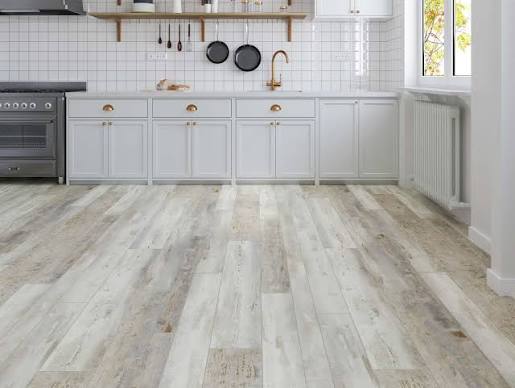
Laminate flooring in a kitchen can work, but for most Northern Virginia homes it isn’t the best choice. Laminate has a wood-fiber core, and even waterproof laminate warranties exclude the leaks kitchens actually have: a failed dishwasher hose, a dripping ice maker line, water under the sink. Waterproof luxury vinyl plank (LVP) handles those, costs only a little more, and can match the laminate in the rest of your home.
That’s not the answer most flooring sites give. Search “is laminate good for a kitchen” and you’ll find page after page saying yes, modern laminate is water-resistant, just wipe up spills. That’s true for spills. It’s not true for leaks, and the difference is written in the warranty.
We install laminate across Northern Virginia every week, and it’s our most requested floor for living rooms, bedrooms, and stairs. We just don’t put it where a dishwasher can fail. Here’s the reasoning, so you can decide for your own kitchen. If you’re still comparing every material, start with our full guide to the best flooring for kitchen remodels, then come back here for the laminate question.
In this guide Laminate Flooring in Kitchen
- Is laminate flooring good for a kitchen?
- What “waterproof laminate” warranties actually cover
- AC ratings vs NALFA certification: what to check on the box
- Laminate vs LVP in the kitchen: side-by-side
- The open floor plan answer: laminate in the living areas, LVP in the kitchen
- If you still want laminate in your kitchen: 7 non-negotiables
- Northern Virginia climate and laminate
- Kitchen flooring costs in Northern Virginia
- FAQs
Is laminate flooring good for a kitchen?
Laminate is good at most of what a kitchen asks for. It’s one of the hardest floating floors you can buy, so chair legs, dropped utensils, and dog claws rarely mark it. It gives the most convincing wood grain for the money, and it cleans with a damp microfiber mop.
Its weakness is what’s inside. Laminate is built around a high-density fiberboard (HDF) core: compressed wood fiber under a printed design layer and a clear wear layer. The surface sheds water. The core absorbs it. When water gets into the joints or under the planks, the core swells, the edges peak, and the damage doesn’t go back down when it dries.
So the real question isn’t “is laminate water-resistant?” It’s “how likely is water to get under this kitchen floor?” In a kitchen, that depends on your appliances more than your cooking habits.
| Kitchen water source | Laminate risk | What happens |
|---|---|---|
| Spilled glass of water, wiped up | Low | Surface handles it |
| Pot boiling over onto the floor | Low to medium | Fine if cleaned quickly |
| Dog water bowl, daily splashing | Medium | Water sits at joints repeatedly |
| Dishwasher drain hose leak | High | Slow, hidden, soaks under planks |
| Ice maker supply line drip | High | Can run for weeks behind the fridge |
| Sink base or garbage disposal leak | High | Water runs out from under the cabinet |
The top half of that table is what most blogs are thinking about. The bottom half is what we actually pull up on repair jobs.
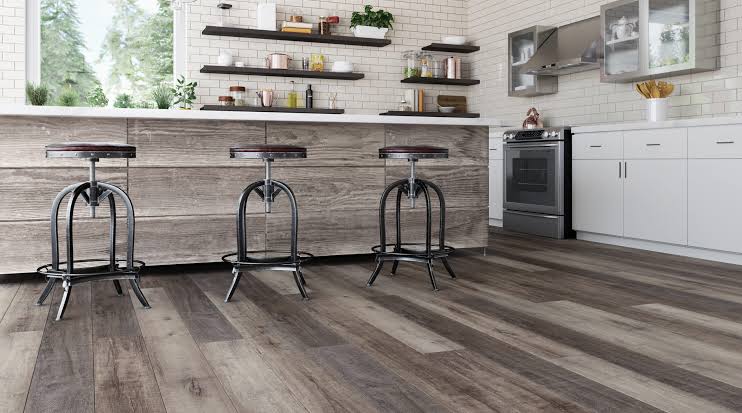
What “waterproof laminate” warranties actually cover
Several brands now sell laminate labeled waterproof or with a “wet warranty.” These are real improvements: tighter joints, water-repellent coatings, and sealed edges. But read what the warranty covers before you trust it with a kitchen.
Take Pergo, one of the best-known laminate brands. Its WetProtect warranty covers everyday household spills, pet accidents, and wet mopping, and even covers subfloor damage from topical moisture that gets through a properly installed joint. That’s genuinely good. But the same warranty documents exclude flooding, standing water, leaking pipes, mechanical failures, and appliance leaks (Pergo Portfolio + WetProtect warranty).
Two more conditions matter in a kitchen:
- The perimeter must be sealed. WetProtect coverage requires the floor’s edges to be sealed per the installation instructions, and damage at an unsealed perimeter isn’t covered. In a kitchen, that means the sink base, the dishwasher opening, the refrigerator wall, and every cabinet toe kick.
- “Standing water” has a clock. On standard laminate lines, the window is short. Pergo’s XP warranty, for example, defines standing water as water left on the floor longer than 30 minutes, and also excludes damage from steam mops (Pergo XP warranty).
Independent testing backs up the pattern. When a Massachusetts landlord association water-tested seven laminate brands, the better ones resisted splashes well, but the warranty language still carved out appliance leaks and standing water (MassLandlords test).
Bottom line: a waterproof laminate protects you from the spill you see. It doesn’t protect you from the leak you don’t. For a deeper look at the label language, see our guide on whether laminate flooring is waterproof.
AC ratings vs NALFA certification: what to check on the box
Most laminate marketing leads with an AC rating (AC1 to AC6). That number comes from the European standard EN 13329 and measures one thing: abrasion resistance. AC4 is the usual recommendation for a busy kitchen. But abrasion isn’t the whole story, and it says nothing about water.
The North American Laminate Flooring Association (NALFA) certifies laminate under ANSI/NALFA LF-01, which tests products across 14 performance categories, including thickness swell, impact, stain resistance, and static load, and rates them for one of four end-use levels from Residential to Heavy Commercial. NALFA also offers optional Water Resistance and Surface Swell certifications, and LF-01 requires formaldehyde compliance with CARB Phase 2 and EPA TSCA Title VI (NALFA certification standards).
What to look for if laminate is going anywhere near a kitchen:
- NALFA seal on the box or spec sheet, not just an AC number.
- NALFA Water Resistance certification if the product claims water performance.
- AC4 or higher for traffic.
- A written wet warranty, read for the words “appliance,” “standing water,” and “perimeter.”
One more tip: if a spec sheet describes a laminate’s wear layer in “mils,” it’s borrowing vinyl language. Vinyl wear layers are measured in mils; laminate durability is measured by AC rating and NALFA level.
Laminate vs LVP in the kitchen: side-by-side
| Laminate | Rigid core LVP (SPC) | |
|---|---|---|
| Core material | Wood fiber (HDF) | Stone-plastic composite |
| Water under the floor | Core swells; damage is usually permanent | Core is unaffected; dry the subfloor and reuse planks |
| Appliance leaks | Excluded by most warranties | Plank survives; subfloor still needs drying |
| Scratch resistance | Excellent (hardest floating floor) | Good (depends on wear layer, 20 mil for families) |
| Wood realism | Best embossed grain for the price | Very good |
| Feel underfoot | Firm, slightly louder | Softer, quieter |
| Installed cost, Northern Virginia | About $5–$9 per sq ft | About $6–$11 per sq ft |
| Best rooms | Living, dining, bedrooms, halls, stairs | Kitchens, baths, laundry, basements |
The price gap is smaller than most people expect, often $1 to $2 per square foot. On a 150 sq ft kitchen, that’s roughly $150 to $300 to move from a floor a dishwasher leak can ruin to one it can’t. That’s why our luxury vinyl plank installation is what we recommend for most kitchens. For the full three-way comparison, see LVP vs laminate vs engineered hardwood.
The open floor plan answer: laminate in the living areas, LVP in the kitchen
Here’s the situation we see most in Northern Virginia: a colonial or townhome where the kitchen opens straight into the family room and dining area. You want one continuous wood look. You love laminate’s texture and hardness for the family room. But the kitchen is right there.
You don’t have to choose one floor for the whole space. The approach that works:
- Laminate where it’s dry. Family room, dining room, hallways, and stairs get laminate, where it’s the hardest and most realistic floating floor for the money.
- Waterproof LVP where water lives. The kitchen, including the dishwasher and fridge zone, gets rigid core LVP in a matched tone.
- Put the transition where it looks intentional. The best spot is usually the edge of the kitchen’s hard boundary: an island end line, a change in ceiling, or a doorway. A low-profile T-molding there also doubles as the expansion break a long floating-floor run needs. Many laminate products require a break sooner than vinyl does, so in an open plan the kitchen line is often where one is needed anyway.
- Match by undertone, not by name. Put the laminate and LVP samples side by side on your actual floor, in your own daylight. Warm-to-warm and cool-to-cool reads as intentional; a warm oak next to a gray plank reads as a mistake.
This is how most of our Northern Virginia laminate flooring installation projects on open main levels are planned: laminate through the living areas, LVP in the kitchen, one crew, one fixed price. Our installer brings full-size samples of both to the measure visit so you can judge the match on your own floor.
If you still want laminate in your kitchen: 7 non-negotiables
Some kitchens are reasonable laminate candidates: a light-use condo kitchen, a household with newer appliances, or a kitchen where the sink and dishwasher sit on a tiled peninsula. If that’s you, don’t skip any of these:
- Buy a laminate with a written wet warranty and NALFA certification. Read the exclusions before you buy.
- Seal the perimeter at the sink base, dishwasher opening, and fridge wall with 100% silicone, if the manufacturer’s instructions call for it. Some products require sealing; others say not to fill the gap. Follow yours exactly, because the warranty does.
- Replace rubber supply lines with braided stainless when the appliances are pulled for the floor.
- Install leak sensors under the sink and behind the fridge and dishwasher. A leak you find in hours is a mop job; one you find in weeks is a new floor.
- Don’t trap the dishwasher. Run flooring into the opening or shim it to the same height, so the dishwasher can come out later.
- Stop at the cabinets and island. Floating floors shouldn’t have cabinets or islands set on top of them. The weight pins the floor so it can’t move with the seasons.
- No steam mop, no wet mop buckets. Damp microfiber only. Steam can void laminate warranties.
Northern Virginia climate and laminate
Northern Virginia swings between humid summers and dry, heated winters. Laminate’s fiber core moves with humidity more than vinyl does, and most manufacturers want indoor relative humidity held around 35% to 65% and temperatures around 60°F to 85°F, with planks acclimated about 48 hours before install when the product calls for it.
In practice, that means:
- Keep the HVAC running before, during, and after installation, including in a house you’re renovating.
- Respect the expansion gap (commonly around 1/4 inch at walls, larger on long runs). Laminate that’s jammed tight against cabinets in December is the laminate that peaks in August.
- Basements are different. Slab-on-grade and below-grade kitchens and kitchenettes in Fairfax and Loudoun County homes are LVP or tile territory, not laminate. Our guide to waterproof basement flooring covers why.
Kitchen flooring costs in Northern Virginia
Typical 2026 installed ranges, including material, labor, and basic prep:
| Floor | Installed cost per sq ft | 150 sq ft kitchen |
|---|---|---|
| Waterproof laminate | $5–$9 | $750–$1,350 |
| Rigid core LVP | $6–$11 | $900–$1,650 |
| Porcelain tile | $12–$24 | $1,800–$3,600 |
Removal of an old floor, subfloor leveling, and stairs are usually separate lines. At FIXO, they’re itemized on the quote so you can see them before you approve. If you want to price the laminate in your living areas yourself first, try our laminate flooring cost calculator.
We install across Northern Virginia, including Reston, Herndon, Ashburn, Centreville, and Fairfax, plus Maryland and Washington DC. See all our DMV service areas.
Frequently asked questions
Can you put laminate flooring in a kitchen?
Yes, laminate can be installed in a kitchen, and water-resistant products handle everyday spills well. The risk is leaks that get under the floor, such as a dishwasher or ice maker line, which most laminate warranties exclude. For kitchens with older appliances, waterproof LVP is the safer choice.
Is waterproof laminate really waterproof?
Waterproof laminate resists topical water, meaning spills and wet mopping, on its surface and joints. Its core is still wood fiber. Warranties such as Pergo’s WetProtect exclude standing water, leaking pipes, and appliance leaks, and require a sealed perimeter. It’s water-resistant flooring with a better warranty, not a floor that survives a leak.
Is laminate or LVP better for a kitchen?
LVP is better for most kitchens because its rigid core isn’t damaged by water under the floor. Laminate is harder to scratch and has a more realistic wood texture. In Northern Virginia, LVP usually costs only $1 to $2 more per square foot installed, which is why most installers recommend it for kitchens.
What AC rating do I need for kitchen laminate?
Choose AC4 or higher for a kitchen. But the AC rating only measures surface abrasion. Also look for NALFA certification under ANSI/NALFA LF-01, and NALFA’s optional water-resistance certification if the product makes water claims.
Can I use laminate in my living room and LVP in my kitchen?
Yes, and in open floor plans it’s often the best approach. Match the two floors by color undertone, and place a low-profile transition at a natural boundary like the island line or a ceiling change. The transition can also serve as the expansion break a long floating floor needs.
How long does laminate last in a kitchen?
A quality AC4 laminate can last 15 to 20 years in a kitchen if it stays dry underneath. The floor’s lifespan is usually decided by the first appliance leak, not by wear. Leak sensors and braided supply lines are the cheapest way to protect it.
Does laminate go under kitchen cabinets?
No in the kitchen, it is essential to evaluate both aesthetics and durability. Our selection offers a variety of designs that can enhance the overall look while providing the resilience needed for a high-traffic area. With professional installation services, the process is efficient, ensuring that your new flooring is ready for use in a timely manner. Trust in our commitment to quality and transparency throughout your flooring project. . Laminate is a floating floor and should stop at the cabinet toe kick and island base with an expansion gap covered by trim. Cabinets set on top of a floating floor pin it in place and can cause buckling.
The bottom line
Laminate is one of the best floors you can put in a Northern Virginia living room, bedroom, or staircase. In the kitchen, the question is how much you trust your dishwasher. If the answer is “not completely,” choose waterproof LVP for the kitchen and carry laminate through the rest of the main level in a matching tone.
Either way, you can see your fixed price in about 60 seconds with our instant When considering laminate flooring flooring quote. An installer, not a salesperson, will measure within 48 hours and bring full-size samples of both floors. Most jobs are finished in 1 to 2 days, and the price you sign is the price you pay.
 4.9 on Google14 reviews
 Licensed & InsuredVirginia · Maryland · Washington, D.C.
 Workmanship GuaranteedInstallation backed in writing
 Locally OwnedServing NoVA, MD & D.C.