A basement floor fails differently from every other floor in the house. It is not usually a flood. It is concrete quietly moving water vapour upward, month after month, into a material that was never asked whether it minded. Here is how to choose a floor for a DMV basement that survives that, and the preparation that matters more than the product you pick.
What actually counts as waterproof basement flooring?
True waterproof basement flooring is a material whose core cannot absorb water and swell, which in practice narrows the field to LVP, tile and sheet vinyl. Laminate and solid hardwood are excluded below grade regardless of what a surface coating claims. But the material is only half the answer: waterproof basement flooring fails just as often because of what is underneath it, since concrete slabs transmit vapour continuously from the soil even when they look and feel dry. A moisture test on the slab, followed by the right vapour retarder, decides whether the floor lasts a decade or lifts within two winters.
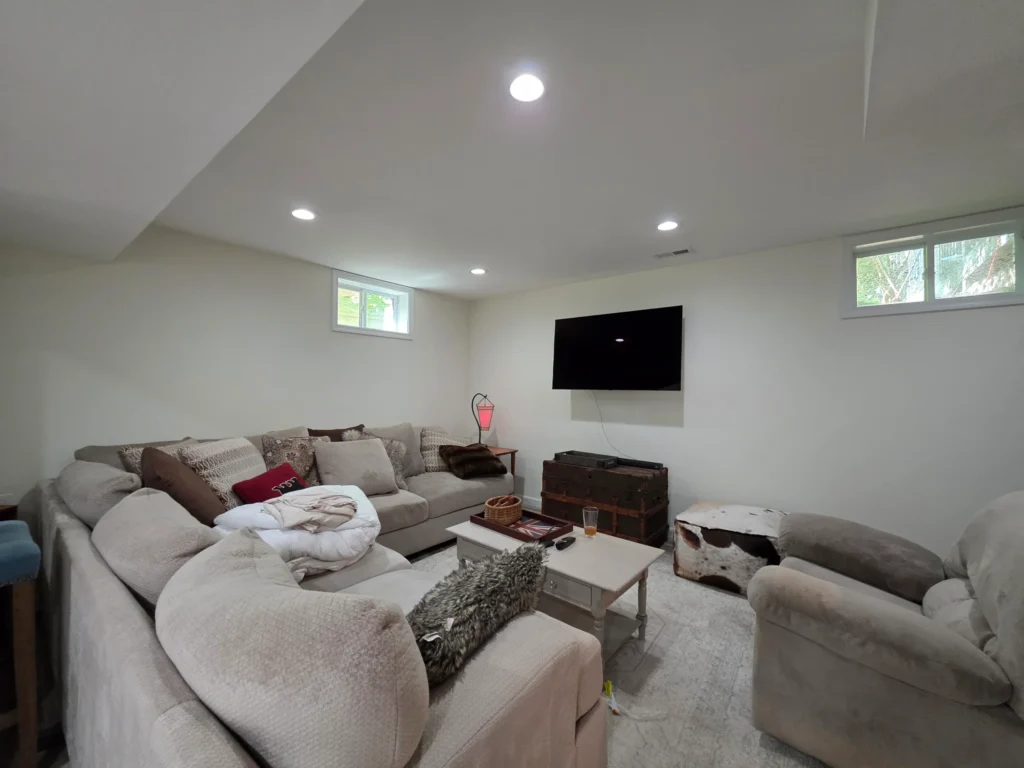
Where basement moisture actually comes from
Four sources, and only one of them is dramatic:
- Vapour drive through the slab. The constant one. Soil under a Northern Virginia or Montgomery County basement holds moisture year round; concrete is porous; the vapour moves toward the drier side, which is your living space. A slab can read visibly dry and still emit meaningful vapour.
- Hydrostatic pressure. After heavy rain, groundwater pushes at the slab and the wall-floor joint. Common in older DC row houses and any lot that drains toward the foundation.
- Condensation. Summer air at 75% relative humidity meeting a slab sitting at 62 °F. The dew point is reached on the floor surface. This is why a basement can be damp in August with no leak at all.
- Plumbing and appliances. Water heaters, washing machines, HVAC condensate lines. Usually where the basement’s mechanical room is.
Test before you choose
A calcium chloride test (ASTM F1869) or an in-slab relative humidity probe (ASTM F2170) costs very little and settles the argument. Most resilient flooring manufacturers cap installation at 75–85% in-slab RH, and a warranty claim on a slab that was never tested tends to go nowhere.
Waterproof basement flooring materials, ranked
1. Rigid core luxury vinyl plank (SPC) — the default answer
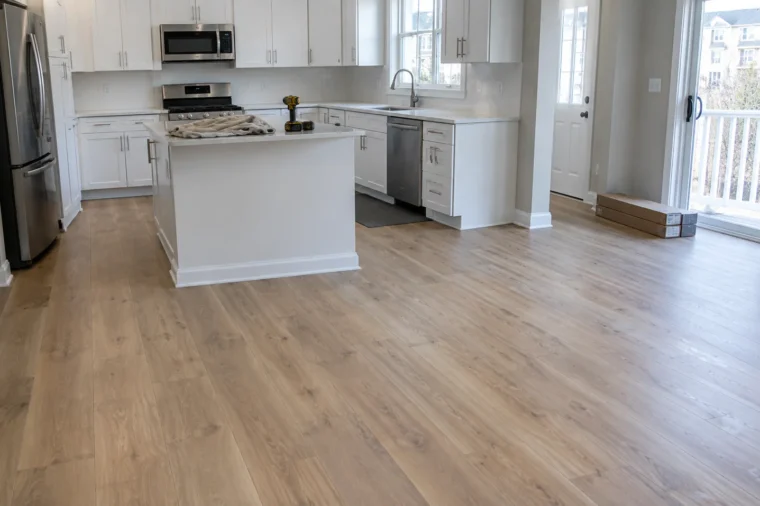
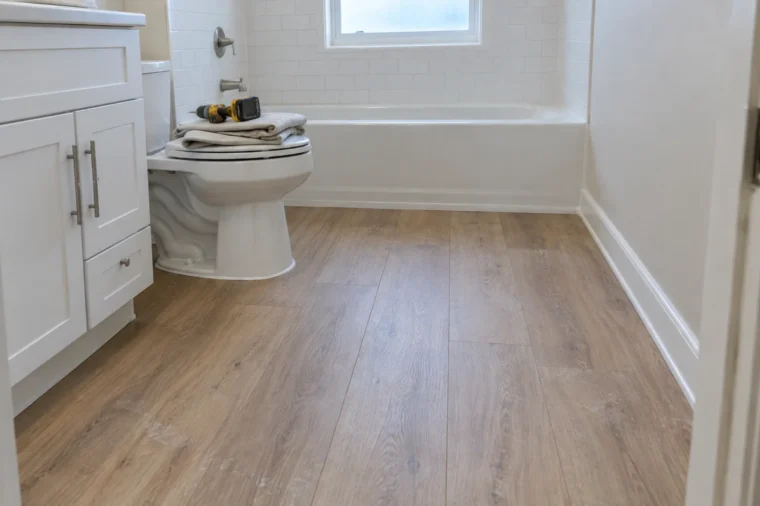
A stone-plastic composite core does not absorb water, does not swell, and does not care about vapour. It floats, so it tolerates the slight movement of a slab, and if a pipe lets go you can lift the affected planks, dry the slab and click them back. Look for a 20 mil wear layer, an attached pad, and a manufacturer statement about installation over concrete. This is what we install below grade more than anything else — the specification is on the LVP flooring installation page.
2. Porcelain tile — the most durable, the least forgiving
Genuinely impervious, and the only floor here that is unbothered by standing water. It is also the coldest and hardest underfoot, the most expensive to install, and it must be bonded to a flat slab with an uncoupling membrane, or slab movement cracks the grout and eventually the tile. Right for a walk-out basement with an exterior door, a basement bathroom, or a mechanical area.
3. Sheet vinyl — underrated for utility space
Seamless across a whole room, which no plank product is. Cheap, waterproof, and unglamorous. If the basement is a laundry and storage area rather than a living space, this is often the sensible choice nobody suggests.
4. Engineered hardwood — possible, conditional
A real wood wear layer over a plywood core is far more stable than solid wood, but it is still wood. It can work above a properly tested, properly sealed slab in a dry, conditioned basement with a dehumidifier. It is a considered decision, not a default. See the engineered hardwood page for how it is built.
5. Laminate — no
The core is compressed wood fibre, the underside is unsealed, and the failure is permanent. We explain the mechanism in is laminate flooring waterproof?. A “waterproof” laminate is warranted against spills from above, not vapour from below.
6. Carpet — no, unless the basement is genuinely dry
Carpet and pad hold moisture against the slab and become a mould substrate. If you want softness down there, put an area rug over a waterproof floor and take it upstairs to dry if anything happens.
| Material | Vapour | Standing water | Comfort | Typical installed |
|---|---|---|---|---|
| Rigid core LVP | Excellent | Survives, dries out | Warm, quiet | $5.00–$8.00 /sq ft |
| Porcelain tile | Excellent | Unaffected | Cold, hard | $9.00–$18.00 /sq ft |
| Sheet vinyl | Good | Excellent (seamless) | Firm | $3.50–$6.00 /sq ft |
| Engineered hardwood | Conditional | Poor | Warm | $9.00–$16.00 /sq ft |
| Laminate | Poor | Fails | Warm | $5.00–$8.00 /sq ft |
Ranges are typical DC-metro market ranges, not FIXO quotes.
The preparation that decides whether any of it lasts
Choose the perfect plank and skip this, and the floor still fails.
- Fix water before flooring. Grading, gutters, downspout extensions, window wells, the sump. A floor is not a drainage solution and no product will out-engineer a wet slab.
- Test the slab. Numbers, not a hand on the concrete.
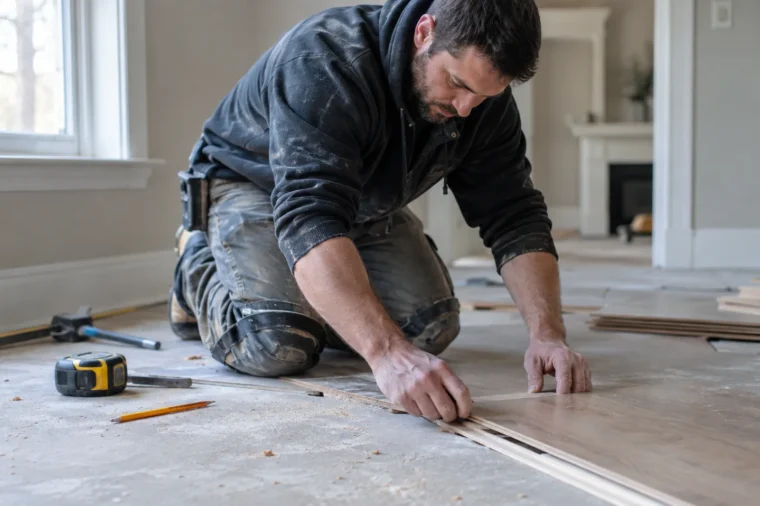
- Grind and patch. Rigid core plank needs flatness within roughly 3/16 in over 10 ft. Basement slabs are poured to drain, not to be flat, so expect high spots to be ground and low spots filled with a cementitious levelling compound.
- Lay a vapour retarder. 6 mil polyethylene, lapped 6–8 in and taped, turned up the wall behind the baseboard — unless the plank already has an attached barrier, in which case doubling up traps moisture between the two layers.
- Leave the expansion gap. 1/4 in to 3/8 in at every wall and column, hidden by trim that is fixed to the wall, never through the floor.
- Control the air. A dehumidifier holding 45–50% relative humidity does more for a basement floor than any upgrade in the plank.
Two habits worth building in
Put the water heater and washing machine in a drain pan plumbed to the floor drain, and leave 200–300 sq ft of matching plank in the storage room. A future repair with material from the same production run is invisible; one with a fresh batch never quite is. If the existing basement floor is already damaged, it is worth working out whether a repair or a full replacement makes more sense before you price anything.
What does waterproof basement flooring cost?
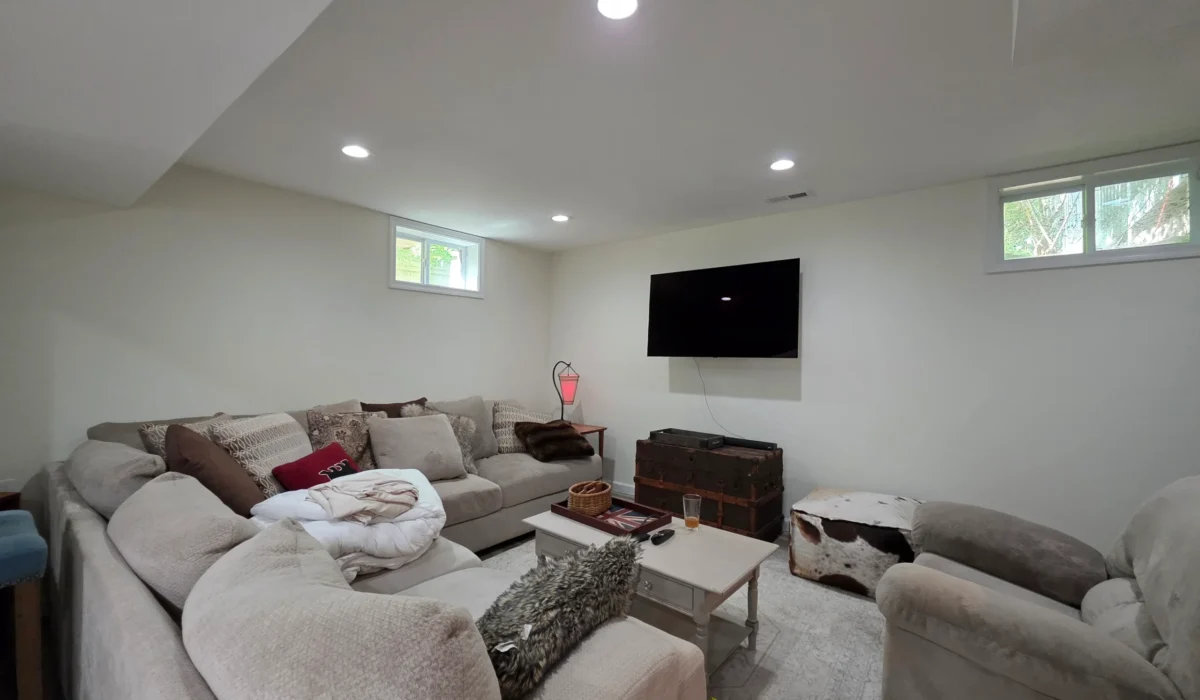
A 700 sq ft finished basement in rigid core LVP, existing carpet removed, with a typical amount of slab correction:
| Carpet and pad removal, haul-away | $525 |
| Slab grinding and levelling (~180 sq ft affected) | $320 |
| Vapour retarder | $210 |
| 20 mil rigid core LVP, 700 sq ft + 8% @ $3.40 | $2,570 |
| Installation @ $2.60 | $1,820 |
| Baseboard, 190 lin ft @ $5.50 | $1,045 |
| Total | about $6,490 — $9.27 /sq ft |
The prep — removal, grinding, barrier — is 16% of that. It is also the 16% that a cheap quote leaves out, and the reason the cheap floor is back on the schedule in three years.
Get a waterproof basement flooring price
FIXO installs rigid core LVP and tile across basements in Alexandria, Arlington, Fairfax, McLean, Bethesda, Silver Spring and DC. The estimator gives you a fixed installed price for the LVP option in about a minute, and if the slab turns out to need work we tell you the number before anything starts — not after the carpet is in the skip.
Waterproof basement flooring questions
Can you put laminate in a basement?
Not as waterproof basement flooring. The fibreboard core swells permanently once water reaches it, and below grade the moisture source is the slab itself rather than a spill.
Do you need a vapour barrier over a concrete slab?
In almost every DMV basement, yes. Slabs move vapour from the soil continuously, and guidance from the US EPA treats controlling that moisture as the precondition for any finished assembly.
How do you test a slab before installing?
Calcium chloride and in-situ relative humidity tests, both standardised by ASTM, give a number rather than a guess. A taped plastic sheet left overnight is a rough indicator only.
 4.9 on Google14 reviews
 Licensed & InsuredVirginia · Maryland · Washington, D.C.
 Workmanship GuaranteedInstallation backed in writing
 Locally OwnedServing NoVA, MD & D.C.