The right commercial flooring contractors in Washington DC hold their own DC Basic Business License, carry the liability coverage your building requires, test the slab for moisture before quoting, and hand you a written phasing plan that keeps your business open. The floor covering itself needs no DC building permit unless the property sits in a historic district.
A 4,000-square-foot office on K Street, a café on 14th Street and a dental suite in Navy Yard need new floors for different reasons, but they share one problem. The crew has to get past the building manager, work around the people still using the space, and lay a floor that passes ADA and slip-resistance checks the first time.
This guide covers what commercial flooring contractors in Washington DC actually do, which DC licenses and permits apply, what commercial flooring installation costs by material, and how to keep your doors open while the work happens. It was written by Alvin for FIXO, a flooring installer licensed and insured in Washington DC, Virginia and Maryland.
In this guide to commercial flooring contractors in Washington DC
- What commercial flooring contractors handle
- Restore or replace first
- DC licenses, permits and insurance
- How to vet commercial flooring contractors: 7 checks
- Commercial flooring installation cost by material
- Choosing the right floor for your space
- Keeping your business open
- Red flags in commercial flooring bids
- Commercial flooring FAQs
- Getting quotes
Key takeaways
- Every contracting business in DC needs its own Basic Business License, and DLCP’s General Contractor/Construction Manager classes cap project value from $500,000 (Class H) to no cap (Class A).
- Floor covering needs no DC building permit unless the property is in a historic district such as Georgetown, Capitol Hill or Dupont Circle.
- Ask which slab moisture test the contractor runs. ASTM F2170 and ASTM F1869 are the common methods.
- Commercial flooring installation in Washington DC typically runs about $2.50 to $30 per square foot, depending mainly on the material.
- A written phasing plan and attic stock keep your business open now and repairs invisible later.
What Commercial Flooring Contractors in Washington DC Handle
Commercial flooring contractors in Washington DC remove old floors, test and prepare the slab, install commercial-grade products, and coordinate the job with building management. Most also fit transitions, wall base and stair treads, while floor boxes, plumbing and wall changes stay with other trades.
The work usually falls into a few project types:
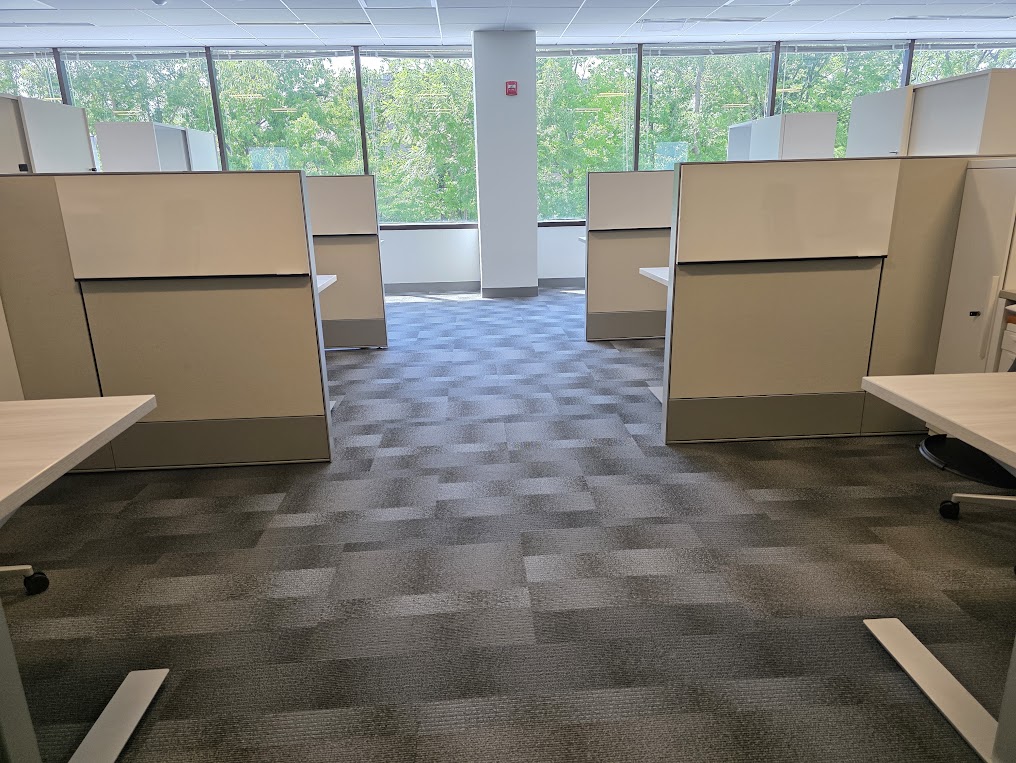
- Office suites and tenant fit-outs, often carpet tile with LVT at entries and break rooms
- Retail stores and restaurants, where porcelain, quarry tile or heavy-gauge LVT has to handle wet shoes and rolling carts
- Medical and dental offices, usually sheet vinyl or LVT with tight or heat-welded seams for easy cleaning
- Apartment and condo common areas, such as lobbies, corridors, mailrooms and fitness rooms
How Commercial Jobs Differ From Residential Ones
Three things change on a commercial job: the paperwork, the schedule and the spec. Managers of most downtown office towers want a certificate of insurance naming them as additional insured before a crew gets building access. Work often runs at night or on weekends. And products are chosen by wear layer, slip resistance and fire rating, not by look alone.
A residential installer can lay excellent floors and still struggle here. Ask whether the crew has worked in an occupied building on a freight elevator schedule, because that experience shows up in how smoothly the job runs.
Restore or Replace Before You Call a Contractor
If the existing floor is still bonded and the slab is dry, restoring it may cost far less than a new floor. Replacement makes sense when tiles are loose, moisture keeps coming back, or the space is changing use.
Terrazzo, quarry tile and hardwood often have years left after honing, regrouting or refinishing. Vinyl composition tile that has been stripped and waxed for 20 years usually doesn’t. Our guide to commercial flooring restoration walks through that decision floor type by floor type. This post picks up once you’ve decided a new floor is the answer and need commercial flooring contractors in Washington DC to install it.
DC Licenses, Permits and Insurance for Commercial Flooring Work
DC licenses general contractors by project size, requires every contractor to hold its own Basic Business License, and exempts floor covering from building permits outside historic districts. Your building’s insurance rules are often stricter than the District’s.
Licensing by Project Size
DC’s Department of Licensing and Consumer Protection (DLCP) issues the General Contractor/Construction Manager license in classes. Each class caps the value of a single project and sets a minimum commercial general liability amount.
| DLCP license class | Single-project cap | Minimum general liability |
|---|---|---|
| Class H | $500,000 | $500,000 |
| Class G | $2,000,000 | $500,000 per occurrence, $1,000,000 aggregate |
| Class C | $5,000,000 | $500,000 per occurrence, $1,000,000 aggregate |
| Class B | $10,000,000 | $1,500,000 |
| Class A | No cap | $2,500,000 |
DLCP also says each contracting business needs its own Basic Business License, and the license of the company it works for doesn’t cover it. So if a general contractor subcontracts your flooring, the flooring company still needs its own DC license. You can look up any license on DLCP’s SCOUT search before you sign.
When a Building Permit Is and Isn’t Needed
DC’s Department of Buildings permit guide lists tiling, carpeting and floor covering among the work that doesn’t need a building permit, unless the property is in a historic district. Large parts of the city are, including Georgetown, Capitol Hill and Dupont Circle, so check your address first. Any wall, plumbing or electrical changes made during the same fit-out still need their own permits.
Insurance Your Building Will Ask For
Most managed office and retail buildings in DC send contractors a list of requirements before the first site visit. It typically covers liability limits, workers’ compensation, auto coverage for vehicles at the loading dock, and the landlord and property manager named as additional insured. Send that list to all the commercial flooring contractors in Washington DC on your shortlist, since a bid from a crew that can’t meet it is a bid you can’t use.
How to Vet Commercial Flooring Contractors in Washington DC: 7 Checks
Check the license, match the insurance to your building’s list, see comparable jobs, confirm installer training, ask how they test the slab, get a phasing plan in writing, and separate the two warranties. These seven checks weed out most bids that look cheap on paper and get expensive later.
1. A DC License You Can Verify
Ask for the license number and look it up on SCOUT yourself. Make sure the license class covers your project’s value, not just the flooring portion of a larger fit-out.
2. Insurance That Matches Your Building’s Requirements
The certificate should come straight from the contractor’s insurance agent and name your landlord and property manager exactly as the building requires. A photo of an old certificate isn’t proof of current coverage.
3. Projects Like Yours
A crew that has finished several occupied office floors knows how to stage material, protect elevator cabs and keep corridors open. Ask commercial flooring contractors in Washington DC for two references from jobs of similar size and type, and call both.
4. Installer Training
Ask what training the installers on your job have, not just the company owner. Certified Flooring Installers (CFI) and the International Standards and Training Alliance (INSTALL) both certify commercial installers. Certification isn’t required by DC law, but it shows the crew has been tested on the materials it’s putting down.
5. A Named Moisture Test
Concrete can hold water for months, and moisture rising through a slab breaks down flooring adhesive. It’s one of the main reasons glue-down commercial flooring installation fails. The in-situ relative humidity test in ASTM F2170 and the calcium chloride test in ASTM F1869 are the two most common methods, and the adhesive maker sets the limit the result has to meet. A contractor who says the slab “looks dry” hasn’t tested it.
6. A Written Phasing Plan
The plan should show which areas close and when, the crew’s working hours, how furniture moves, and when each area returns to use. It also tells you whether the contractor has actually thought through your space.
7. Two Warranties, in Writing
The manufacturer covers defects in the product. The contractor covers the installation: seams, bond, transitions and flatness. Put the length and scope of the workmanship warranty in the contract, and confirm the installation method follows the manufacturer’s instructions so the product warranty stays valid.
Commercial Flooring Installation in Washington DC: Cost by Material
Most commercial flooring installation in Washington DC falls between about $2.50 and $30 per square foot installed, depending mainly on the material. Prep work, after-hours labor and building logistics decide where a job lands inside each range.
| Material | Typical installed cost | Where it fits |
|---|---|---|
| Carpet tile | $2.50 to $11 per sq ft | Offices, corridors, classrooms |
| Vinyl composition tile (VCT) | $3 to $9 per sq ft | Back-of-house, storage, budget retail |
| Luxury vinyl tile (LVT), glue-down | $3 to $18 per sq ft | Offices, retail, medical, break rooms |
| Porcelain tile for retail or restaurants | $15 to $30 per sq ft | Entries, restrooms, kitchens, dining rooms |
Carpet tile and porcelain ranges come from our DMV cost guides, including our guide to commercial carpet installation; the VCT and LVT ranges are national figures from Fixr’s cost data. Commercial-grade LVT with a thick wear layer usually sits in the middle to upper part of its range.
Five costs rarely show up on a residential quote:
- After-hours labor. Night and weekend shifts usually cost more per hour, and some buildings allow noisy work only outside business hours.
- Removing glued floors. Scraping old VCT, carpet adhesive or thinset takes far longer than lifting a floating floor.
- Moisture mitigation. A slab that fails its moisture test may need a moisture-control coating before flooring goes down, which adds material and at least one cure day.
- Leveling. Older DC buildings often have uneven slabs that need patching or self-leveling compound.
- Logistics. Freight elevator time, loading dock bookings and, for a dumpster on the street, a DDOT public space permit.
Choosing the Right Commercial Floor for Your Space
Good commercial flooring installation starts with matching the floor to how the space is used, then checking it against ADA and slip-resistance rules. A floor that looks right but fails either one has to be redone.
| Space | Common choice | What to check |
|---|---|---|
| Open office | Carpet tile, with LVT at entries and break rooms | Attic stock for replacing worn tiles |
| Retail sales floor | LVT with a 20-mil or heavier wear layer, or porcelain | Rolling carts, entry water, transitions |
| Restaurant kitchen and restrooms | Quarry or porcelain tile with epoxy grout | Wet slip resistance, drainage, cove base |
| Medical or dental suite | Sheet vinyl or LVT | Cleanability, tight or heat-welded seams |
| Apartment corridors and lobbies | Carpet tile or LVT | Fire rating for corridors, sound underlayment |
Attic stock is the extra material ordered with the job and stored on site. It’s how you replace a stained carpet tile in year six without a visible patch.
ADA and Slip-Resistance Basics
The 2010 ADA Standards require floor surfaces on accessible routes to be stable, firm and slip resistant. Carpet on those routes needs a pile no higher than 1/2 inch and fastened exposed edges. Changes in level up to 1/4 inch can be vertical; between 1/4 and 1/2 inch, they need a bevel no steeper than 1:2.
For tile in level interior areas that get walked on when wet, ANSI A137.1 sets a minimum wet DCOF of 0.42. Ask for the tile’s DCOF result before you approve it for a restaurant, a restroom or the lobby by the front door.
Keeping Your Business Open During Installation
Most commercial flooring installation can happen while a business keeps running, if the work is split into phases and timed around cure periods. Good commercial flooring contractors in Washington DC show you that plan before you sign.
- Phase by zone. Close one department, aisle or dining section at a time instead of the whole floor.
- Lift, don’t empty. Carpet tile can often be installed under furniture with lifting equipment, so workstations stay in place.
- Respect cure times. Glue-down floors need time before traffic. AHF Contract, for example, advises keeping foot traffic off for 24 hours and heavy or rolling loads off for 72 hours after installing its products.
- Control odor. Ask for low-VOC adhesives and products with indoor air quality certification, such as FloorScore, when people work nearby.
- Book the building early. Freight elevators, loading docks and after-hours access often need several days’ notice.
Red Flags When Comparing Commercial Flooring Bids
Set aside any bid from commercial flooring contractors in Washington DC that has no moisture test, no line items, no proof of DC licensing, or no plan for how your business keeps running.
- A square-foot price with no site visit. Without seeing the slab, the number leaves out prep.
- “Moisture testing isn’t necessary.” Adhesive warranties usually depend on it.
- Residential products on a commercial floor. Check the wear layer and whether the manufacturer offers a commercial warranty.
- No attic stock in the order. Matching a discontinued carpet tile or LVT later is often impossible.
- A vague schedule. “About a week” isn’t a phasing plan.
Frequently Asked Questions
Do I need a permit to replace flooring in a DC commercial space?
Usually not for commercial flooring installation in Washington DC. The Department of Buildings lists tiling, carpeting and floor covering as work that doesn’t need a building permit, unless the property is in a historic district. Permits are still needed for wall, plumbing or electrical changes made during the same project, and your building may have its own approval process for contractors.
What license does a commercial flooring contractor need in DC?
Every contracting business working in DC needs its own Basic Business License from DLCP. Contractors running construction projects hold a General Contractor/Construction Manager license, issued in classes from Class H, for projects up to $500,000, to Class A, with no cap. Each class carries a minimum liability insurance amount, and licenses can be checked on SCOUT.
How much does commercial flooring cost in Washington DC?
Commercial flooring installation in Washington DC typically costs about $2.50 to $11 per square foot for carpet tile, $3 to $18 for glue-down LVT, and $15 to $30 for porcelain tile in retail and restaurant spaces. Floor removal, moisture mitigation, leveling and after-hours labor push the total higher, so compare bids line by line.
Can commercial flooring be installed after business hours?
Yes. Much commercial flooring installation happens at night or on weekends, and some DC buildings require noisy work to happen outside business hours. After-hours work usually costs more per hour, so ask each contractor to price it as a separate line. That lets you weigh the premium against the cost of closing for a day.
How soon can people walk on new commercial LVT?
It depends on the product and adhesive. Many glue-down LVT systems need about 24 hours before foot traffic and longer before heavy or rolling loads, and AHF Contract advises 72 hours for rolling traffic on its products. Floating LVT can usually take traffic right away. Follow the manufacturer’s written instructions rather than a verbal estimate.
What flooring works best for a restaurant in DC?
Quarry tile or porcelain tile with epoxy grout is the usual choice for restaurant kitchens and restrooms, because it handles grease, hot water and strong cleaners. For wet areas, pick tile with a wet DCOF of at least 0.42 under ANSI A137.1. Dining rooms often use heavy-gauge LVT or porcelain, which are easier to keep clean than carpet.
Can new commercial flooring go over the old floor?
Sometimes. LVT and some carpet tile systems can go over well-bonded VCT or sheet vinyl if the surface is flat and clean and the adhesive maker approves it. Loose tiles, cushioned vinyl and old carpet have to come out. In buildings from before the 1980s, have old vinyl tile and its adhesive tested for asbestos before anyone scrapes or grinds it.
Getting Quotes From Commercial Flooring Contractors in Washington DC
The best commercial flooring contractors in Washington DC hand you the paperwork before you ask for it: a license number you can look up, a certificate that meets your building’s list, a named moisture test and a phasing plan with dates. Bids that arrive without those details tend to grow once demolition starts.
FIXO is licensed and insured in Washington DC, Virginia and Maryland, and an installer, not a sales rep, measures your space. Send your square footage, a few photos and your building’s contractor requirements through our contact page, or see the neighborhoods we cover on our flooring installation in Washington DC page.
 4.9 on Google14 reviews
 Licensed & InsuredVirginia · Maryland · Washington, D.C.
 Workmanship GuaranteedInstallation backed in writing
 Locally OwnedServing NoVA, MD & D.C.